 AnswerLion
faq schema example
FAQ Schema Example: Real JSON-LD Markup That Works
See a real faq schema example with copy-ready JSON-LD markup, implementation notes, and validation tips that improve AI and search visibility.
Published · Updated · By AnswerLion
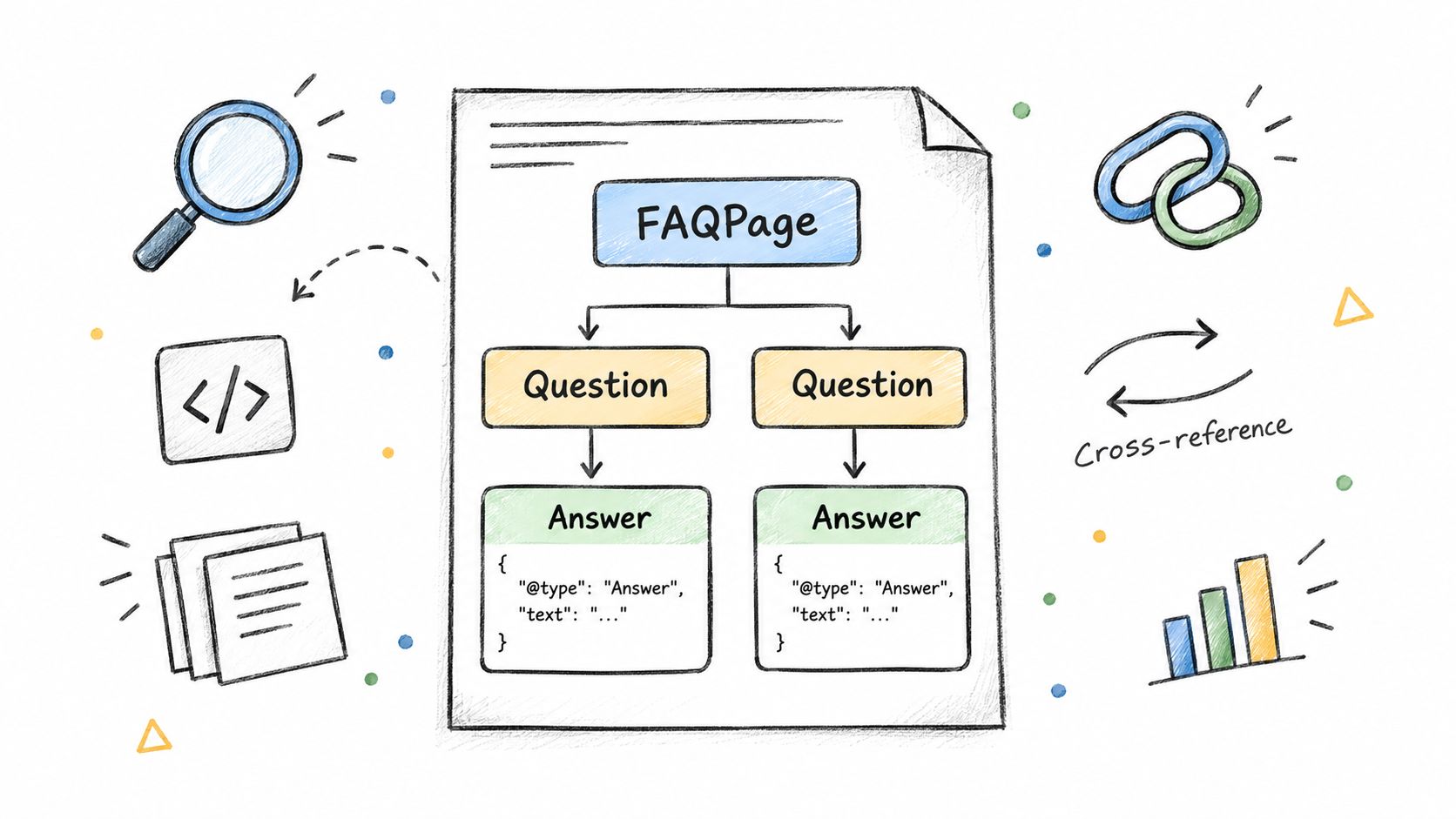
Your FAQ content is ready to publish, but the implementation question remains: can search systems and AI assistants tell exactly which answer belongs to each question? A toggle in your CMS may produce valid markup, yet production quality depends on more than code that passes a test. The page needs clear, visible answers, a precise machine-readable structure, and content that remains useful even when no expanded search result appears.
A practical FAQ schema example should deliver three outcomes: markup validation, unambiguous machine-readable interpretation, and durable value for readers. The JSON-LD below gives you a standards-aligned template for a publisher-controlled commercial FAQ. The implementation approach reflects a broader shift from conventional search visibility toward answer engine optimization and AI visibility, where clearly structured answers can support understanding across systems without relying on a particular search feature.
Table of Contents
- Why a Real FAQ Schema Example Matters Now
- The Three-Tier Structure Behind Every FAQPage
- A Copy-Ready JSON-LD FAQ Schema Example
- Layering Optional Properties for Stronger Entity Models
- JSON-LD vs Microdata vs RDFa for FAQ Markup
- What Google Shows for FAQ Markup in 2026
- Choosing Between FAQPage and QAPage With Clear Examples
- Common Validation Errors and One-Line Fixes
- Verifying Implementation With Three Independent Checks
- Connecting FAQ Schema to Answer Engine Optimization Outcomes
- Deployment Checklist and Quick Reference
- Glossary of FAQ Schema Terms
Why a Real FAQ Schema Example Matters Now
Marketing directors often inherit FAQ schema as a checkbox task: a plugin offers a rich-results toggle, and the team expects a larger search listing. That’s an incomplete way to evaluate the work. A sound implementation starts by connecting every machine-readable question to the exact answer a visitor can see on the page.
Think of FAQPage markup as a structured Q&A contract. Your page publishes a question and its authoritative answer; the markup makes that relationship explicit to systems that process structured data. If the markup says one thing and the visible page says another, the contract breaks. If the structure is correct but the page is inaccessible, systems can’t reliably verify it.
A production-ready FAQ schema example should pass three separate tests:
- Validation: The markup follows the expected vocabulary and object hierarchy.
- Interpretation: Each question maps to its intended answer without relying on visual layout.
- Content value: The visible FAQ resolves real user questions and remains useful even when a search feature doesn’t display it.
This distinction matters because a valid object, a visible search enhancement, and useful semantic structure are different outcomes. Treating them as one can lead teams to optimize for eligibility rather than the content and clarity that endure.
The template in this guide is designed for FAQs written and controlled by the publisher. It gives teams a concrete implementation to adapt, along with criteria for choosing the right format, validating the live page, and avoiding common schema errors. The practical standard is straightforward: make the answer useful to a person first, then make the relationship unmistakable to a machine.
The Three-Tier Structure Behind Every FAQPage
Schema.org defines FAQPage as a webpage that presents one or more frequently asked questions. Its structure isn’t a set of decorative labels. It expresses a hierarchy: the page is an FAQPage, its mainEntity contains Question objects, and each question connects to an acceptedAnswer of type Answer, whose text contains the answer itself. See the Schema.org FAQPage definition.
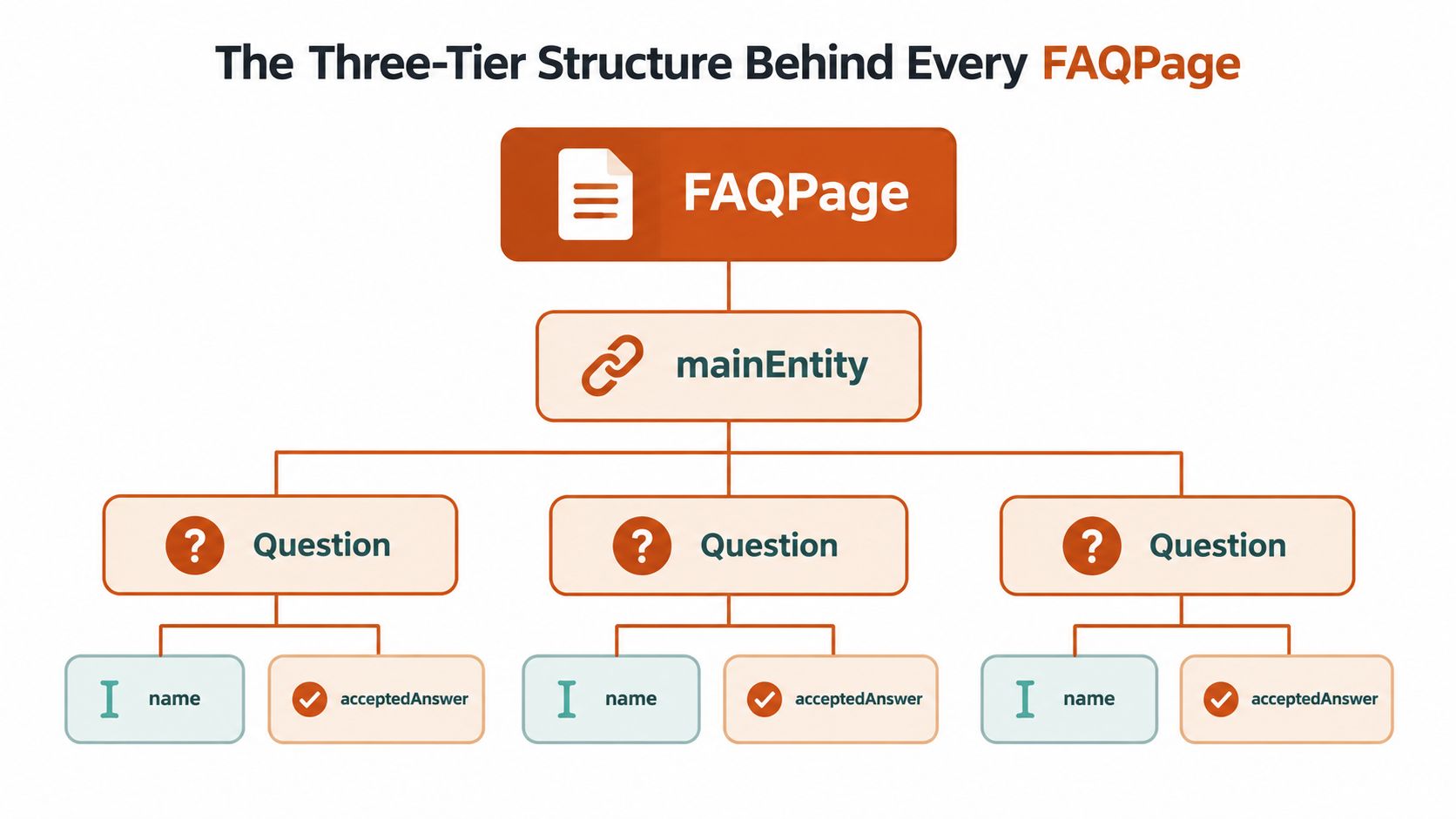
Each level supplies context the next level needs. FAQPage identifies what kind of page the data describes. mainEntity identifies the questions that form the page’s central content. The Question object’s name holds the complete question, while acceptedAnswer associates that question with one definitive response. The answer’s text property holds the response content.
Without those relationships, a machine reader has to infer which paragraph answers which heading. Page design can obscure those connections: answers may be separated from questions by layout, embedded in accordions, or rearranged across screen sizes. A structured hierarchy makes the intended pairing explicit instead of leaving it to visual guesswork.
For a page with multiple publisher-authored FAQs, repeat the complete Question object inside the mainEntity array. Don’t put answer text directly beside a question as an unrelated fragment, and don’t omit acceptedAnswer because the answer appears in the HTML. The visible page and structured data serve different roles, but they must describe the same content.
Practical rule: Before writing JSON-LD, make a simple list of each visible question and its single authoritative answer. If you can’t pair them clearly, the page content needs work before the markup does.
A Copy-Ready JSON-LD FAQ Schema Example
A customer reaches a commercial FAQ page to check what a service includes and how to get support. The markup should represent those visible answers as clear, paired Q&A data, not as an attempt to earn a Google rich result. Google recommends JSON-LD as the preferred structured-data syntax. Replace the sample text with accurate content published on the page.
<script type="application/ld+json">
{
  "@context": "https://schema.org",
  "@type": "FAQPage",
  "mainEntity": [
    {
      "@type": "Question",
      "name": "What does the service include?",
      "acceptedAnswer": {
        "@type": "Answer",
        "text": "The service includes an initial planning session, implementation support, and guidance for maintaining the setup. The final scope depends on the selected service package."
      }
    },
    {
      "@type": "Question",
      "name": "How can a customer get support?",
      "acceptedAnswer": {
        "@type": "Answer",
        "text": "Customers can contact the support team through the channels listed on the service page. The team can help with setup questions, troubleshooting, and next steps."
      }
    }
  ]
}
</script>
@context identifies the Schema.org vocabulary, and the page-level @type identifies the content as an FAQ page. The mainEntity array contains the questions. Each name gives the complete question, while acceptedAnswer pairs it with an Answer whose text holds the response.
Keep each answer direct and self-contained so it makes sense outside the surrounding page. Use one definitive answer for each publisher-authored question, and keep the JSON-LD aligned with the visible content. Schema-only FAQs and promotional claims phrased as questions create a mismatch that crawlers, validators, and other systems cannot resolve reliably. The useful outcome is an unambiguous Q&A contract that can support parsing beyond search features. Its reliability comes from accurate content and consistent question-answer pairing.
Layering Optional Properties for Stronger Entity Models
Start with the required FAQPage hierarchy, then add optional properties only when they describe real information your page maintains. Additional fields can make a structured-data model richer, but they don’t replace the relationship between FAQPage, Question, and acceptedAnswer.
For example, a question object may include datePublished or dateModified when those dates accurately refer to the question or its answer. Author information can add provenance when your CMS has a clear, maintained author record. Use a valid Schema.org author entity, such as Person or Organization, rather than adding a name as an unexplained string.
inLanguage can identify the language of the content when that information is known and correctly maintained. For voice-oriented applications, SpeakableSpecification is a separate property with its own intended use and structure. It isn’t a shortcut for marking every FAQ as voice-ready, nor does including it establish that a voice assistant will reuse the answer.
The practical test is whether each optional property adds accurate meaning that a consuming system can verify. A fresh-looking timestamp that isn’t updated when content changes weakens trust rather than strengthening the model. Likewise, a named author who didn’t write or review the answer adds little provenance.
Add metadata when your publishing process can keep it accurate. A lean, correct FAQ object is more useful than a crowded one with unsupported claims.
JSON-LD vs Microdata vs RDFa for FAQ Markup
Schema.org supports JSON-LD, Microdata, and RDFa, and Google documents all three as formats for structured data. The right choice depends on your publishing stack, but new FAQ implementations usually benefit from JSON-LD because it can sit apart from the visible HTML while describing the same content.
| Format | Syntax Style | Placement | Maintenance Cost | Recommended Use |
|---|---|---|---|---|
| JSON-LD | A JSON object expressing structured relationships | Commonly included in a script element on the page | Often easier to maintain separately from page layout | Default for new implementations and reusable templates |
| Microdata | Schema properties attached to HTML elements | Embedded in the visible markup | Can require edits when templates or page structure change | Existing CMS or theme already uses it consistently |
| RDFa | Structured properties expressed through HTML attributes | Embedded in page markup | Tied to the elements carrying the attributes | Existing systems built around RDFa |
The comparison is about implementation fit, not different FAQ meanings. Each format needs to represent the same page, questions, and answers. JSON-LD’s separation from layout can make it easier for a development team to manage, while Microdata and RDFa remain practical when a legacy theme already generates them reliably.
Avoid maintaining multiple competing versions of the same FAQ markup on one page. Duplicated representations can drift as editors update visible content, creating a mismatch that’s harder to audit. Pick a format your CMS can keep in sync, validate it, and document where the source of truth lives.
For a migration, preserve the questions and answers first, then translate their relationships into the target syntax. The content model stays the same; only the way the page encodes it changes.
What Google Shows for FAQ Markup in 2026
A commercial page can pass validation and still show no expandable FAQ in Google. In August 2023, Google announced that FAQ rich results would primarily appear for well-known, authoritative government and health websites, sharply limiting the feature for commercial sites. The announcement of the FAQ rich-result change explains why valid markup alone does not guarantee a particular search display.
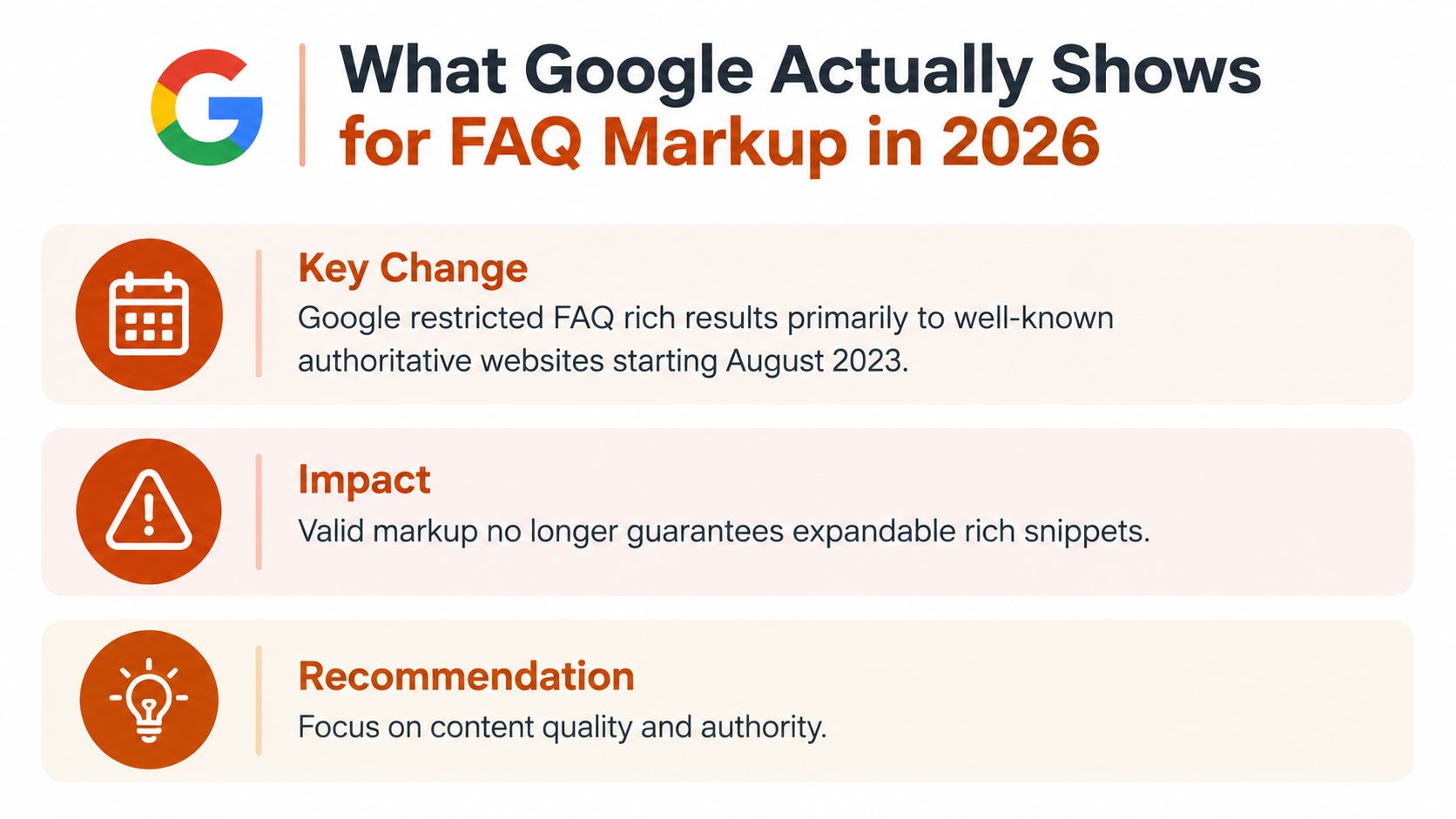
The Schema.org vocabulary remains valid. Google’s restrictions changed the expected search treatment, not the meaning of the markup. A validator can check whether recognized properties are present, but it cannot make Google show a rich result.
That distinction changes the business case. A clear FAQ gives visitors direct answers and helps editorial teams keep responses consistent. Its structured question-and-answer pairs also form an unambiguous contract for systems that parse semantic content, including AI assistants and internal search. These benefits remain useful even if a search feature changes.
Web Almanac figures show FAQPage markup on 0.2% of desktop pages in 2022 and 0.6% in 2024, as reported in the FAQ schema statistics overview. Adoption increased, but remained limited. These figures measure markup usage, not ranking gains or guaranteed visibility in AI-generated answers.
For commercial teams, assess whether each answer is accurate, visible on the page, and useful on its own. Keep the structured response aligned with the published text, and make the FAQ serve readers and answer systems first. Treat an expanded Google listing as a possible display, not the implementation’s outcome.
Choosing Between FAQPage and QAPage With Clear Examples
The key distinction is who controls the answer and how the page is organized. Use FAQPage for a set of official questions and answers written or approved by the site. Use QAPage for a page centered on one user-submitted question where users can provide responses. Google describes that difference in its QAPage structured-data guidance.
An FAQPage represents each question with a single accepted answer. That fits a service page explaining support options, a knowledge-base page written by a company, or an official policy FAQ. The publisher owns the content and can maintain one authoritative response.
A community Q&A page has a different model. A question can have several responses, with one accepted answer and other suggested answers. A simplified outline looks like this:
{
  "@context": "https://schema.org",
  "@type": "QAPage",
  "mainEntity": {
    "@type": "Question",
    "name": "How can I resolve this setup issue?",
    "acceptedAnswer": {
      "@type": "Answer",
      "text": "The community's accepted response."
    },
    "suggestedAnswer": [
      {
        "@type": "Answer",
        "text": "Another user-submitted response."
      }
    ]
  }
}
The decision rule is direct: if your team controls the answer, use FAQPage; if users submit answers to a single question, use QAPage. Don’t label a publisher-written FAQ as Q&A markup just because it has questions, and don’t apply FAQPage to a forum with competing user responses. Choose the type that reflects the actual content model.
Common Validation Errors and One-Line Fixes
A page can display a polished FAQ while its markup contains incomplete answers, duplicated entities, or text that no longer matches the page. Catch these problems at the object level before applying a template sitewide. Each question-answer pair should form a clear contract: the structured content must describe the answer visitors can read.
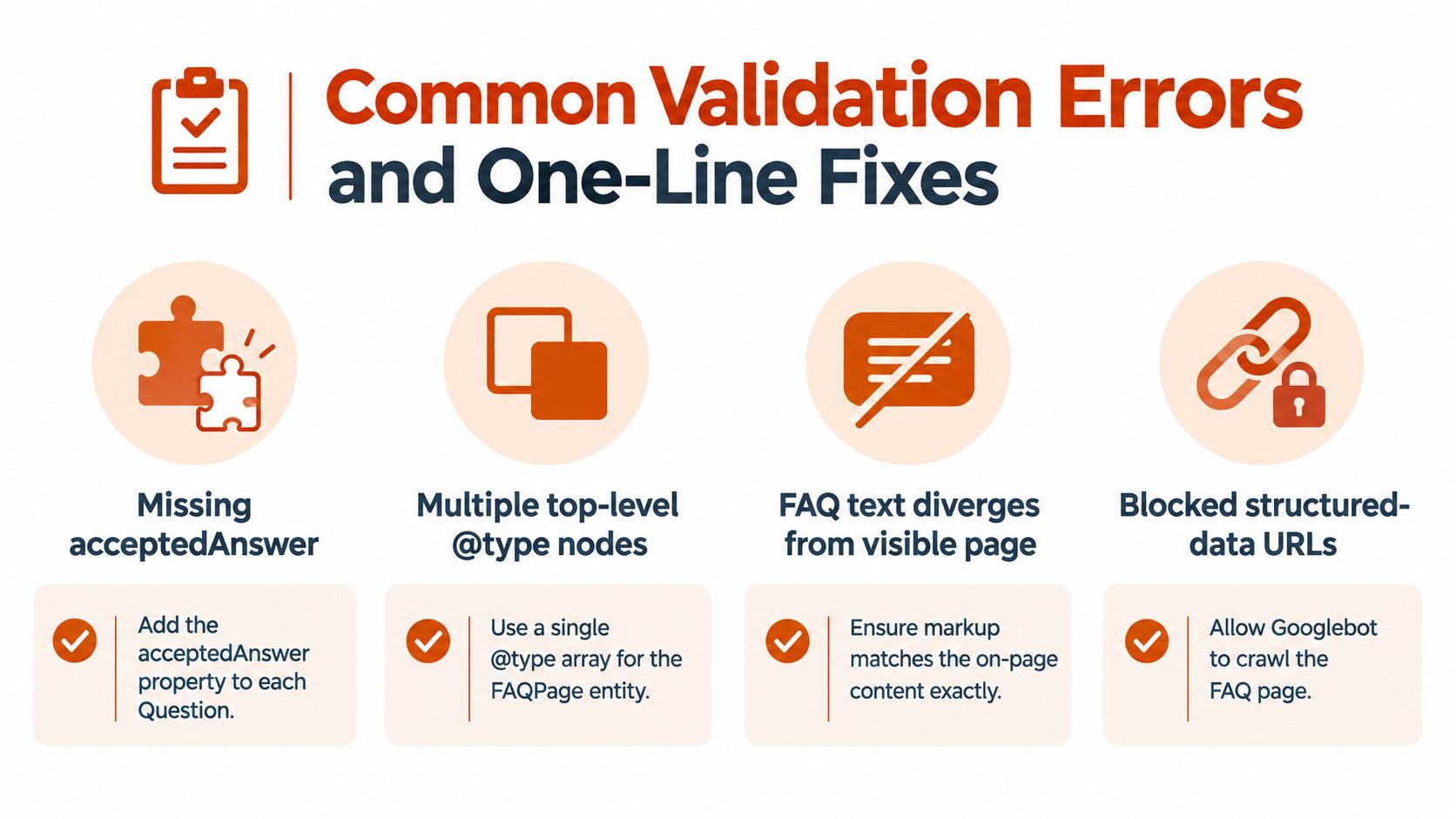
| Symptom | Likely cause | One-line fix |
|---|---|---|
| A question is detected without a usable answer | Its acceptedAnswer object is missing or incomplete |
Add an acceptedAnswer object with @type set to Answer and a text value |
| The page has conflicting or repeated top-level FAQ entities | A template outputs multiple competing FAQPage roots | Consolidate the FAQ data into one FAQPage entity with its mainEntity array |
| The structured question or answer doesn’t match what visitors see | The content team updated the page but not its markup, or the template generates different text | Make the structured text match the visible question and answer |
| Google can’t access the page to inspect its content | A crawl rule or access control blocks the URL | Allow Googlebot to crawl the page and remove unintended access restrictions |
| Duplicate questions appear in the same list | Editors or a template inserted the same question more than once | Remove duplicate Question objects or rewrite them as distinct questions |
Google’s structured-data policies require markup to describe content that is present and accessible on the page. Blocking the page with robots.txt, noindex, or another access control can prevent Google from reading it. Confirm both that the FAQ is visible to visitors and that crawlers can access the URL.
Treat a warning as a prompt to inspect the implementation. Fix syntax and required-property errors first, then check warnings for discrepancies between the markup and published content. Keep the answer text synchronized when editors update the page. That discipline makes the FAQ data more reliable for validators and other systems that parse structured question-and-answer pairs, regardless of whether a search feature displays them.
Verifying Implementation With Three Independent Checks
A production review uses different tools for different questions. Passing one check isn’t the same as confirming the live page is crawlable or that Google interprets the markup as intended.
Rich Results Test: Use Google’s tool to inspect its understanding of the page and whether the structured data is eligible for supported search features. An error calls for a technical fix. A valid result still doesn’t establish that Google will show a rich result, particularly given the restrictions described earlier.
Schema Markup Validator: Use a standards-focused validator to review the Schema.org structure beyond Google’s supported search features. Check that the types and properties form the intended hierarchy, especially the connection from mainEntity to each Question and its acceptedAnswer.
URL Inspection: In Search Console, inspect the deployed URL to see how Google accesses and processes the live page. Confirm that the page was crawled and that the structured data is detected. If the test version works but the live page doesn’t, investigate rendering, access controls, deployment, or differences between the tested markup and production HTML.
These checks answer separate questions: can the markup be interpreted, does it align with the vocabulary, and can Google read the deployed page? Keep that distinction in mind when checking what AI assistants say about your business, too. Validation confirms structure, while visibility monitoring examines whether systems surface the content.
Connecting FAQ Schema to Answer Engine Optimization Outcomes
For AEO, structured data is one part of a broader answer-engine contract. The page needs a direct answer, visible supporting content, crawlable HTML, and technical signals that consistently describe the business and its services. FAQ markup gives each Q&A a defined structure within that system.
Start with the page itself. Put the answer near the question, write it so it stands alone, and keep the visible text aligned with the markup. Then ensure robots rules and access settings let relevant crawlers reach the page. XML sitemaps can help search systems discover pages, while an llms.txt summary can provide a concise orientation to important site content. These assets support discoverability; they don’t replace useful pages or accurate structured data.
FAQ schema also works alongside broader entity markup, such as Organization and Service. The combination can help systems distinguish the business from the specific offering and understand which questions the page answers. A complete generative engine optimization approach coordinates those signals with clear content and consistent business information across the web.
Use recurring visibility checks to learn whether priority answers appear accurately across AI assistants. Pair those observations with technical validation, crawlability checks, and editorial review. That makes FAQ implementation part of a measurable operating process rather than a one-time markup release.
The underlying principle is consistency. The page, schema, business details, and crawler access should tell the same story in formats both people and systems can interpret.
Deployment Checklist and Quick Reference
Before publishing, check the implementation against this short deployment plan:
- Structure: Use one
FAQPageentity, amainEntityarray, completeQuestionobjects, and oneacceptedAnswerper publisher-controlled question. - Content parity: Confirm every structured question and answer appears visibly on the page and reflects the current copy.
- Page access: Make sure robots rules,
noindex, and access controls don’t prevent crawlers from reading the page. - Validation: Run the Rich Results Test and Schema Markup Validator, then inspect the deployed URL in Search Console.
- Monitoring: Recheck priority questions across major AI assistants monthly, and investigate inaccurate or missing answers.
Use the JSON-LD template as the implementation baseline, the format comparison to guide your CMS decision, and the FAQPage versus QAPage rule to confirm the content type. When a question or answer changes, update both the visible page and its markup, then validate the live version again.
Glossary of FAQ Schema Terms
FAQPage: A Schema.org page type for a page presenting frequently asked questions and their answers.
mainEntity: The property that connects a page to its primary entities, such as the questions in an FAQ.
acceptedAnswer: The property that connects a Question to its authoritative answer.
JSON-LD: A structured-data format that represents information as a JSON object, commonly separated from visible page markup.
Microdata: A way to add structured-data properties directly to HTML elements.
RDFa: A method for expressing structured data through attributes in HTML.
SpeakableSpecification: A Schema.org property for identifying content suitable for speech output in supported contexts.
Rich Results Test: Google’s tool for checking structured data and its interpretation for supported search features.
llms.txt: A proposed site file that can summarize important content for language-model crawlers and systems.
AEO: Answer engine optimization, the practice of improving how answer-focused systems understand and surface a business’s content.
AnswerLion helps businesses improve how AI assistants understand, cite, and recommend them through AEO audits, answer-first content, structured data implementation, and ongoing visibility monitoring. If you’re ready to build an FAQ schema program around clear, accurate answers rather than rich-result assumptions, visit AnswerLion to discuss a practical plan.