 AnswerLion
ai brand mentions
AI Brand Mentions: What They Are and How to Earn Them
Learn how AI assistants use ai brand mentions, why third-party sources decide who gets named, and the steps that earn accurate, measurable visibility.
Published · Updated · By AnswerLion
A buyer asks an AI assistant for a shortlist, gets three names, and starts calling from that list. If your business isn’t one of those names, you’re not losing a click. You’re losing the conversation entirely, often before you know it happened.
That’s the commercial reality behind AI brand mentions, and it’s why measuring them properly pays off quickly. Separate what’s named, what’s cited, and what’s recommended, and you can see exactly where to focus next.
Table of Contents
- What AI Brand Mentions Are and Why They Matter
- Mentions, Citations and Recommendations Compared
- How AI Assistants Choose Which Brands to Name
- How to Audit Your AI Brand Mentions Step by Step
- Third-Party Sources Drive AI Brand Descriptions
- Fixing Owned Pages So Engines Read You Correctly
- Start With a Baseline Audit This Month
What AI Brand Mentions Are and Why They Matter
A small manufacturer in Ohio asks an AI assistant which accounting firm suits a business of its size. The assistant names three firms, explains why each one fits, and every other qualified firm in the state disappears from the buyer’s thinking.
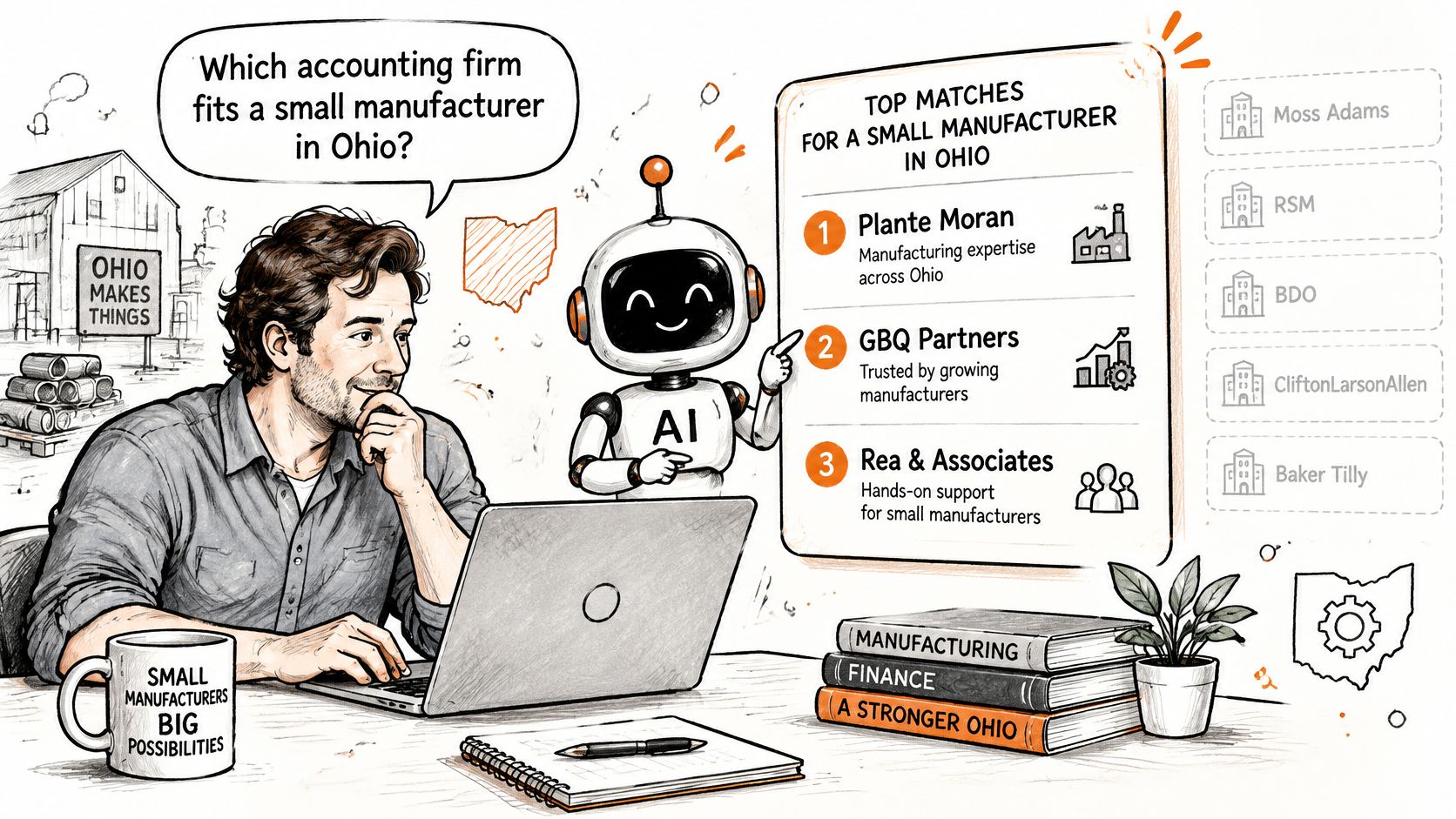
An AI brand mention is any instance where an assistant writes your company’s name into its generated answer as a recommendation, comparison, or example. It works like a trusted friend’s referral, except this friend has read much of the web and can name only a handful of businesses at a time.
Where the assistant gets its picture of you
Assistants build that picture from training data, live web search, and sources they’re given access to during retrieval. That’s why the description attached to your name traces back to your website, your listings, press coverage, directories, and reviews, not just to the homepage copy you control.
AnswerLion exists because a growing share of buying research starts with a question to an AI assistant, which names a handful of businesses and leaves everyone else out, and most businesses have no idea what these tools say about them. Closing that gap starts with a clear view of your current position.
Why absence costs you the buyer
Shortlists now form inside the answer. A buyer who trusts that answer may never run a traditional search, open ten tabs, or reach your carefully built landing page.
- Named and described well: You enter the buyer’s first calls with your strongest fit already explained.
- Named but described wrongly: You get considered for the wrong work, or ruled out for a service you do offer.
- Absent entirely: A competitor receives the enquiry, and you get no signal that the opportunity existed.
Getting named is the outcome. Getting named accurately, for the right questions, is the advantage.
With shared definitions for mentions, citations, and recommendations, you can judge where your brand stands today and invest in the change that moves buyers toward you first.
Mentions, Citations and Recommendations Compared
Being cited and being named are two different outcomes, and treating them as one number hides where you’re winning. A 2026 analysis reported in iPullRank’s AI search statistics and trends found ChatGPT cited a source in 87% of relevant domain appearances but named the associated brand in only 20.7% of them.
The same comparison found Gemini named brands in 83.7% of appearances but linked to them in only 21.4%. Your page can support an answer that the buyer reads carefully without your name ever appearing in the text.
Five brand visibility signals and what each one shows
| Signal | What the assistant does | Why it matters |
|---|---|---|
| Named mention | Writes the brand name into the answer | Shortlist awareness |
| Direct recommendation | Suggests the brand for the buyer’s question | Purchase intent |
| Citation without mention | Uses your page as a source but does not name you | Content retrieved but not converted |
| Mention without link | Names the brand with no source URL | Category awareness |
| Citation of supporting page | Links a verifiable URL behind the answer | Evidence for comparisons and validation |
Record each signal in its own column across every audit run. One row per prompt, per engine, per run gives you a clean count of named mentions, direct recommendations, citations without mentions, and mentions without links.
A citation proves the assistant read your content, while a mention proves the buyer heard your name.
Which signal deserves priority
That depends on the buyer’s stage, and separating the signals makes the priority obvious. Mentions shape the shortlist when a buyer asks who should handle a job, which platform fits a team, or which local provider to call.
Citations supply the evidence buyers check before deciding. They support comparisons, pricing questions, and validation of a claim the assistant made about you. A healthy profile builds both, and reporting them separately shows you which one to strengthen next for the fastest commercial gain.
I would never accept a single blended visibility score from a dashboard. Ask for the five counts, by engine, and you’ll know whether your next investment belongs in content that gets retrieved or in positioning that gets you named.
How AI Assistants Choose Which Brands to Name
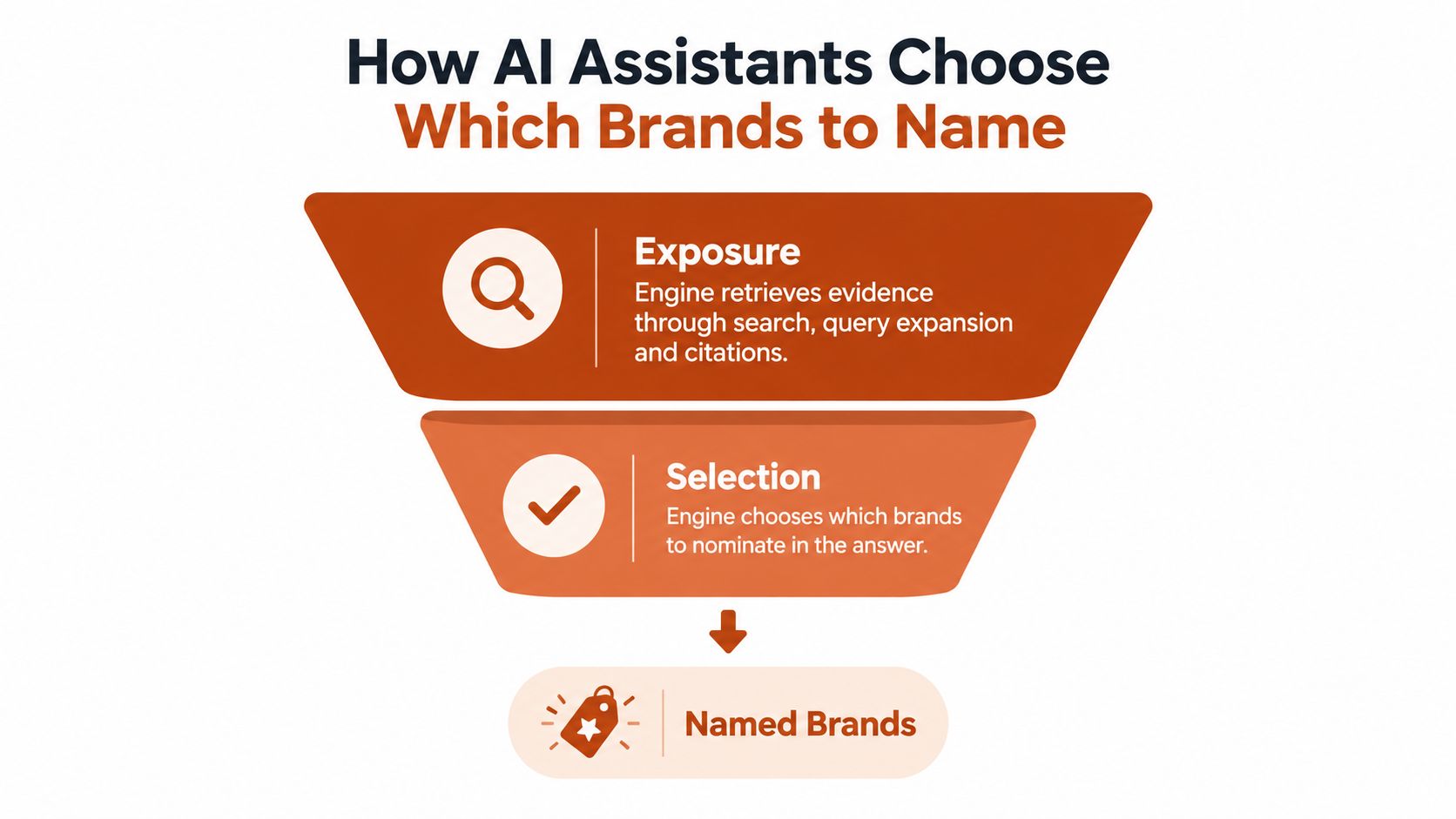
Assistants pick brands in two stages, and each stage responds to different work. First comes exposure, when the engine retrieves evidence through search, query expansion, and citations. Then comes selection, when it chooses which brands to nominate in the answer.
Think of a restaurant critic building a top three list. The critic must visit a restaurant and gather evidence before naming it, and visiting alone doesn’t guarantee a place on the list.
The two rates that diagnose your position
Your exposure rate measures how often your brand or a supporting source enters the observable retrieval path. Your selection rate measures how often that exposure becomes an explicit recommendation.
Exposure is the first gate. In a 2026 audit of retrieval-augmented recommendation, when neither the target brand nor its own domain appeared in the observable retrieval path, target mention rates were only 2.8% for GPT and 3.8% for Gemini. Get into the retrieval path, and selection work starts to pay.
How four AI engines name and cite brands
| Engine | Brand named in answer | Source linked | Study |
|---|---|---|---|
| ChatGPT | 20.7% of relevant appearances | 87% of relevant domain appearances | 2026 ChatGPT appearance analysis |
| Gemini | 83.7% of appearances | 21.4% of appearances | 2026 ChatGPT and Gemini comparison |
| ChatGPT Search | 4.01 brands per prompt | 1.72 link citations per prompt | 2025 study of 100,000 websites |
| Perplexity | 3.77 brands per prompt | 6.87 link citations per prompt | 2025 study of 100,000 websites |
Read the rows separately, because each engine behaves differently. ChatGPT is citation-heavy and brand-name-light, Gemini is brand-name-heavy and link-light, and the 2025 study of 100,000 websites from Otterly shows Perplexity averaged 3.77 mentions and 6.87 citations per prompt, citing more than it names.
ChatGPT Search sits at the other end, naming more brands per prompt than it links. One blended target across engines will mislead you, so set a baseline and a goal for each engine you care about.
Two different fix lists
Exposure improves with crawlable, server-rendered pages, consistent Organization and Service data, and accurate third-party references. Selection improves with answer-first copy, clear differentiators, and evidence-backed comparisons that give the model a reason to pick you.
Our guide to AEO best practices sets out how those two workstreams fit together. Report the rates separately, and a citation gain will never be mistaken for a mention gain.
How to Audit Your AI Brand Mentions Step by Step
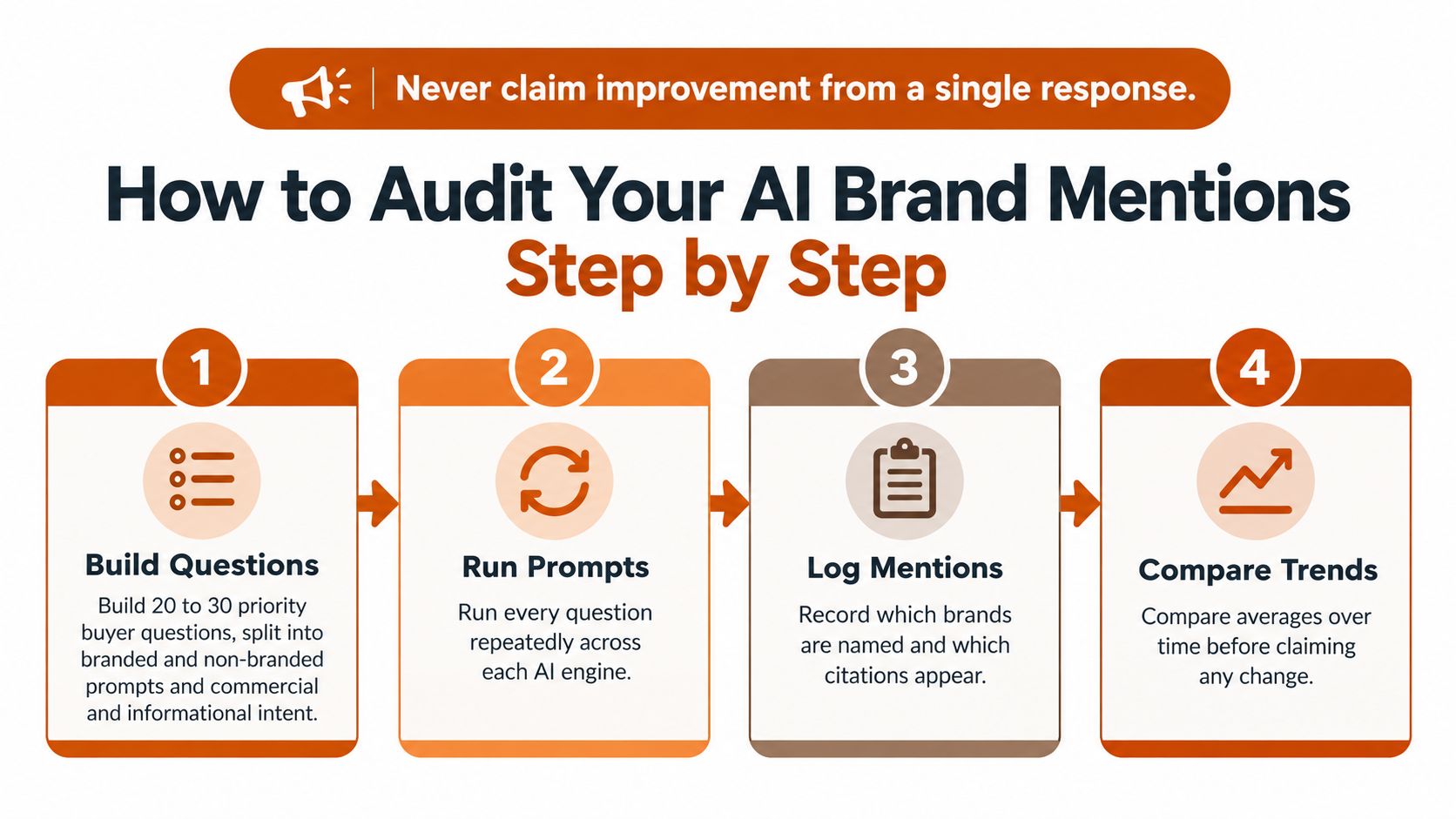
One response is a sample, not a result. AI answers vary from run to run, so a useful audit treats brand mentions, citations, and recommendations as separate prompt-level signals, then builds confidence through repeated measurement.
Build the prompt set
- Build 20 to 30 priority buyer questions: Draw them from sales calls, enquiry forms, and the questions prospects ask before they buy. Separate branded prompts that name your business from non-branded prompts that ask for a provider, then split both into commercial and informational wording. Commercial prompts tend to surface brand names more often than informational prompts, so report the groups separately.
- Run each prompt repeatedly on each engine: A 2026 measurement study on arXiv recommends running each prompt at least 7 times per day for stable brand-visibility estimates and at least 8 times when source-level coverage is also being measured.
- Aggregate over 2 to 4 weeks: Individual outputs vary stochastically. Rolling averages show the underlying trend instead of crediting one lucky answer or blaming one omission.
Calculate and log the right fields
- Calculate mention rate: Divide runs where your brand appears by total relevant runs, then segment by engine, prompt intent, market, and competitor set. This turns scattered screenshots into a number you can improve.
- Log position and citations separately: Record mention position, citation presence, and each cited source in separate columns, since a brand can be named without being cited or cited without being named prominently.
- Score recommendation and description: Record whether the answer recommends your business, includes it among alternatives, or mentions it only in passing. Mark factual accuracy and recommendation sentiment as well, so errors in your offer, locations, or pricing remain visible.
- List every cited source: Tag each domain as accurate, outdated, or missing. That list becomes your correction plan for third-party profiles, listings, and coverage.
AnswerLion re-runs the same list of customer questions across the major AI engines on a regular schedule and records whether the business is named, how it is described, and who else is cited. The reporting format used in an AI search visibility audit shows how these fields fit together.
Re-run identical prompts on a fixed schedule after every change. Like-for-like measurement lets you attribute improvement to a specific fix and keeps citation gains from being mistaken for mention or recommendation gains.
Third-Party Sources Drive AI Brand Descriptions
Your own website matters, but it isn’t where most of your AI reputation is decided. Ahrefs’ 2025 study of 75,000 brands found branded web mentions had a Spearman correlation of 0.664 with brand appearances in Google AI Overviews, compared with 0.218 for traditional backlinks.
That gap changes where the work goes. Third-party discussion in publications, directories, reviews, and comparison pages tracks AI visibility far more closely than link counts, so monitoring should count mentions across independent sources rather than links back to your site.
Branded web mentions against backlinks as AI Overview signals
| Measure | Branded web mentions | Traditional backlinks |
|---|---|---|
| Spearman correlation with AI Overview visibility | 0.664 | 0.218 |
The same study ranked brands by web mention volume and counted their AI Overview appearances:
| Brands ranked by web mention volume | Average AI Overview mentions |
|---|---|
| Top quartile | 169 |
| Next quartile | 14 |
| Brands with none | 0 (26% of the sample) |
The distribution is where the commercial value sits. Moving up a quartile is the difference between being a default name in your category and an occasional afterthought. Position relative to competitors matters as much as your raw total, because assistants name a shortlist and a brand sitting one tier down never enters it.
This is also where the three signals separate. High mention volume gets you named. The citations attached to those mentions show which domains produced the result, and a recommendation, the version that actually sends buyers, tends to follow brands with both volume and consistent descriptions behind them.
Why an excellent homepage can’t override the web
Assistants assemble descriptions from many sources at once. A multi-location dental group can update its website carefully while one clinic’s old phone number still sits on three directories. The assistant reads those directories, repeats the wrong number with confidence, and patients call a line that no longer connects.
Or take a regional law firm whose directory entry still shows a closed office. Every answer about that town sends prospects to an address the firm left two years ago, and the firm’s own site cannot outvote the stale listings on its own.
The source mix explains why. Reporting summarized in QuickSEO’s analysis of branded and non-branded AI search notes McKinsey research found brand-owned pages represent only 5 to 10% of sources referenced by AI systems, with third-party publishers, review sites, communities, and video supplying most of the rest.
The same summary reports a 2025 study of generative search across consumer categories: earned media from third-party publications accounted for 69 to 92% of citations, while social content represented only 0 to 0.3%. Posting more on social won’t reliably lift your mentions. Earning credible editorial coverage will.
Practical rule: Fix the sources assistants actually cite before you publish more pages of your own.
Build a source-of-truth map first
List every domain that describes your business: directories, press coverage, review sites, comparison pages, affiliate reviews, partner pages, industry databases. For each one, record what it says about your name, services, locations, and trading status, and whether it appeared as a cited source in your monitoring runs.
That map answers the question that matters. Which external sources are shaping the model’s description of you, and does the story they tell match what you would say about yourself?
Prioritize corrections by influence
- Rank domains by citation frequency: The domains that appear most often as cited sources go to the top of the list, because an error there repeats in every answer that draws on them.
- Fix high-influence errors first: A wrong name, address, phone number, service, or trading status on a heavily cited domain does more harm than a missing page on your own site.
- Pitch publications something specific: A data point, a customer outcome, or an expert comment gives a journalist a reason to cover you that a generic request never will.
- Complete review-site profiles in full: Fill in categories, service lists, photos, and hours on the platforms your buyers trust, and respond to reviews so the profile reads as maintained.
- Be selective with listicles: High-volume, low-trust roundup sites add noise. One accurate entry on an authoritative comparison page beats ten thin listings.
This sequencing pays off most for multi-location businesses, SaaS vendors, and review-sensitive categories, where outdated directories and affiliate reviews create omissions and false attributes that follow you into every answer.
Authority over volume
Report two numbers, not one: total mention volume and your quartile position against named competitors. The distance between quartiles is where enquiries are won, and volume alone can hide a business that is everywhere on low-trust sites and nowhere on the sources assistants actually cite.
Technical accessibility gets you read. Third-party authority gets you named and recommended. Durable visibility comes from owned facts and external evidence telling the same accurate story, so the assistant never has to choose between two versions of you.
Expect two speeds of return. Correcting a clearly wrong fact can show up as soon as engines re-crawl the corrected page, often within weeks. Authority built through third-party mentions compounds over months, and each accurate source makes the next description easier to get right.
Fixing Owned Pages So Engines Read You Correctly
Third-party sources carry the most weight, and your owned pages still set the facts everyone else copies. Get them right first, and every correction downstream becomes easier.
Start with crawler access
OpenAI separates its crawlers through independent robots.txt controls, as set out in OpenAI’s GPTBot documentation. OAI-SearchBot supports inclusion in OpenAI search results, while GPTBot crawls content that may be used to improve OpenAI’s foundation models.
Allowing one doesn’t automatically allow the other. Set each policy deliberately in robots.txt, keep search discovery open, and confirm your important pages aren’t blocked by a noindex directive or sitting behind a login.
Add structured data and validate it
Add Organization, Service, FAQ, and Article markup to the pages that define your business. Validate each template with the Rich Results Test, inspect the live page to confirm the markup renders, and request recrawling once it’s deployed.
Keep your sitemap clean, with fully qualified, absolute URLs for every page you want discovered. Google treats a sitemap as a hint rather than a guarantee, and new pages can take several days to be found and crawled, so verify pickup instead of assuming it.
Write answer-first openings
Compare two ways to open a service page. “Founded in 1998 with a passion for service” gives an assistant nothing quotable. “We audit accounting for Ohio manufacturers with 20 to 200 staff” gives it a specific, reusable statement about who you serve and what you do.
Lead every core page with a sentence like the second one, then support it with specifics, proof, and FAQs. That’s the copy assistants lift into answers. If an engine already gets you wrong, our guidance on what to do when AI describes your business wrong walks through the correction sequence.
Run the fixes in order
- Crawler access: Set robots.txt directives for search and training crawlers, and remove accidental blocks.
- Schema validation: Deploy and test Organization, Service, FAQ, and Article markup, then request recrawling.
- Answer-first rewrite: Reopen core service pages with direct, specific statements that answer one buyer question each.
- llms.txt summary: Publish a short plain-text summary of your core services, worded to match your answer-first openings so every source describes you the same way.
Some changes, such as fixing a wrong description, can show up quickly after engines re-crawl the site. Building authority through third-party mentions takes longer, and that’s exactly why the fast owned-page wins belong at the front of your plan.
Start With a Baseline Audit This Month
Your audit results point to one clear first move. If you’re cited often but named rarely, fix selection first with answer-first copy, clear differentiators, and evidence-backed comparisons that give assistants a reason to choose you.
If you’re rarely cited or absent altogether, fix exposure first through crawler access, structured data, and accurate third-party references. If assistants describe you wrongly, correct the sources first, because those descriptions feed every other answer.
The action to take this month
Run the audit on the buyer questions that matter most, record named, cited, and described results for each engine, and rank your fixes by the gap each one closes. Every AnswerLion engagement starts with a baseline of how AI engines answer the customer’s questions today, so progress is measured against evidence from day one.
Our standalone AEO audit tests priority customer questions across every major AI engine, identifies who gets cited instead of the business and why, and provides a prioritized fix list. Results usually come in three stages: engines start describing the business accurately, then start naming it for targeted questions, then visibility widens to related questions as authority builds.
Baseline, diagnose, fix, re-run. That sequence turns AI brand mentions from a curiosity into a channel you can grow on purpose.
Start earning AI brand mentions with a baseline audit that shows you exactly how ChatGPT, Google AI, Claude, and Perplexity describe your business today, who they name instead, and which fixes will move you onto the shortlist first. Visit AnswerLion to book your AEO audit and turn this month’s measurement into next quarter’s enquiries.