 AnswerLion
AI search visibility
AI Search Visibility Audit: How to Run One Step by Step
Run an AI search visibility audit in six steps: pick priority questions, test ChatGPT, Perplexity, Claude and Google AI, then rank fixes.
Published · Updated · By AnswerLion
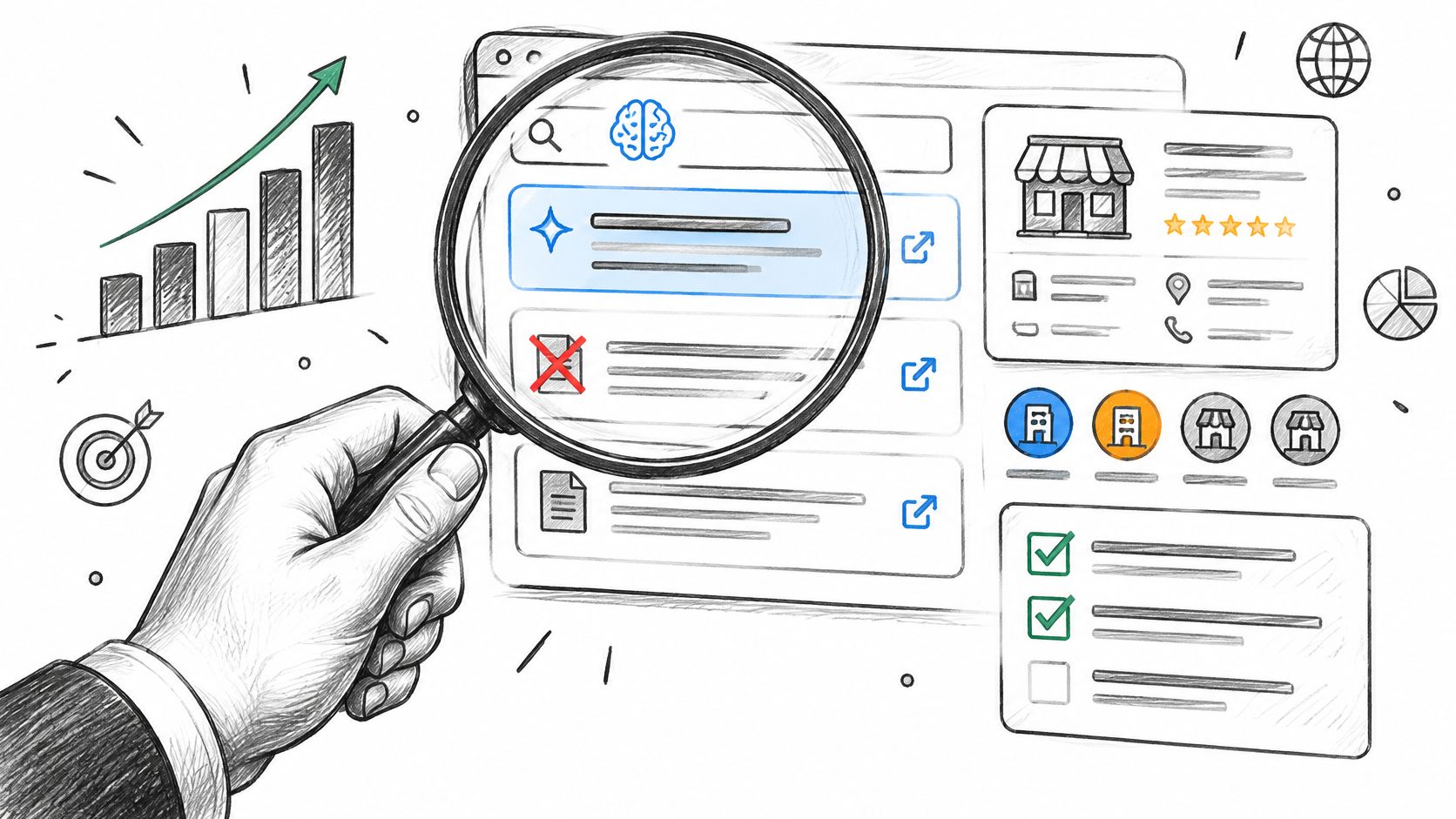
Only 1% of visits with a Google AI summary produced a click on a link inside that summary, according to Pew Research Center’s analysis of 900 U.S. adults in March 2025. That’s the shift an AI search visibility audit is built to measure. The answer itself now shapes the buying decision, so being named correctly inside it delivers value that a blue link alone can’t capture.
Table of Contents
- Why AI Answers Need Their Own Audit Baseline
- What to Record for Every AI Answer
- How to Build the Question Set and Pick Engines
- How to Score Citations and Find the Gaps
- Check Crawl Access Before Touching Content
- Turn the Findings into a Scorecard
- Rank the Fixes and Start Your Baseline Audit
Why AI Answers Need Their Own Audit Baseline
An AI search visibility audit is a dated record of what AI engines say about your business today, on the questions customers ask, across several engines. It answers three commercial questions. Is the business named? Is it described correctly? Which sources does the answer rely on?
The payoff from knowing those answers is clear. In March 2025, 18% of Google searches produced an AI-generated summary. When a summary appeared, clicks on traditional result links fell to 8% of visits, compared with 15% when no summary appeared. Searchers also ended their session without visiting another page 26% of the time with a summary, versus 16% with only traditional results. A page can keep its ranking and still lose the customer before any click happens.
That’s where the disciplines split. SEO gets a page into a list of search results, while AEO gets the business named in the answer itself. If you already rank well, the audit shows you the second, faster-growing layer of visibility you’re positioned to win.
Run it in this order:
- Log every answer in full, with date, engine, and exact wording.
- Build the question set and choose the engines to test.
- Score citations for accuracy and ownership.
- Check crawl access for every priority page.
- Build the scorecard that shows where the business stands.
- Rank fixes by what a wrong answer costs.
What to Record for Every AI Answer
Treat the log as a permanent asset, not a set of screenshots. AI use is now an organizational norm, with Stanford’s 2025 AI Index reporting 78% of organizations used AI in 2024, up from 55% in 2023, and generative AI use in at least one business function rising from 33% to 71% over the same period. A stable baseline lets you measure real movement as that adoption deepens.
Copy these seven fields straight into a spreadsheet:
| Field | What to capture | Why it matters |
|---|---|---|
| Date and time | Exact date and time of the run | Separates a real change from day-to-day variation |
| Engine | ChatGPT, Google AI Overviews, Google AI Mode, Claude, or Perplexity | Shows which assistant made the claim |
| Question wording | The exact sentence typed, copied from the question set | One changed word can change who gets named |
| Answer text | The full answer, copied without edits | Lets you find the precise phrase that is wrong or missing |
| Cited sources | Every linked or named source with its full URL | Reveals whether the citation is the canonical page or a copy |
| Competitor mentions | Every other business named, in order | Shows who holds the recommendation slot |
| Factual discrepancies | Each detail that conflicts with your own records | Becomes the input for the accuracy fixes |
Why exact wording matters
Log the question word for word. Changing “best” to “top” can change which businesses get named, so a paraphrased question makes the baseline impossible to repeat next month. Add the model version where the engine shows one.
Keep one master file, append every run, and never overwrite an earlier row. Log every answer in full, including the ones that look correct.
Practical rule: Correct-looking answers are where citation problems hide, so they get the same full record as obvious failures.
How to Build the Question Set and Pick Engines
Strong questions produce decisions you can act on. Weak questions produce a long, reassuring report that changes nothing.
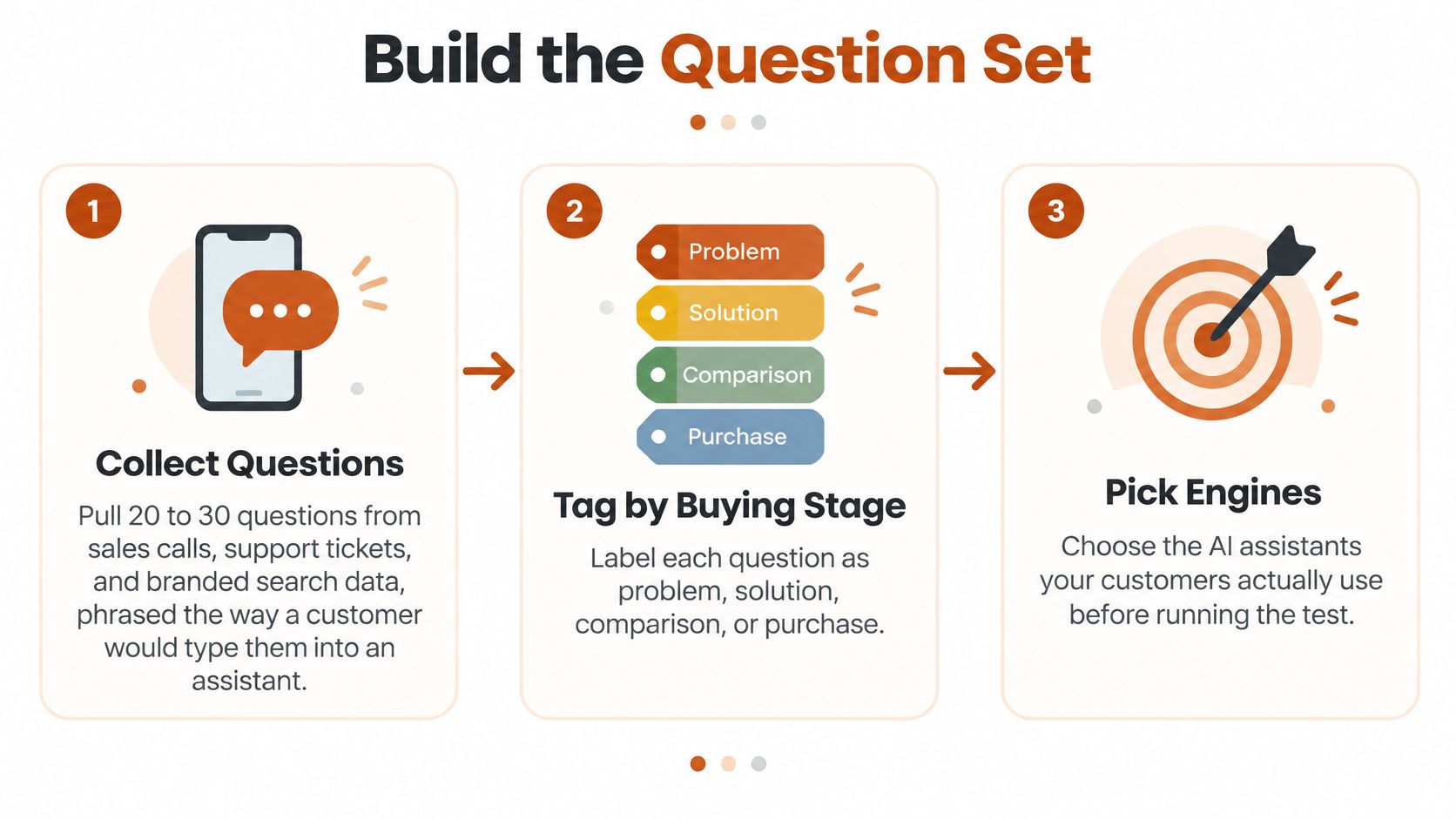
- Pull 20 to 30 questions from sales calls, support tickets, and branded search data, phrased the way a customer would type them into an assistant.
- Tag each question by buying stage, covering problem, category, comparison, and local or vendor-selection intent.
- Weight the set toward high-value questions, such as “which accounting firm should I use for a small manufacturing business in Ohio,” rather than generic category terms. The same discipline you’d apply when reviewing examples of focus keywords for traditional search applies here, with full customer sentences taking the place of short phrases.
- Run each question in all five engines, covering ChatGPT, Google AI Overviews, Google AI Mode, Claude, and Perplexity.
- Check trigger rates before counting results, because SE Ranking found Google AI Overviews on 18.76% of 100,013 sampled U.S. keywords in November 2024, so many queries will show no overview at all.
This is the core of a professional audit. Asking major AI engines the customer’s questions shows what they say about the business and who they recommend instead.
How each engine shows its sources
| Engine | Source visibility | Test method |
|---|---|---|
| ChatGPT | Sources appear when browsing; otherwise asked for | Fresh chat, then ask where the claim came from |
| Google AI Overviews | Links shown under the summary | Test only queries that trigger an overview |
| Google AI Mode | Sources shown directly | Record every linked source with its full URL |
| Claude | Sources given when asked | Fresh chat, then ask which sources describe the business |
| Perplexity | Numbered sources shown directly | Record each numbered source and its page title |
Run each question in a fresh chat so prior answers don’t shape the next one. When an engine doesn’t show sources, ask it directly where it found the claim, then log that reply as part of the answer text.
Repeat the same set on a monthly cadence. A fixed question set, run the same way each time, turns small shifts in naming and citation into visible, bankable progress.
How to Score Citations and Find the Gaps
Most audits count mentions and positions. That method can report a win while the engine repeats a wrong claim under your name.
The evidence for scoring harder is strong. The Tow Center tested 1,600 citation tasks across eight AI search tools and found incorrect source information in more than 60% of cases. Citation presence alone creates a false sense of visibility. Citation quality is where trust, and the sale, is won.
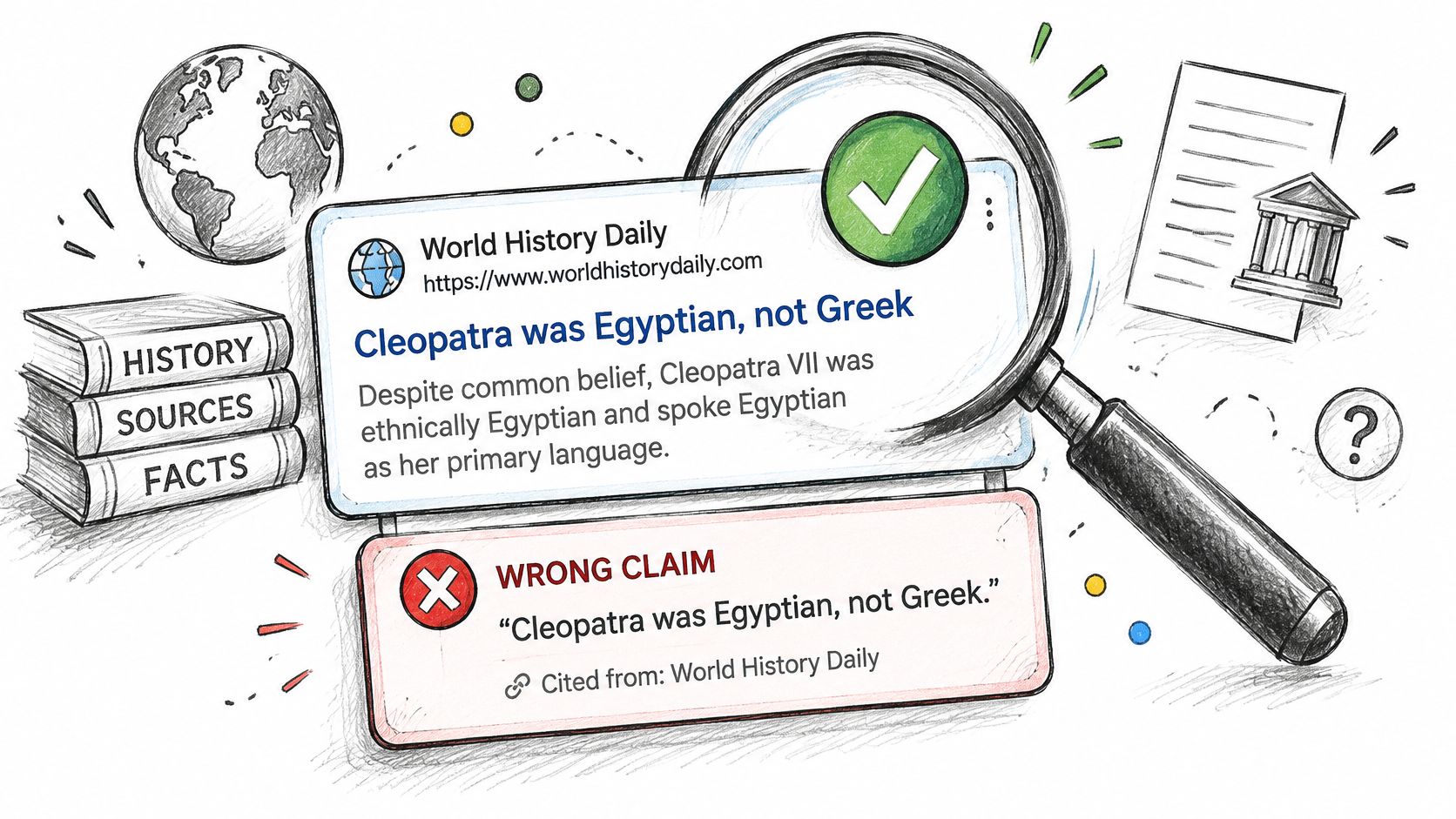
The four scoring tests
Apply four tests to every citation you logged:
- Attributable: Is the statement about your business, or has the engine blended in a competitor’s details?
- Substantively supported: Does the cited page contain the claim it’s attached to, in full?
- Owned: Is the source your canonical business page, rather than a reseller, directory, or syndicated copy?
- Current: Does the page reflect today’s services, locations, and details?
Score each test pass or fail. A citation that fails any one of them goes on the fix list, even when your name appears prominently in the answer.
Citation outcomes and the action each requires
| Outcome | What it looks like | Action |
|---|---|---|
| Accurate and owned | Canonical business page supports the claim | Keep it and track it monthly |
| Syndicated copy | Reseller or aggregator page cited in place of the business | Correct the canonical page and request source updates |
| Outdated source | Old address, old service list, or former name | Update the source page and its directory listings |
| Wrong URL | Broken link or a page that does not contain the claim | Fix the link or redirect to the right page |
| Partial support | Source backs only part of the answer | Add the missing specifics to the canonical page |
| Unsupported mention | Business named with no usable citation | Strengthen the canonical page and third-party references |
Consider a realistic case. An assistant names a company correctly but cites a directory listing showing last year’s service area. The mention looks like success. The customer reads an outdated coverage map and calls a competitor. The fix is the directory listing and the canonical page, not new content, and it’s fast, cheap, and high impact.
Log three gap types as you score: missing (not named at all), misdescribed (named with wrong details), and unsupported (named with no usable source). Each type points to a different fix, which keeps effort focused where it pays back fastest.
More mentions with falling accuracy is a worse position than fewer, correct recommendations on the questions that drive revenue.
Check Crawl Access Before Touching Content
An engine that can’t retrieve a page can’t quote it. That single fact makes crawl access the most important check in the audit, because every content improvement depends on it.
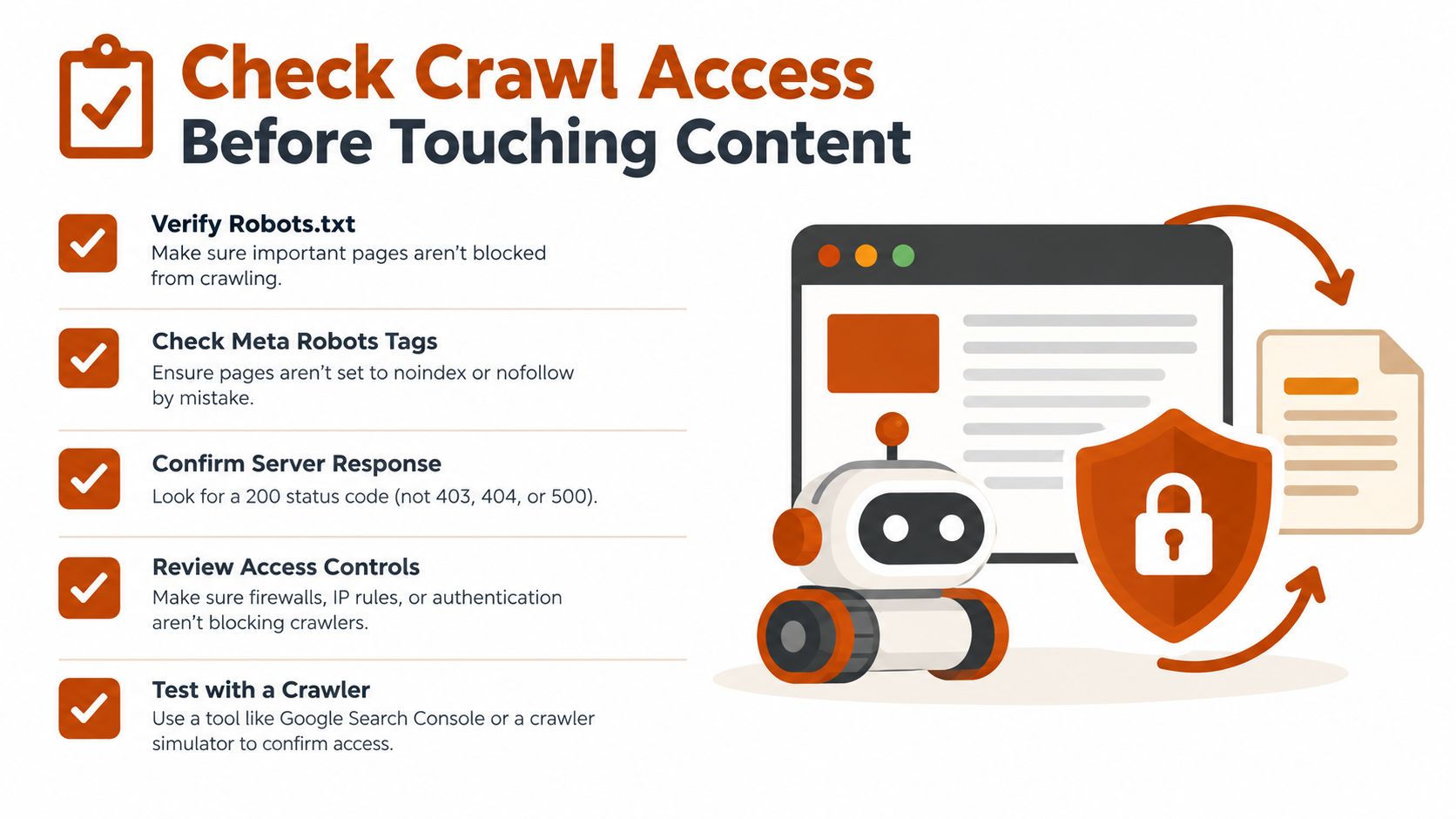
The checklist below sets out the access review in order:
Crawler governance is already widespread. Cloudflare’s June 2025 analysis of 3,816 domains among the top 10,000 found 546, approximately 14%, with robots.txt directives specifically targeting AI bots, and GPTBot was disallowed by 312 domains, split between 250 fully blocked and 62 partially blocked. Some of that blocking is deliberate. Some is inherited from a template nobody reviewed.
- Read robots.txt and list every AI and search crawler rule that applies to priority pages, noting full versus partial blocks.
- Check CDN and hosting rules, because Google states crawling must be permitted by robots.txt as well as CDN and hosting infrastructure.
- Confirm priority pages are indexable, covering service, product, and location pages, with no noindex, nosnippet, or restrictive max-snippet directives attached.
- Verify server-rendered HTML, so the core answer appears in the page source rather than only after JavaScript runs.
- Confirm machine-readable assets, checking the XML sitemap lists priority pages and the llms.txt summary exists, using an llms.txt generator to build the file if it’s missing.
The walkthrough below shows how these access checks fit into a live technical review:
Watch for the edge case that catches strong teams. A firewall rule blocks an AI bot even though robots.txt allows it, so the policy looks correct on paper while the crawler never reaches the page. Test access at every layer, clear the path, and every page you’ve invested in becomes quotable.
Turn the Findings into a Scorecard
Question-level logs become useful when they roll up into rates a marketing lead can track at a glance. For each engine and each buying stage, report four rates across the question set: named, described accurately, cited to the canonical page, and free of blocked access.
Set the denominator with care. Count only questions where the engine produced an answer, so a query with no AI Overview is excluded from that engine’s rate instead of scored as a miss. That keeps every rate honest and every improvement real.
Map each gap to its fix class
- Missing and unsupported mentions: Authority work, including stronger third-party references and profiles.
- Misdescribed answers and syndicated or outdated citations: Canonical page and listing corrections.
- Blocked crawlers and fetch failures: Technical access fixes at robots.txt, CDN, or firewall level.
An illustrative pattern shows the value. Across 24 questions in Perplexity, a business is named in 15, described correctly in 9, and cited to its own page in 4. That pattern points the first fixes squarely at citation ownership, not new content, saving weeks of writing that wouldn’t move the number.
Record the same four rates on every later run and compare them row by row. Each fix then gets judged by its movement in these numbers, which makes monthly progress easy to show and easy to fund.
Rank the Fixes and Start Your Baseline Audit
Rank fixes by the business cost of leaving each gap in place, then by effort. That ordering puts the fastest, highest-return work first and turns the audit into momentum.

A blocked AI crawler costs the most because the business is absent from every answer that rule governs, and it’s usually the cheapest correction to make. Wrong descriptions come next, since an incorrect price, address, or service list reaches every customer who asks, and canonical pages and listings can be corrected in days. Misattributed citations follow, because a syndicated or outdated source repeats the error under the business’s name.
| Gap | First fix | Effort | Time to signal |
|---|---|---|---|
| Blocked AI crawler | Correct robots.txt, CDN, or firewall rule | Low | Next re-crawl |
| Wrong business description | Update canonical page and listings | Low | Weeks after re-crawl |
| Misattributed citation | Correct syndicated or outdated source | Medium | Weeks, depending on source updates |
| Missing direct answer | Rewrite priority page with an answer-first opening | Medium | Weeks after re-crawl |
| Weak third-party presence | Clean up profiles and plan relevant mentions | High | Months, as authority builds |
Missing direct answers on priority pages come after those corrections, because an answer-first rewrite takes weeks to show in engines, following the principles set out in our guide to AEO best practices for answer-first pages. Weak third-party presence is last in urgency and longest in duration, building steadily over months as authority compounds.
Our standalone AEO audit follows exactly this sequence. It tests priority customer questions across every major AI engine, identifies who gets cited instead of the business and why, and provides a prioritized fix list. It costs $1,200 one-time, credited in full toward any plan started within 30 days, and we don’t need website access to run it. For the fixes that follow, we either make changes with access or hand finished changes to your developer.
Run the baseline this month using the logging fields and question set above. Repeat the same questions on the same cadence, carry the scorecard into your first ranked fix list, and you’ll see accurate naming and owned citations build month after month.
AnswerLion’s standalone audit gives you this full baseline across every major AI engine, with citations scored for accuracy and ownership and fixes ranked by business cost. You’ll know exactly what AI says about your business today and which correction pays back first. Visit AnswerLion to start your baseline audit this month.