 AnswerLion
AEO best practices
9 AEO Best Practices for AI Visibility in 2026
Discover 9 AEO best practices that get your business cited by ChatGPT, Google AI, Claude, and Perplexity — from answer-first content to schema and monitoring.
Published · Updated · By AnswerLion

Buyers already ask ChatGPT, Google AI, Claude, and Perplexity for a shortlist, and a small set of businesses gets named. Everyone else stays invisible, even when the site still ranks. In a Pew Research Center analysis of Google activity during March 2025, approximately 18% of all searches produced an AI-generated summary, and 58% of surveyed respondents encountered at least one during the month. Visitors clicked a traditional result in only 8% of visits when a summary was present, compared with 15% when none appeared. They clicked a source inside the summary on 26% of pages with a summary, versus 16% of pages showing only traditional results.
That gap is the practical case for AEO best practices. SEO gets a page into a list. AEO gets the business named and described in the answer itself, with no ad spend. Good SEO remains the foundation, because most AI engines still draw on web search and on credible, well-structured pages. The inputs that move visibility sit inside the business: direct answers, structured data, and consistent listings. Those can change this month, and description fixes often appear after engines re-crawl the site, within weeks.
Treat the nine practices as a measure-fix-track system. Document where you stand, restructure what machines can read, then track movement across every major engine. Most businesses have not started, so the field is still open. Clear answers, specific facts, and consistent descriptions are still rare enough to create an advantage. We use the term AEO, and the work is the same discipline as GEO.
Table of Contents
- 1. Baseline AI Visibility Audit Across Priority Customer Questions
- 2. Answer-First Page Architecture
- 3. Question-Driven FAQ Content
- 4. Schema.org Structured Data Implementation
- 5. AI Crawler Access Through robots.txt and XML Sitemaps
- 6. llms.txt Publication for Machine-Readable Summaries
- 7. Server-Rendered, Fast HTML for Reliable Extraction
- 8. Harmonized Entity Data Across Directories, Reviews, and Publications
- 9. Recurring Multi-Engine Monitoring with Competitor Benchmarking
- AEO Best Practices: 9-Point Comparison Guide
- From Checklist to Compounding Visibility
1. Baseline AI Visibility Audit Across Priority Customer Questions
Every later change is guesswork until you know who the engines already name. Build 20 to 40 high-intent questions from sales calls, support tickets, and search query data, then run that identical set through ChatGPT, Google AI, Claude, and Perplexity. Record the full answer, not a yes-or-no mention. Note which brands are cited, how your business is described, and which facts are missing or wrong.
A mid-market software company can discover it is absent from three of five core category questions, such as “best accounting software for freelancers,” and turn that gap list into the first content sprint. A multi-location dental group can find that one location’s hours are misreported by two engines, then correct the source data before expanding service pages.
The team reviewing those answers needs the raw text, not a dashboard screenshot alone.

Our baseline audit tests priority questions across the major engines, shows who gets cited instead of you and why, and returns a prioritized fix list. Leadership sees current standing before implementation budget is committed. For the audit itself, website access isn’t required.
- Hold the set fixed: Repeat the same wording in every later cycle so movement is comparable.
- Separate three scores: Track inclusion, citation, and accuracy. A wrong description is not a win.
- Start with revenue questions: Category, comparison, and local-intent prompts beat vanity brand queries.
2. Answer-First Page Architecture
A page becomes quotable when the first sentence could stand alone as the answer. Put the service, the audience, and the concrete outcome in that opening line. Supporting detail follows. AI assistants extract passages that resolve one question cleanly, and human visitors with a precise need convert faster when they don’t have to hunt.
Controlled tests summarized in an independent review of citation evidence ran 10,000 queries and nine content modifications. Adding citations, quotations, and statistics increased source visibility by more than 40% across queries, while keyword stuffing reduced performance. Pages around position five saw roughly a 115% relative lift. Position-one pages changed little. A separate evaluation found that only 51.5% of generated sentences were fully supported by their citations on average, while 74.5% of citations supported the attached sentence. Precise, auditable claims beat vague FAQ padding.
Practical rule: One primary question per core page. Secondary questions get their own sections, each opening with a complete sentence.
A regional HVAC company that opens with the service, the service area, and a typical response time gives local queries something specific to quote. A B2B analytics platform that opens each feature page with the problem solved and the outcome delivered does the same for vendor research. We rewrite service, product, and location pages so the opening sentence answers one question, then backs it with specifics.
3. Question-Driven FAQ Content
Sales conversations already contain the long-tail questions engines are asked next. Pull the last 90 days of calls, chat logs, and tickets. Pair each real question with a short factual answer that includes figures, timeframes, and named policies. Those units are easy to retrieve and hard to misquote.
Build from live demand, not a template
A B2B SaaS company that publishes a 30-question FAQ on integrations and data security can see those security answers surface in vendor-evaluation responses. An e-commerce brand that states sizing, shipping, and returns with exact policy language becomes the source those queries can cite. Generic “we care about customers” lines don’t.
Google’s people-first guidance, formalized with the helpful content system in August 2022, still maps cleanly onto this work. Its creating helpful content guidance asks whether a page serves an existing audience, shows first-hand expertise, has a clear purpose, and leaves the reader able to finish the job. Use the words people search in titles and main headings.
- One fact per answer: State the policy, the limit, or the timeframe in the first sentence.
- Quarterly review: Offerings change. Stale answers train engines on last year’s product.
- Pair with markup later: The words come first. FAQ structured data only clarifies what readers can already see.
What doesn’t work is inflating an FAQ with questions nobody asked, just to look complete.
4. Schema.org Structured Data Implementation
Schema removes guesswork about who you are and what a page covers. Start with Organization markup on the homepage, then extend Service, FAQPage, and Article types across templates. Google supports JSON-LD, Microdata, and RDFa, and recommends JSON-LD. Its structured data policies require the properties for the result type, visible marked-up facts, current and original content, and pages that aren’t blocked from Googlebot by robots.txt, noindex, or access controls. Validate with the Rich Results Test and URL Inspection, plus the Schema Markup Validator.
A multi-location clinic that deploys location-level Organization data, including LocalBusiness detail where it fits, stops engines from mixing hours across sites. A professional services firm that connects Organization markup to verified profiles with sameAs strengthens entity recognition. Names, addresses, and phones must match the directories exactly.
This walkthrough shows how visible FAQ copy and markup stay aligned.
Schema clarifies entities. It doesn’t replace the answer on the page. A worked FAQ schema example is useful when you are checking that the questions in the markup are the same questions a reader sees. Markup that invents offers or hides answers fails both trust and eligibility.
5. AI Crawler Access Through robots.txt and XML Sitemaps
Unretrieved pages can’t be cited. Audit robots.txt so the crawlers major AI platforms publish, including OAI-SearchBot, ChatGPT-User, ClaudeBot, and PerplexityBot, can request the pages you want quoted. Treat training-only directives as a separate decision, reviewed against each platform’s documentation at least twice a year. A leftover staging disallow is a common reason product documentation never enters retrieval.
Google’s robots.txt introduction is clear about the limit of that file. It mainly manages crawler requests and server load. A blocked URL can still be indexed if other sites link to it. Robots.txt isn’t an access-control or de-indexing tool. Pair it with noindex, authentication, internal links, rendering, and the sitemap.
Point crawlers at revenue URLs
An online retailer that cuts the sitemap to canonical product and category URLs concentrates crawl activity on pages that sell. A B2B software company that removes a blanket disallow restores access to documentation buyers ask about.
- Canonical and live: Include only indexable URLs that return 200.
- Honest lastmod: Updated pages should look updated, so recrawls aren’t delayed by a stale date.
- Check the whole path: CDN rules and authentication can block a bot that robots.txt appears to allow.
This is one of the fastest technical wins, and it is the prerequisite for every content investment that follows.
6. llms.txt Publication for Machine-Readable Summaries
llms.txt is a concise markdown file at the site root. It summarizes the business, the category, and the pages a language model should read first. Jeremy Howard of Answer.AI proposed the format in 2024 so systems get a curated entry point instead of inferring priorities from a full crawl. It doesn’t replace schema or the sitemap. It sits beside them.
Write the summary as two factual sentences: who you serve and what you offer. Link only to canonical, answer-first pages. A SaaS company can point to the product overview, pricing explanation, security documentation, and integration guides. A regional law firm can list practice areas, attorney bios, and the consultation process. Update the file when a major service, price structure, or leadership fact changes.
A curated file helps only if every linked page already states the facts you want repeated.
Publishing the file signals that the business has organized its knowledge for machine use. A practical llms.txt generator speeds the first draft, then an editor should cut anything promotional. What doesn’t work is a marketing brochure dumped into markdown, or links to thin pages that contradict the homepage.
Our technical setup includes this file alongside crawler access and a clean sitemap, so the most important facts are easy to retrieve and quote.
7. Server-Rendered, Fast HTML for Reliable Extraction
Engines read what the first response contains. If headings, prices, hours, and answers appear only after client-side JavaScript runs, many retrieval systems never see them. Server-rendered HTML puts those facts in the initial markup. Clean heading hierarchy, lists, and tables make the same facts easier to extract.
Compare the raw source of a key page with the rendered view before you celebrate a redesign. If the answer is missing from source, it isn’t reliably available. Prioritize service, pricing, and location templates. A B2B platform that moves marketing pages from client-side rendering to server-side rendering makes product descriptions consistently available in retrieval. An e-commerce brand that cuts page weight and places critical product facts in static HTML improves both speed and extraction.
Google’s guidance on AI features and structured data states that generative features use publicly accessible, crawlable content, and that no special Schema.org vocabulary or AI-specific text file is required. Structured data still helps conventional features when it matches visible content. Recrawling can take several days, so measure against a documented baseline rather than expecting same-day movement.
- Semantic elements: Use real headings, lists, and tables instead of generic containers for the facts you want quoted.
- Server-render the money pages first: Service, pricing, and location pages outweigh blog chrome.
- Keep JavaScript for interaction: Don’t hide the answer behind it.
8. Harmonized Entity Data Across Directories, Reviews, and Publications
Assistants cross-check the web. When the name, address, phone, categories, and service descriptions agree, the entity is easier to recommend. When they conflict, engines hedge or repeat the wrong location. Create one source-of-truth document before you touch a single listing. Then correct directories, review platforms, industry profiles, and publications in that order.
A restaurant group that standardizes hours and addresses across 40 listings gives local dining questions current facts to repeat. A B2B technology firm that earns two relevant publication mentions and refreshes professional profiles strengthens the category association engines already look for. Prioritize the platforms those engines cite most often in your category, not every directory that will take a listing.
Consistent external facts keep working after the engines change their interface.
Respond to reviews on a steady cadence. Recent, accurate review language shapes how the business is described, while ignored profiles drift. Third-party references still matter, and outreach should earn relevant mentions rather than chase volume. What fails is editing the homepage while Google Business Profile, a niche directory, and an old press bio still disagree. We treat harmonized listings as a durable fix, because consistent descriptions continue to support recommendations as retrieval systems evolve.
9. Recurring Multi-Engine Monitoring with Competitor Benchmarking
The same questions, on a fixed cadence, turn a project into an operating rhythm. Re-run the baseline set across ChatGPT, Google AI, Claude, and Perplexity. Report citation frequency, whether you are named, where you sit relative to competitors, and whether the description is accurate. Hold the question set constant for at least two quarters before you revise it. A shifting prompt list manufactures progress.
A separate Pew Research Center look at browsing data found that 65% of surveyed respondents had conducted a search showing an AI reference somewhere on the results page. AI references show up in ordinary searches, not only in searches about AI. That is why monthly movement belongs in a leadership report, written in plain language.
A digital-first retailer tracking 35 category questions each month can shift content spend toward queries where rivals are gaining. A regional healthcare network can show citation movement across four engines next to appointment inquiries, without pretending the two are the same metric.
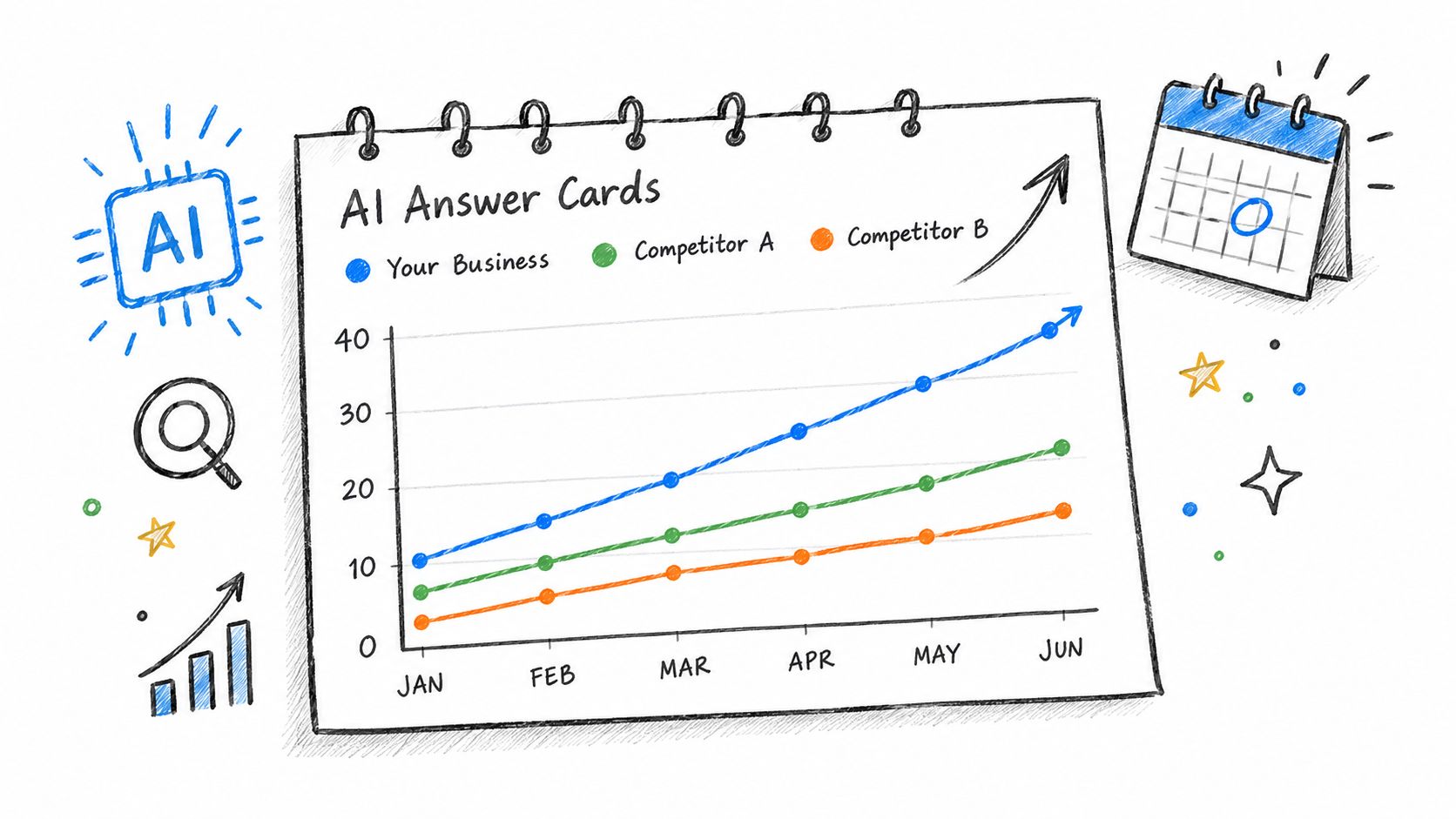
Connect each monthly change to the action taken in the prior cycle. LLM visibility tracking works when competitor share of voice sits beside your own mentions. Our monitoring cycle covers multiple engines and turns those comparisons into the next fix list. A one-off screenshot isn’t a trend.
AEO Best Practices: 9-Point Comparison Guide
| AEO Practice | 🔄 Implementation Complexity & Resources | 📊 Expected Outcome | ⭐ Ideal Use Case | 💡 Key Advantage |
|---|---|---|---|---|
| Baseline AI Visibility Audit | Medium; requires question research, multi-engine testing, and documentation | Establishes baseline citations, accuracy gaps, and competitor presence | Before launching an AEO program or allocating budget | Makes progress measurable and priorities explicit |
| Answer-First Page Architecture | Medium; requires content review and page restructuring | Creates clearer, more quotable answers for engines and visitors | Service, product, and location pages | Scales a consistent answer format across many pages |
| Question-Driven FAQ Content | Low to medium; requires customer-question research and periodic updates | Addresses specific long-tail questions with concise answers | Businesses with recurring sales or support questions | Turns real customer questions into reusable, citable content |
| Schema.org Structured Data | Medium to high; requires developer support, validation, and maintenance | Clarifies business entities, services, and page content for machines | Sites needing consistent entity and offering information | Adds machine-readable context that complements visible content |
| AI Crawler Access and XML Sitemaps | Low to medium; requires technical review and periodic checks | Helps eligible crawlers discover priority pages | Sites with crawl restrictions or incomplete sitemap coverage | Removes basic access barriers with relatively modest effort |
| llms.txt Publication | Low; requires a concise file and occasional updates | Provides a curated summary and links for machine readers | Businesses seeking an additional structured site guide | Quick to create and maintain; adoption is still developing |
| Server-Rendered, Fast HTML | High; may require engineering and performance changes | Makes core content more reliably accessible for extraction | JavaScript-heavy or slow sites with important product or service content | Supports both machine extraction and visitor performance |
| Harmonized Entity Data | Medium to high; requires coordination across directories and platforms | Improves consistency of business details and external references | Multi-location businesses or brands with inconsistent listings | Reduces conflicting information across sources |
| Recurring Multi-Engine Monitoring | Medium; requires ongoing testing, reporting, and analysis | Tracks citation, accuracy, and competitor visibility over time | Teams managing AEO as an ongoing program | Shows trends and helps guide subsequent investment |
From Checklist to Compounding Visibility
Measure, fix, then track. That order is the operating system, and skipping the first step is how teams rewrite the wrong pages. Nothing should change until you know which questions omit you, which descriptions are wrong, and which competitors are being named instead. The audit produces that picture. The middle practices repair what machines read. Monitoring tells you whether the repair held.
Most of the work sits inside the business. You choose the opening sentence, the FAQ facts, the JSON-LD, the crawler rules, the sitemap, the llms.txt links, the HTML that ships on first response, and the listing fields that must match. You don’t need ad spend to be described accurately. Because few companies have done this work, movement can show earlier than a traditional ranking fight. Engines re-crawl and refresh more often than search positions typically move. After a re-crawl, changes can surface within weeks. Authority from consistent mentions and repeated, accurate answers compounds over the following months.
There is a real trade-off in sequence. Publishing more pages before crawl access is fixed wastes the sprint. Adding schema before the visible answer exists gives machines a neat description of a vague page. Chasing new prompts every month hides whether you gained share. The practices that don’t pay off are keyword stuffing, FAQ filler, blocked documentation, and listings that disagree with the site.
AEO best practices also respect a limit that generic checklists skip. Being cited inside the answer is a different outcome from ranking beneath it. The opening evidence showed summaries can cut clicks on ordinary results while sending some users to the sources they name. Your report should therefore separate AI-answer inclusion, source citations, and competitor presence from standard organic rankings. The U.S. click data doesn’t describe every market, yet Google’s scale makes the pattern relevant for companies selling across major international markets.
Start with the baseline. Select the priority customer questions, run them across the four engines, and keep the full answers. If you want that measurement, the fixes, and the monthly read in one program, engage an AEO partner such as AnswerLion. The sequence stays the same either way: know where you stand, repair what was found, and track whether the engines now name you correctly.
AnswerLion audits how ChatGPT, Google AI, Claude, and Perplexity currently describe your business, then implements answer-first pages, structured data, crawler access, and consistent citations so you can be named in the answer. Monitoring and plain-language reporting show whether those fixes changed inclusion and accuracy across engines. Visit AnswerLion to start with a baseline of your priority customer questions.