 AnswerLion
llm visibility tracking
LLM Visibility Tracking: The Complete Measurement Guide
Master llm visibility tracking with proven measurement frameworks, sample query design, and reporting practices that show real AI assistant visibility over
Published · Updated · By AnswerLion
A CMO reviews the monthly pipeline report and sees a soft patch in qualified form fills. Google rankings look stable, but prospects are arriving with sharper questions and stronger opinions than before. Some have already compared vendors through ChatGPT, Perplexity, or Google AI Mode, then clicked only when they were ready to act. The marketing team has been measuring search positions, not whether AI answers include the brand, describe it correctly, or help create demand.
That’s the visibility gap. LLM visibility tracking is the measurement system that shows what buyers encounter before a visit is recorded in analytics. Done well, it tells leadership whether AEO work is improving the brand’s presence, accuracy, and influence across AI answers. It also helps separate meaningful movement from ordinary output variation.
The change in discovery is already visible in mainstream search. Pew Research Center analyzed browsing data from more than 900 U.S. adults and 68,879 unique Google searches in March 2025; 18% of searches generated an AI summary alongside traditional results, and about 58% of participants encountered at least one AI-generated summary that month. Pew Research Center’s analysis of AI summaries in Google Search illustrates why a ranking report alone can’t describe the full discovery experience.
The practical response isn’t to add another dashboard and call the problem solved. Build a controlled program that tests the same buyer questions repeatedly, audits whether evidence supports AI claims, and connects answer visibility to commercial outcomes. That discipline makes every other AEO investment easier to evaluate.
Table of Contents
- The Visibility Gap Most CMOs Notice Too Late
- What LLM Visibility Tracking Actually Measures
- Designing the Sample Query Set
- Controlling the Sampling Conditions
- Tracking Citation Quality, Not Just Citation Presence
- Measuring Demand Beyond Rankings and Clicks
- The Month-One Operating Rhythm
The Visibility Gap Most CMOs Notice Too Late
A CMO sits through a quarterly review where every chart looks healthy. Rankings hold. Branded search volume climbs. Then a sales director mentions that several recent prospects arrived having already compared the product against a rival inside an AI assistant, and nobody in the room can say what those answers claimed. The meeting ends with a question no existing report can answer.
That is the gap. Conventional reporting measures positions and sessions. It says nothing about whether a generated answer names your brand, describes it accurately, or pushes the right buyers toward you. A company can hold its search position while disappearing from the answers buyers read. It can also appear and still lose: described as the budget option two years after moving upmarket, or recommended for a use case it no longer serves. One ranking metric cannot tell these failures apart.
The mechanics of AI answers make this harder to eyeball. Generated responses typically synthesize several sources at once: vendor pages, review platforms, comparison articles, forum threads. Your mention sits inside that mix, next to competitor citations and third-party claims you do not control. An answer that names you off a single weak source is a different signal than one that corroborates your positioning across several. Only a deliberate audit separates the two.
Executive test: If your current report can’t tell you whether an AI answer named your brand, described it accurately, and influenced qualified demand, it isn’t a visibility measurement program.
So treat tracking as the control system for AEO. A baseline records what engines say today. Scheduled re-measurement of a fixed question set shows whether your content, technical, and authority work is changing the answer. The mechanics differ enough from conventional search that why AEO visibility can move faster than SEO visibility should shape the expectations you set with leadership.
Resist the urge to start with a dashboard. Define visibility first: presence, accuracy, and the demand an answer can create. Share-of-voice charts can wait until those three hold up.
What LLM Visibility Tracking Actually Measures
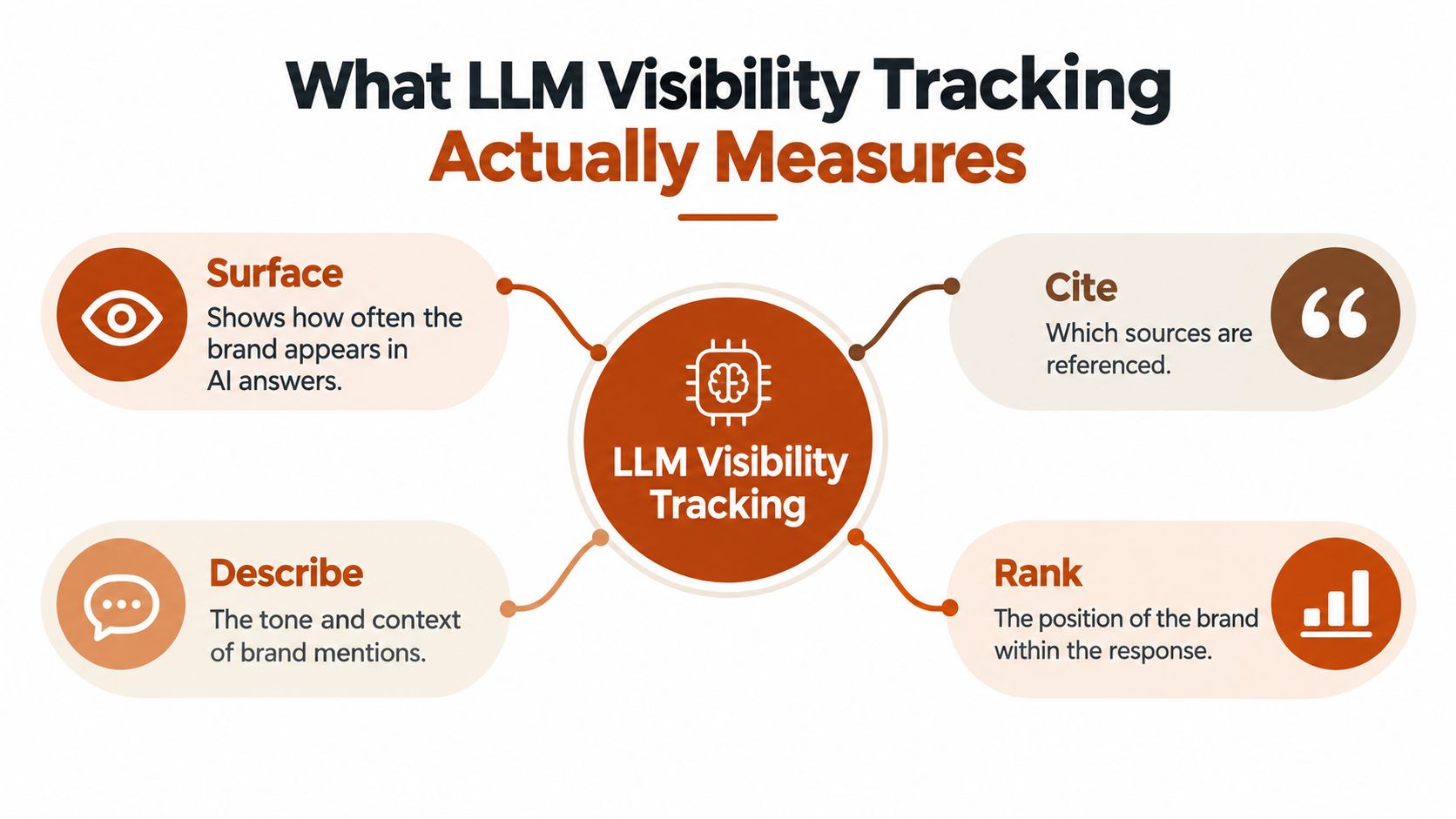
LLM visibility tracking is the systematic measurement of how AI assistants surface, cite, describe, and position a brand across a fixed set of customer questions over time. It isn’t a tally of screenshots, a ranking report for chatbots, or a test of whichever prompt someone tried that morning. A defensible program gives every answer a defined question, engine, context, and scoring method.
Measure three layers separately:
- Presence: Did the answer name the brand? Record whether the mention appears, where it appears in the response, and whether the assistant recommends it or merely includes it in passing.
- Accuracy: Did the assistant describe the business correctly? Score key attributes such as products, services, location, audience, and relevant differentiators against an agreed source of truth.
- Influence: Did the answer support qualified demand? Connect the prompt and recommendation context to branded search, direct traffic, assisted conversions, and sales-qualified outcomes where the available analytics allow it.
These layers need different evidence. Presence is observable in the answer itself. Accuracy requires human review against business facts and source material. Influence requires joining answer-level findings to commercial indicators, not assuming that a mention caused a sale.
Classic share of voice is too blunt to stand alone. A brand can gain mentions while being mischaracterized, or lose citations while still appearing in recommendations. Keep a versioned question set, then segment results by engine because ChatGPT, Perplexity, and Google AI Mode can surface different sources and answer the same question differently.
The boundary of the program matters, too. Decide in advance which customer questions, engines, markets, competitors, and brand attributes are in scope. Don’t count a generic mention as a recommendation, a citation as proof of accuracy, or a movement in one engine as a universal change. A practical guide to checking what AI says about your business can help teams turn informal spot checks into a repeatable audit.
Designing the Sample Query Set
Your measurement is only as credible as the questions behind it. Build a fixed, versioned query set from real buyer language, not a collection of prompts designed to make the brand look good. The questions should cover the journey from learning about a category to deciding which provider to choose.
Start with four intent buckets:
| Intent bucket | Example prompt | What to record | Local variant example |
|---|---|---|---|
| Discovery | “What should a mid-sized company look for in a customer support platform?” | Category criteria, brands named, sources cited | “What should a small business in Denver look for in a customer support provider?” |
| Comparison | “Compare [Brand] with [Competitor] for teams that need implementation support.” | Comparison claims, differentiators, omissions | “Compare these providers for businesses in Austin.” |
| Best provider | “Which providers are strongest for [specific use case], and why?” | Recommendation, rationale, position in the answer | “Who are the best providers for [service] in [city]?” |
| Purchase intent | “What should I check before choosing a [product or service]?” | Buying criteria, brand fit, next-step guidance | “What should I ask a [service provider] before booking in [city]?” |
Write prompts so each engine receives the same question and comparable context. Keep phrasing stable between measurement cycles; if a prompt changes, version it rather than replacing the old question without notice. You can add a separate exploratory set for new customer language, but don’t blend those results into the baseline until you’ve decided whether to promote the prompts into the tracked cohort.
Local-service and regulated businesses need variants that test the claims most likely to affect a buyer’s decision. Ask about service areas, qualifications, availability, and appropriate use cases. For a multi-location company, test whether the assistant names the correct location rather than treating every branch as interchangeable.
Practical rule: Measure the questions your sales team hears, the objections your website answers, and the comparisons buyers make. If your prompt set never tests those moments, your dashboard is measuring the wrong market.
There’s no universal question count that makes a sample defensible. Start with a manageable set that covers priority topics and intent buckets, then expand when a gap appears in sales conversations, customer research, or answer audits. Keep the core cohort stable so month-to-month comparisons remain useful.
Controlling the Sampling Conditions
A single assistant answer is a noisy observation, not a ranking signal. Repeating a question can produce different wording, sources, and brand positions. Experimental research reports that repeated outputs can disagree substantially, and one study describes borderline judgments that differed by up to approximately 50% across 20 identical runs when temperature and randomization controls weren’t fixed. Research on repeatability in LLM outputs supports a simple operating principle: control the test before interpreting the result.
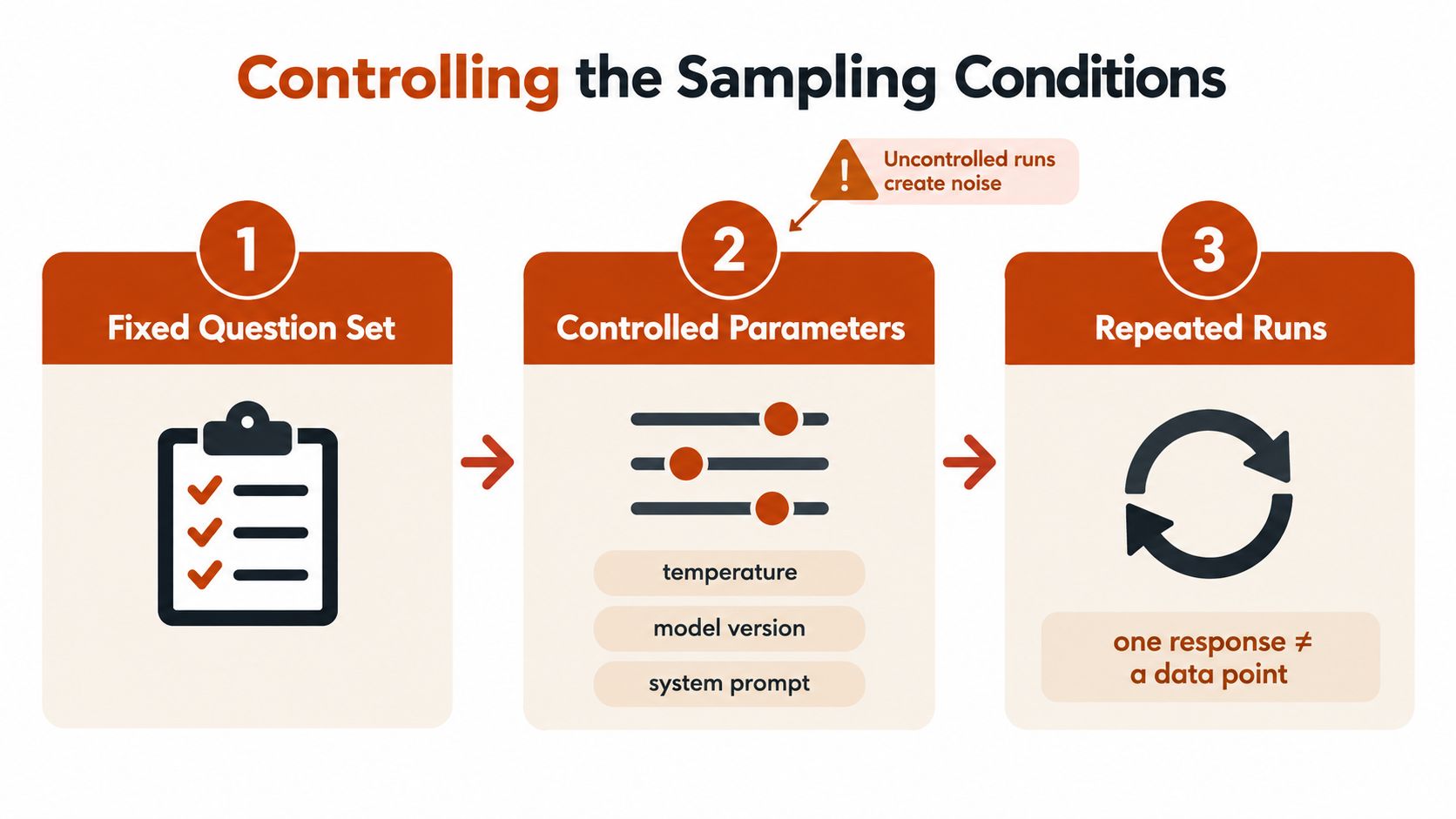
For each run, log the prompt version, engine and model identity, timestamp, locale, and temperature or equivalent settings when available. Keep the question fixed across replicates. Use temperature-zero or low-temperature settings where the platform permits, but don’t treat that as a guarantee of identical responses: model architecture and provider backends can still introduce variation.
Make the run record auditable
An analyst or agency should be able to reproduce the test conditions from the record. Store the full response, cited sources, and scoring decisions alongside the run metadata. If an engine changes its model or response behavior, note the change; don’t present the resulting comparison as if every other condition were constant.
Run multiple replicates per question and calculate an estimated mention probability: the share of runs in which the brand is named, correctly described, and associated with a source. Track run-to-run variance and show confidence intervals where possible. For questions where competitors alternate position, report that instability instead of declaring a winner from a single response.
Temperature-zero execution improves consistency but doesn’t eliminate variation. Prompt paraphrases can also introduce instability, which is why exploratory paraphrases belong in a separate test rather than being mixed into the fixed monthly cohort. When a finding is borderline or competitor ordering shifts across runs, widen the sample before calling it progress or decline.
A CMO doesn’t need raw generations in the executive summary. They do need to know whether measured movement exceeds ordinary variation, which question clusters changed, and whether the change is consistent across engines. Without those controls, a reporting system can mistake response noise for an AEO win.
Tracking Citation Quality, Not Just Citation Presence
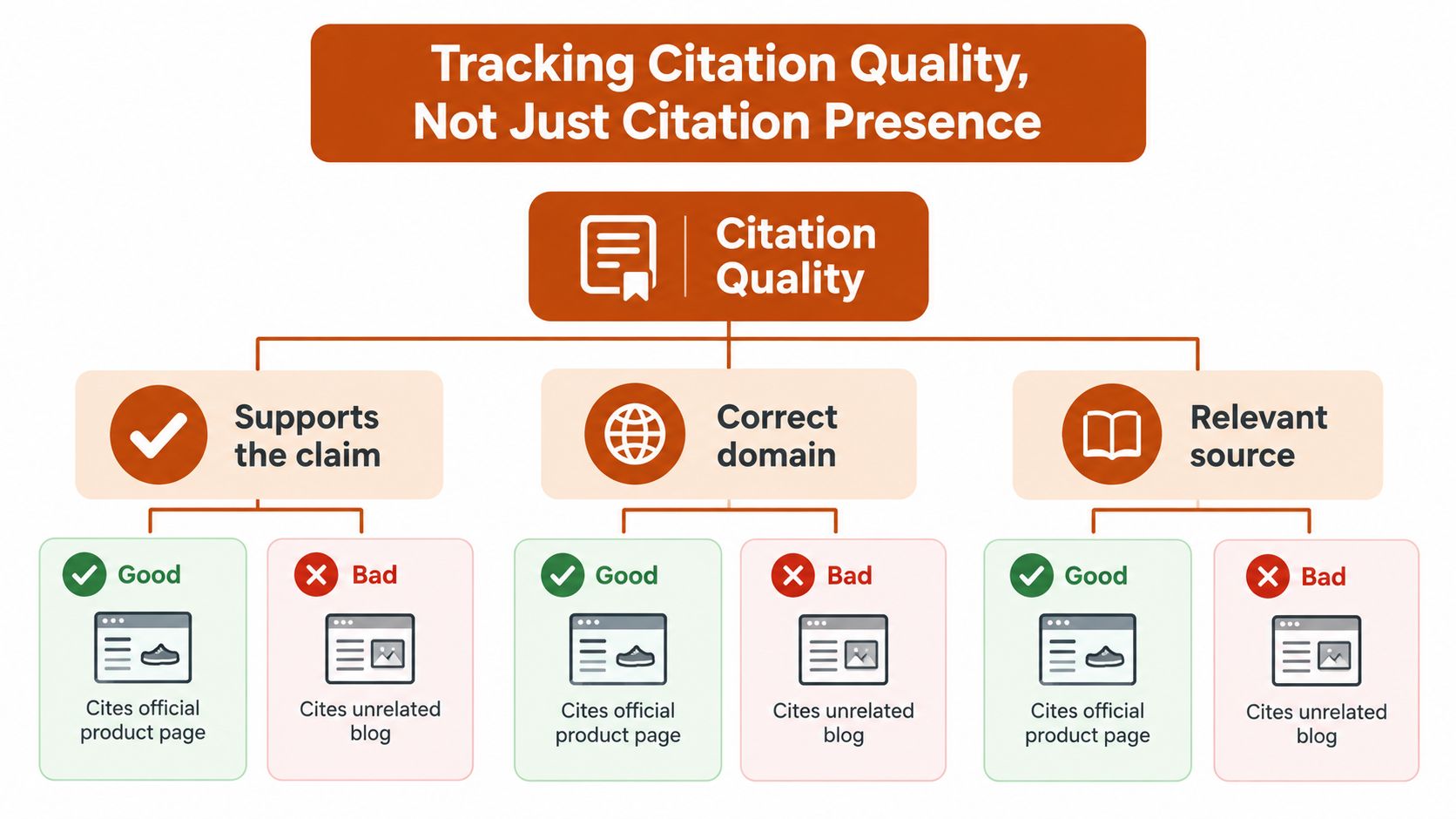
A citation can appear beside a recommendation and still fail to support it. That makes raw citation count a vanity metric unless someone checks what the source says. The ALCE benchmark evaluates fluency, factual correctness, and citation quality as separate dimensions; on the ELI5 dataset, even leading systems lacked complete citation support in roughly 50% of cases. The ALCE benchmark for evaluating citations in generated answers reinforces why presence and support must be scored independently.
Use a scorecard that distinguishes exposure from trustworthiness:
- Mention rate: How often the brand is named across the tracked runs.
- Recommendation rate: How often the answer actively recommends the brand for the relevant need.
- Factual-attribute accuracy: Whether the response gets core business details right.
- Citation-support rate: Whether cited sources substantiate the specific claim or recommendation.
- Source diversity: Whether answers rely on a range of relevant domains or repeatedly draw from a narrow set.
For each displayed source, record its domain, page type, freshness, the claim it appears to support, and whether it entails that claim. A citation to an official product page may support a product feature; an unrelated blog mention may not support a recommendation about suitability. Do not award credit just because a URL is present.
Audit drift and appropriate restraint
Review whether descriptions change across related prompts and follow-ups. A service area, qualification, price, or product attribute can drift in ways that matter more than simple omission, particularly for regulated, technical, local-service, and multi-location businesses.
An assistant’s decision to abstain when evidence is weak is also a quality signal. One 2026 PLOS Digital Health study found that citation validity and answer accuracy were independent, so a valid-looking source doesn’t establish that the answer is correct. The PLOS Digital Health research on citation validity and answer accuracy makes the case for auditing the claim, not just the link.
A brand with fewer citations but consistently accurate descriptions and well-supported recommendations can have healthier AI visibility than a frequently mentioned brand in unreliable contexts. For the operational response to incorrect descriptions, see what to do when AI describes your business incorrectly.
Measuring Demand Beyond Rankings and Clicks
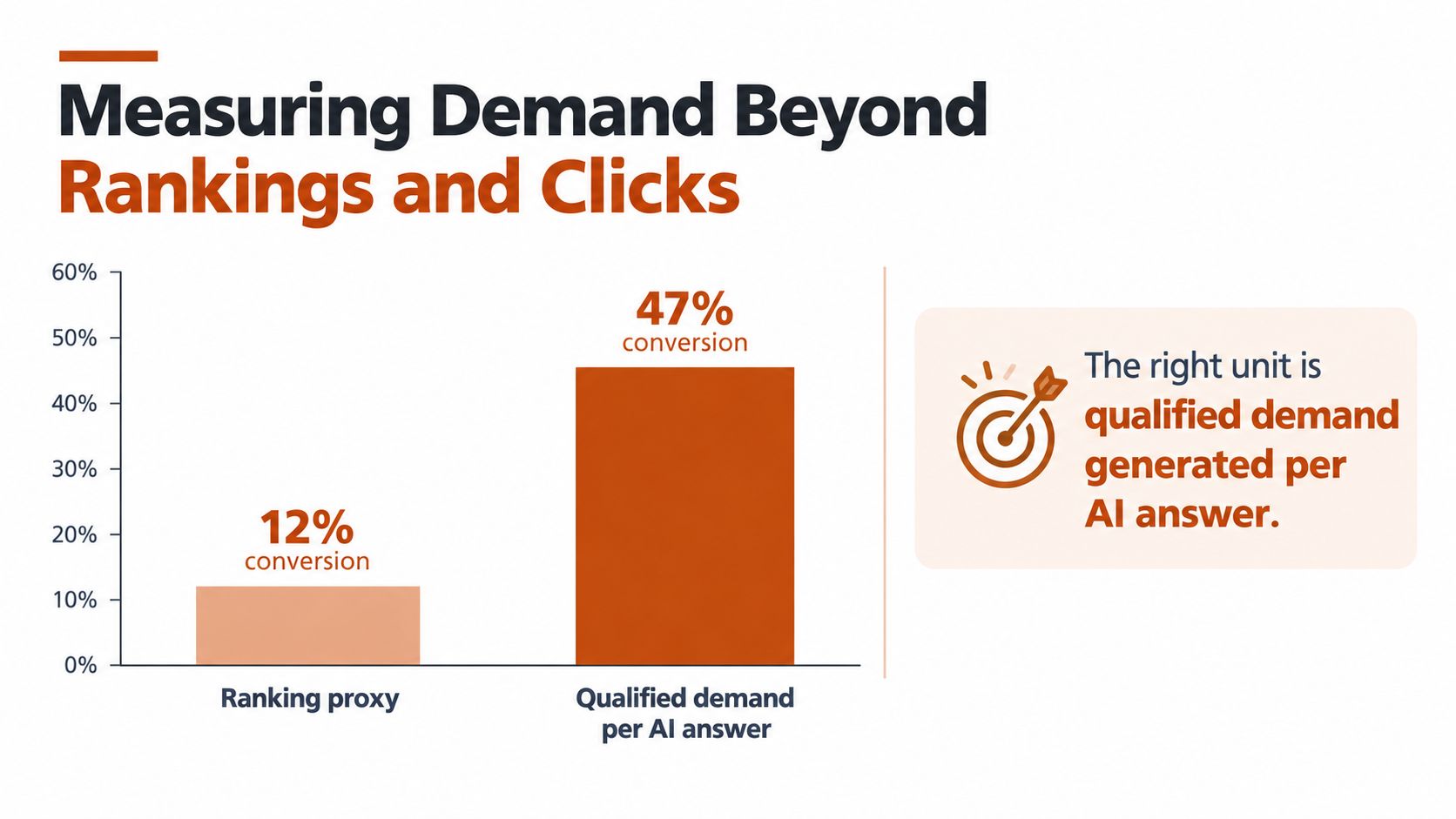
A CMO can read a strong rankings report and still be losing ground in AI answers. The two systems reward different things, and the overlap is thinner than most dashboards assume. An August 2025 Ahrefs study of 15,000 long-tail queries sent to four assistants found that only 12% of cited URLs also ranked in Google’s top ten for the same query, and that clicks on traditional results fell from 15% to 8% when a Google AI summary appeared. The analysis of LLM visibility metrics that matter is a useful corrective for any team still treating a page-one position as proof of AI presence.
Clicks understate the problem further. Pew Research Center found that searches with AI Overviews produced a median zero-click rate of 80%, compared with 60% for searches without them. Pew’s research on AI summaries and click behavior means an answer can shape a buyer’s shortlist while leaving no session in your analytics.
Run this like an experiment, not a reporting pull. For each prompt in your fixed set, record recommendation position, competitor share, answer sentiment, factual accuracy, and cited-source type, then hold the sampling conditions constant so month-to-month movement means something. Connect those signals to branded-search volume, direct traffic, assisted conversions, and sales-qualified outcomes where your analytics can support the relationship.
Segment by intent. Discovery, comparison, best-provider, and purchase-intent prompts influence demand at different points in the buying cycle, and a blended average hides where your visibility is doing commercial work.
Qualified demand per AI answer is the question worth putting in front of executives. Whether the answer reaches the right buyer, frames the brand accurately, and coincides with movement in commercial indicators tells you more than a citation count ever will.
Report the direction of the evidence and the limits of attribution on the same slide. Claiming an AI answer caused a conversion you cannot tie to it is the fastest way to lose credibility for the whole program.
The Month-One Operating Rhythm
A credible program needs a recurring operating rhythm, not a one-off audit. Use the first month to establish the baseline, confirm technical eligibility, compare competitors, and assign actions to findings. Then preserve the same core measurement conditions so the next report has a fair comparison.
Establish the baseline and technical floor
Capture the fixed prompt set across priority engines, save complete responses and citations, and score presence, accuracy, and influence separately. Overlay relevant competitors on the same questions. This gives the team a comparative view of where it appears, where another brand is recommended, and which sources shape the answer.
Check the technical basics before attributing changes to content. Google says pages must be indexed and eligible to appear in Search with a snippet to qualify as supporting links in AI Overviews or AI Mode. Its guidance also emphasizes crawler access and consistency between structured data and visible page text, and says no special AI markup or dedicated machine-readable file is required. Google’s documentation for AI features in Search is the right baseline for eligibility checks.
Turn findings into an action list
Audit robots.txt permissions separately for OAI-SearchBot and GPTBot. OpenAI documents that publishers can allow OAI-SearchBot for consideration in search results while disallowing GPTBot, which crawls content that may be used to improve generative AI foundation models. OpenAI’s crawler documentation makes clear that these permissions serve different purposes, so your audit should reflect the intended outcome for each.
Before making a content change, verify that priority pages are indexable, eligible for ordinary search snippets, accessible to intended crawlers, and consistent between structured data and rendered content. Then connect each recommendation to a specific gap in the data, such as an inaccurate service detail, unsupported citation, or missing answer to a priority buyer question.
The monthly report should give executives a concise decision view, not a raw export:
- Executive summary: The clearest movement, risk, and business implication.
- Engine-by-engine table: Presence, recommendation, and accuracy changes by platform.
- Citation-quality scorecard: Whether sources support claims and remain relevant.
- Competitor overlay: Which brands appear in the same answers and how they’re positioned.
- Prioritized actions: The specific technical, content, or authority issue each action addresses.
This cadence makes the report useful because each finding leads to a decision. Keep the baseline stable, record changes to prompts or engines, and revisit the action list at the next measurement cycle.
AnswerLion builds AEO programs around documented baselines, answer-first content, technical readiness, citation quality, and recurring multi-engine measurement. Visit AnswerLion to assess how AI assistants describe your business and build a measurement program that connects those answers to meaningful demand.