 AnswerLion
generative engine optimization agency
Generative Engine Optimization Agency: What They Deliver
Learn what a generative engine optimization agency actually delivers, how it differs from a traditional SEO firm, and how to evaluate the right partner
Published · Updated · By AnswerLion
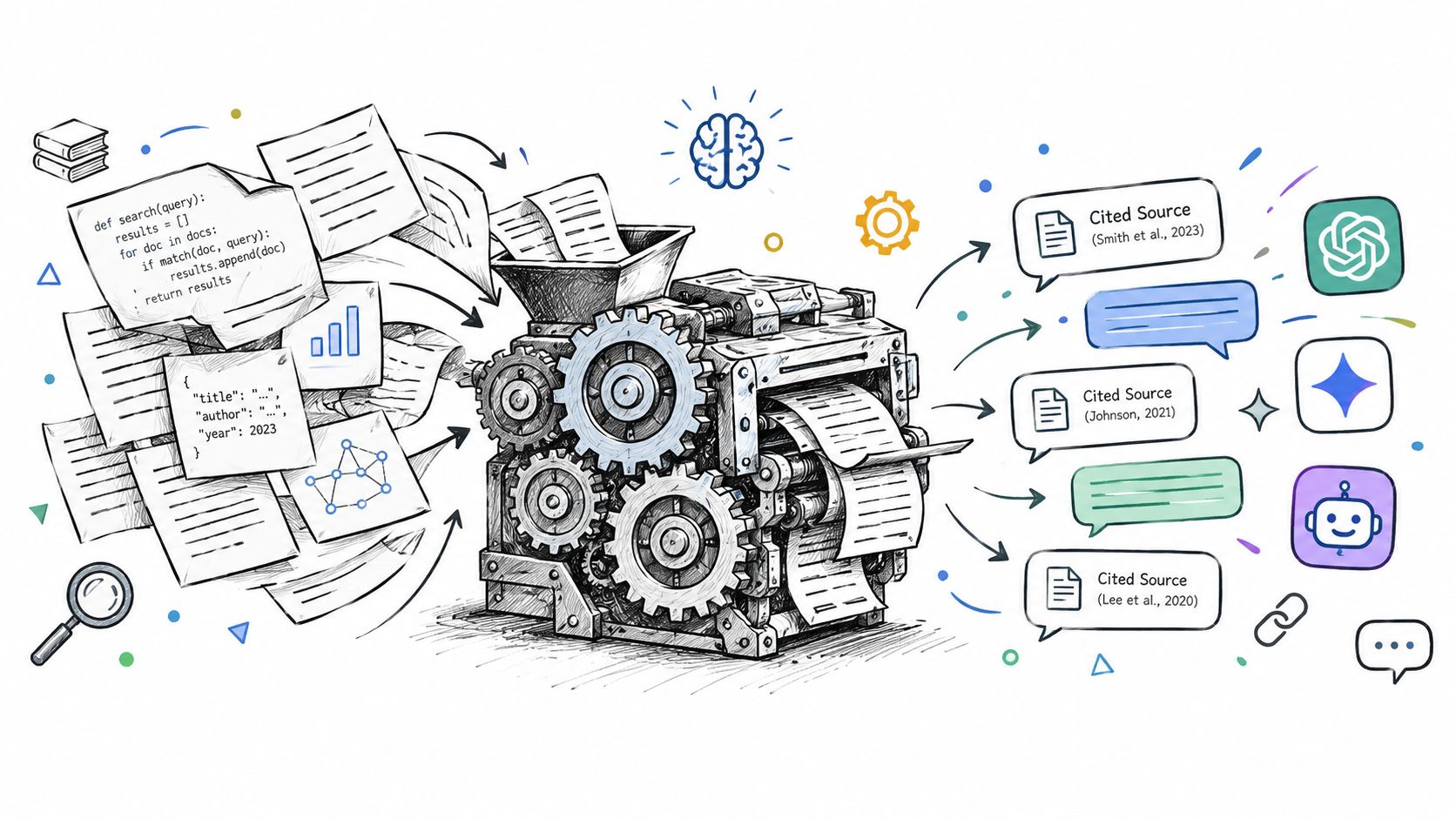
Your CEO has probably asked the same question in slightly different words three times already. A competitor shows up in ChatGPT, a summary in Google sounds too confident, and your own brand is either missing or described like it’s two companies merged into one. That’s the moment a generative engine optimization agency stops sounding abstract and starts looking like a necessary part of the growth stack.
The work is simple to say and harder to do well. A serious agency does not chase vague “AI rankings.” It audits how AI systems currently describe your brand, fixes the factual gaps that cause omission or confusion, and tracks whether the right answer is showing up across engines over time. The prize is different now, too, because the goal isn’t only to win a click on a results page, it’s to be named accurately inside the answer itself.
Table of Contents
- The Moment a CMO Realizes AI Is a Channel
- What Generative Engine Optimization Actually Means
- How a GEO Agency Differs from a Traditional SEO Firm
- The Baseline Audit as the First Deliverable
- Answer-First Content and Technical Readiness
- Authority, Citations, and Local Accuracy
- Monitoring as an Attribution Loop
- Choosing the Right GEO Agency and What the First 90 Days Look Like
The Moment a CMO Realizes AI Is a Channel
The first sign is usually a messy one. Someone on the marketing team asks ChatGPT which vendors to consider in your category, and your company doesn’t appear until the follow-up prompt. Then a competitor shows up twice, a second competitor gets a flattering description, and your own brand is either absent or summarized with stale facts.
That’s not a branding nuisance. It’s a signal that the market is already forming opinions inside AI interfaces, before a buyer ever reaches your site. Google has already pushed AI Overviews beyond a narrow experiment, expanding them to more than 100 countries and territories in October 2024 and to more than 200 countries and territories and over 40 languages by May 2025, while also reporting a more than 10% increase in Google usage in major markets for query categories where the feature appeared Google’s October 2024 AI Overviews update.
Why this changes the agency conversation
A traditional SEO retainer was built around pages, links, and ranking. A generative engine optimization agency works one layer earlier in the funnel, where the system decides whether your business is understandable enough to quote. That means the brief is not “help us get more traffic” in the usual sense, it’s “help us get represented correctly when the answer is already being written for the user.”
Practical rule: if a buyer can ask a model a category question and get a shortlist without visiting ten blue links, your brand needs visibility work that reaches inside the answer layer.
The distinction matters because leaders often assume AI visibility is just SEO with a new name. It isn’t. Traditional SEO still matters, but the agency you hire now has to think in terms of answer quality, source selection, entity clarity, and cross-engine consistency. If the business is hard for machines to parse, the best content strategy in the world won’t fix the gap on its own.
What separates the discipline from older search work is the reporting question. Instead of asking only where a page ranks, the better question is whether the brand was named, whether the answer was accurate, and whether the cited source was defensible. That’s the frame that turns a CEO’s casual ChatGPT complaint into a real operating problem.
What Generative Engine Optimization Actually Means
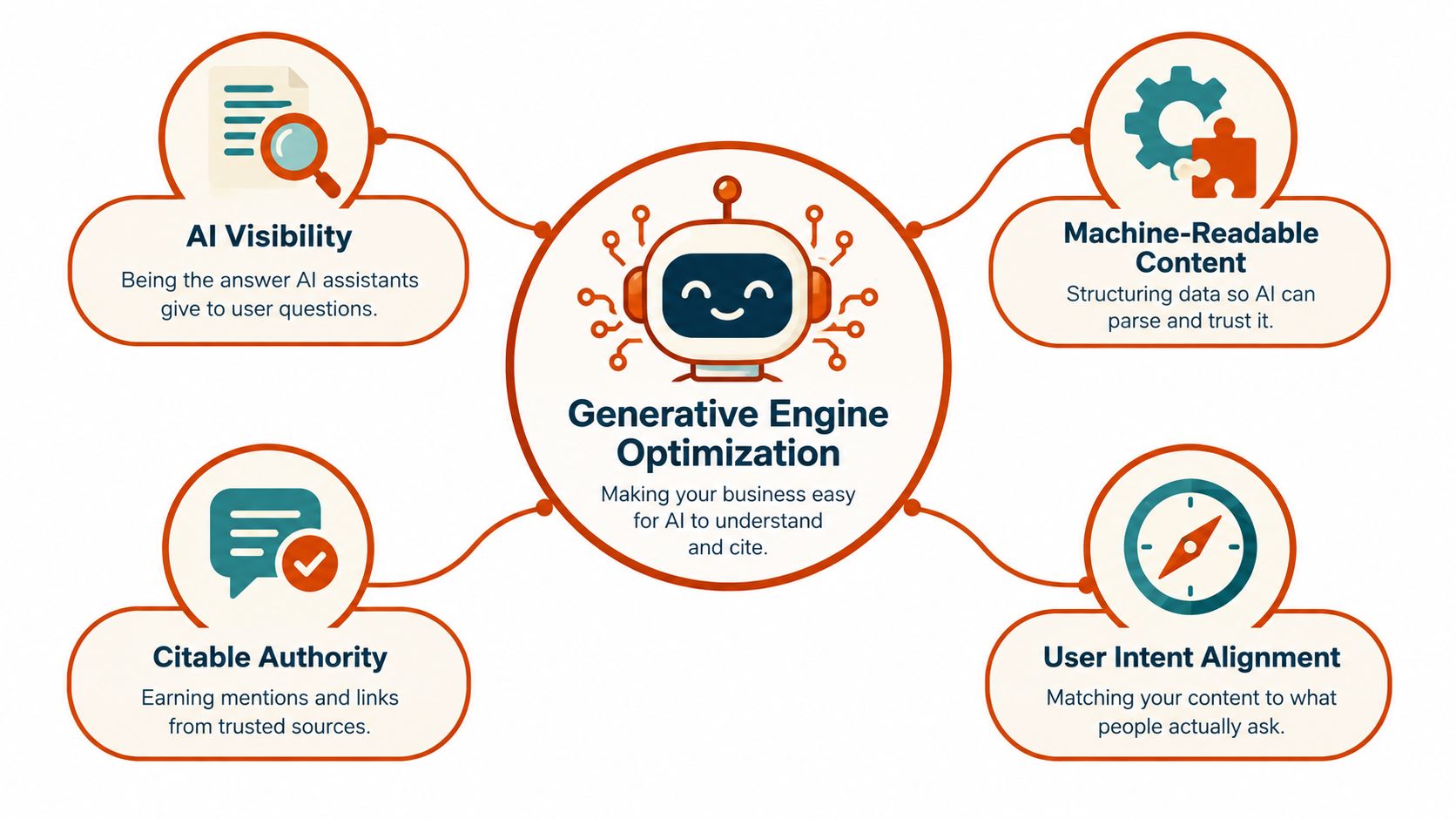
Generative engine optimization means making your business easy for AI systems to understand, trust, and cite. People use different labels for the same discipline, including AEO and LLM SEO, but the work is the same, helping generative systems represent your company accurately when they answer a question.
The engines themselves work through a mix of stored knowledge, live retrieval, and source-grounded synthesis. That matters because the answer is not built only from one webpage or one backlink profile. It is assembled from the content the system can retrieve, the facts it can extract, and the sources it considers reliable enough to mention. That is why clean language, stable entity facts, and accessible pages matter so much.
The new prize is a mention inside the answer
The old prize was ranking on a results page and earning the click. The new prize is showing up in the answer layer itself, where a user may get what they need without ever scanning a traditional SERP. Google’s documentation on AI features makes the technical side clear, pages have to be indexed and eligible for ordinary Search snippets before they can support links in AI Overviews or AI Mode, and Google says there’s no special Schema.org markup or new AI-specific file required for generative visibility Google’s AI features guidance.
That’s why this work lands on tools like ChatGPT, Google AI Overviews, Google AI Mode, Claude, and Perplexity. Buyers are already asking category, comparison, and “best for” questions in those places. The job of the agency is to improve the odds that your business becomes the answer, or at least one of the correctly framed options in the answer.
AI visibility is less about tricking a model and more about removing ambiguity. The cleaner your facts, the easier it is for the system to cite you with confidence.
This is also why content strategy looks different from classic SEO. A page can be well written and still fail if it buries the core fact, leaves out a critical service detail, or forces the model to infer what should have been stated plainly. GEO rewards clarity, not just depth.
How a GEO Agency Differs from a Traditional SEO Firm
A good generative engine optimization agency doesn’t replace SEO, it sits on top of it. The overlap is real, but the unit of success changes, and that changes how the team works, what it reports, and what gets prioritized first.
| Dimension | Traditional SEO | Generative Engine Optimization |
|---|---|---|
| Output | Ranking and click growth | Mention and accurate representation inside an answer |
| Primary target | Search engine results pages | AI-generated answers and answer layers |
| What gets optimized | Links, on-page relevance, technical performance | Machine-readable clarity, citations, and factual consistency |
| Typical signal time | Months | Weeks to early signal, then compounding movement |
| Main report artifact | Rank tracker and organic traffic | Multi-engine mention tracking and citation quality |
| Technical focus | Crawlability, internal links, backlinks, site architecture | Index eligibility, structured data, server-rendered clarity, and source trust |
The overlap matters because GEO is not a shortcut around fundamentals. If the site is weak, thin, or inaccessible, the AI layer has less to work with. But the emphasis shifts from “how do we get this URL to rank?” to “how do we make this business easy to quote correctly?”
What marketing leaders notice in practice
Traditional SEO teams often start with keywords and page groups. GEO teams start with questions, because the answer format drives the work. They want to know how your company is described, which competitors are recommended instead, and which facts are missing from the pages that should settle the question.
That means the operating rhythm changes too. A rank tracker gives you a position. A GEO program gives you a view of mention movement across engines, along with the evidence that explains why the model said what it said. That’s a much more useful artifact when the CEO asks why ChatGPT prefers a competitor with weaker traffic but stronger external corroboration.
The difference also shows up in what the agency spends time on. SEO is often weighted toward internal improvements and link acquisition. GEO spends more time harmonizing entity facts, rewriting answer sections, fixing listings, and validating whether third-party references support the same story your site tells.
This comparison also sits alongside a stronger technical breakdown of AI visibility shifts, which is useful if you’re deciding whether your current SEO partner can carry the load.
The Baseline Audit as the First Deliverable
The first real deliverable isn’t content. It’s a documented baseline of what AI systems already say about the business, run across the questions that matter most commercially. If the agency skips this, it’s guessing, and guessing in this category gets expensive fast.
What gets measured before anything changes
The audit should start with the exact questions buyers ask, not only the ones the marketing team prefers. A serious team runs those prompts in fresh sessions across relevant engines, records who is named, who’s omitted, what facts are misstated, and which competitors appear instead.
That creates a punch list, not just a report. Some questions reveal missing service details. Others show that the engine is pulling the wrong location, the wrong audience, or the wrong comparison set. The value is in tracing each problem back to the page, profile, or external source that needs to change.
A useful baseline has to capture source behavior too. It’s not enough to know that your company was mentioned. You need to know whether the model gave a citation, surfaced a third-party reference, or substituted a competitor with stronger corroboration elsewhere on the web. That’s the point where mention tracking becomes an attribution problem, not a vanity metric.
Operational checkpoint: the best baseline includes the prompt, the engine, the session state, the answer text, the cited source, and the exact fact that was missing or wrong.
Why fresh sessions matter
Fresh sessions matter because personalization can make a bad answer look good. A signed-in account, a history of brand searches, or prior custom instructions can distort what a buyer would see. Agencies that ignore session state end up reporting flattering noise instead of market reality.
That’s why the baseline should be repeatable. The same prompts should be re-run in clean conditions so you can compare movement over time and distinguish genuine improvement from one-off variability. Once the baseline exists, the agency can prioritize the fixes that will move the answer set fastest.
The strongest audits end with a specific sequence. First, fix the pages that are easiest to understand wrongly. Then fix the facts that are easiest to corroborate externally. Then measure again. That’s how a baseline becomes a growth plan instead of a slide deck.
Answer-First Content and Technical Readiness
Once the audit exposes the gaps, the rewrite work starts with the answer itself. The opening line should answer one question directly, not bury it under context. Supporting facts follow immediately, then a small FAQ or clarification block captures the variations the model is likely to infer.
The content pattern that works
Answer-first pages are built to be quoted. The first sentence states the core claim clearly, the next few sentences add specifics, and the FAQ section handles adjacent questions like pricing model, geography, implementation, or who the service is for. This structure makes it easier for a system to extract a clean statement and less likely that it will misread the page.
That approach works best when the language is stable. If your service description changes every quarter, the machine sees a moving target. If your page says one thing, your LinkedIn profile says another, and your directory listings say a third, the model has to choose between them, and that’s where competitors often win by being more consistent.
The technical stack follows the copy, not the other way around. Google’s structured data guidance says pages should be accessible to Googlebot, not blocked by robots.txt or noindex, and the markup has to include required properties, match the page’s main content, and use current original information Google’s structured data policies. That makes crawlability and index eligibility foundational, not optional polish.
The readiness checklist
A good agency sequences the work in the right order:
- Server-rendered HTML first: make sure important text is present in the rendered page, not hidden behind scripts that dilute accessibility.
- Indexability next: confirm the page can be indexed and isn’t blocked by noindex, robots.txt, or other access restrictions.
- Schema after that: implement Organization, Service, FAQ, and Article markup where it fits the content.
- Machine-readable summaries: publish an llms.txt summary so systems and tools can find the most important business facts quickly.
- Validation last: check the implementation with Google’s testing tools and inspect the live URL after deployment.
Google also notes that there’s no special Schema.org format or AI-specific text file required for AI features, which is important because some vendors try to sell speculative markup as if it were a direct solution. Schema helps machines understand the page, but it doesn’t replace crawl access, plain-language facts, or a page that answers the question.
If a page can’t be crawled cleanly, no amount of elegant schema will rescue it.
That’s the sequence that separates practical operators from generic SEO vendors. The work starts with answer clarity, then removes technical barriers, then gives the machine a better semantic map of the page.
Authority, Citations, and Local Accuracy
The part of GEO that gets mislabeled as link building is really about corroboration. The agency is making sure the business’s facts show up consistently enough across the web for the engine to trust them.
That work lives across directory listings, publication mentions, review-site profiles, and location pages. If the site says one thing and other profiles say something older, AI systems can drift toward the stale version. The risk rises fast for local and multi-location businesses, where service areas, branch addresses, and review themes are easy to confuse.
Local accuracy is where trust breaks first
BrightLocal reported that consumers using AI to find local business recommendations rose from 6% in 2025 to 45% in 2026, and that 97% of AI users sometimes double-checked recommendations against reviews BrightLocal’s AI trust research. That makes entity consistency across profiles more than housekeeping. If the answer layer recommends a branch, it has to know which branch exists, what it offers, and what limits apply.
A strong agency program audits the full entity footprint. That includes location pages, review platforms, business profiles, directory listings, and structured data. It also tests prompts that ask for nearby options, service-area-specific providers, and branch-level recommendations, because those queries are more likely to expose inconsistency.
The local angle also demands post-recommendation verification. In the same BrightLocal research, 62% of users searched Google for more information, 58% visited the business website, and 52% clicked cited sources after receiving an AI recommendation. The answer is only part of the job. The landing page and the profile it points to still need to confirm the recommendation quickly.
What authority work actually includes
This part of the engagement usually includes three moves. First, correct the public-facing profiles so the facts line up. Second, seek relevant third-party references that reinforce the same entity story. Third, monitor whether the engines are echoing the improved version or still carrying old descriptions forward.
If your business has already been described incorrectly by AI, this is the kind of cleanup work that matters most. The value is reputation management and reduced ambiguity across the sources the models use to form a recommendation.
When this work is done well, the business looks coherent everywhere it appears. That coherence matters because it lowers the odds of a wrong answer.
Monitoring as an Attribution Loop
A dashboard that shows a 40% citation rate looks like a win until you check whether the cited page supports the claim the model repeated. That gap is where most reporting fails. Monitoring has to work like an evidence trail, not a traffic report. Each priority question gets rerun on a recurring cadence, and the agency records whether the brand was named, which competitor appeared, what facts were covered, and whether the cited source backed the answer.
What gets scored over time
A useful monitoring system separates mention rate from evidence quality. The team does not just count how often the brand appears, it checks whether the answer contains the right facts and whether the citation supports them. NIST’s TREC 2024 RAG track frames answer generation as a pipeline that retrieves evidence, synthesizes an answer, and attributes each sentence to supporting sources, which is the right mental model for GEO monitoring NIST TREC RAG proceedings.
That framework makes the report more useful for CMOs. Instead of one blended score, the dashboard should show retrieval presence, factual coverage, competitor inclusion, and citation quality. Those are different failure modes, and they need different fixes.
The better agencies do not stop at the answer screenshot. They compare runs over time, note when a competitor enters or exits the answer set, and flag when an engine changes behavior after a crawl or model update. That gives leadership a movement story instead of a single snapshot.
Measurement rule: if you can’t tell whether the brand was omitted, mischaracterized, or outcompeted, you do not have a visibility report, you have an anecdote.
Why clicks are not enough
A high citation rate does not automatically mean a strong traffic story, and AI-visible exposure can be volatile. A Search Engine Land analysis of AI Overview referral behavior reported that AI Overview traffic represented 7.53% of organic sessions overall, reaching roughly 16 to 17% at its February to March 2026 peak, while some visits were misclassified in analytics Search Engine Land’s AI Overview data analysis.
That is why the reporting loop should include assisted conversions and post-recommendation behavior, not just raw clicks. Some users read the answer, verify it elsewhere, and convert later. Others never click the summary at all. If the dashboard only rewards direct traffic, it misses the influence of the visibility work.
The practical way to start is to learn how to check what AI says about your business yourself, then hand the recurring cadence to the agency. A solid monitoring program treats AI visibility as a channel with attribution complexity, not a vanity channel. That is the more honest way to manage it.
Choosing the Right GEO Agency and What the First 90 Days Look Like
A serious agency should show you a documented baseline in the first week, answer-first rewrites and technical readiness work in month one, and a monthly report that compares mention movement and competitor presence across engines. If they lead with “AI rankings,” they’re simplifying a discipline that depends on measurement, not slogans.
The first 90 days should feel like a controlled operating system, not a content blast. Ask for the prompt set, the engine list, the session state, the rewrite plan, and the reporting format before you sign. If the agency can’t show how it will track change, it’s not set up for this channel.
AnswerLion builds answer-first visibility programs around the exact problems CMOs are being asked about right now, missing citations, wrong descriptions, and weak machine understanding. If you want a practical GEO and AEO partner that starts with measurement and turns it into durable fixes, visit AnswerLion.