 AnswerLion
ai visibility agency
AI Visibility Agency: What It Does and How It Is Measured
An AI visibility agency gets your business named in ChatGPT and Perplexity answers. See what it does, how it differs from SEO, and how it is measured.
Published · Updated · By AnswerLion
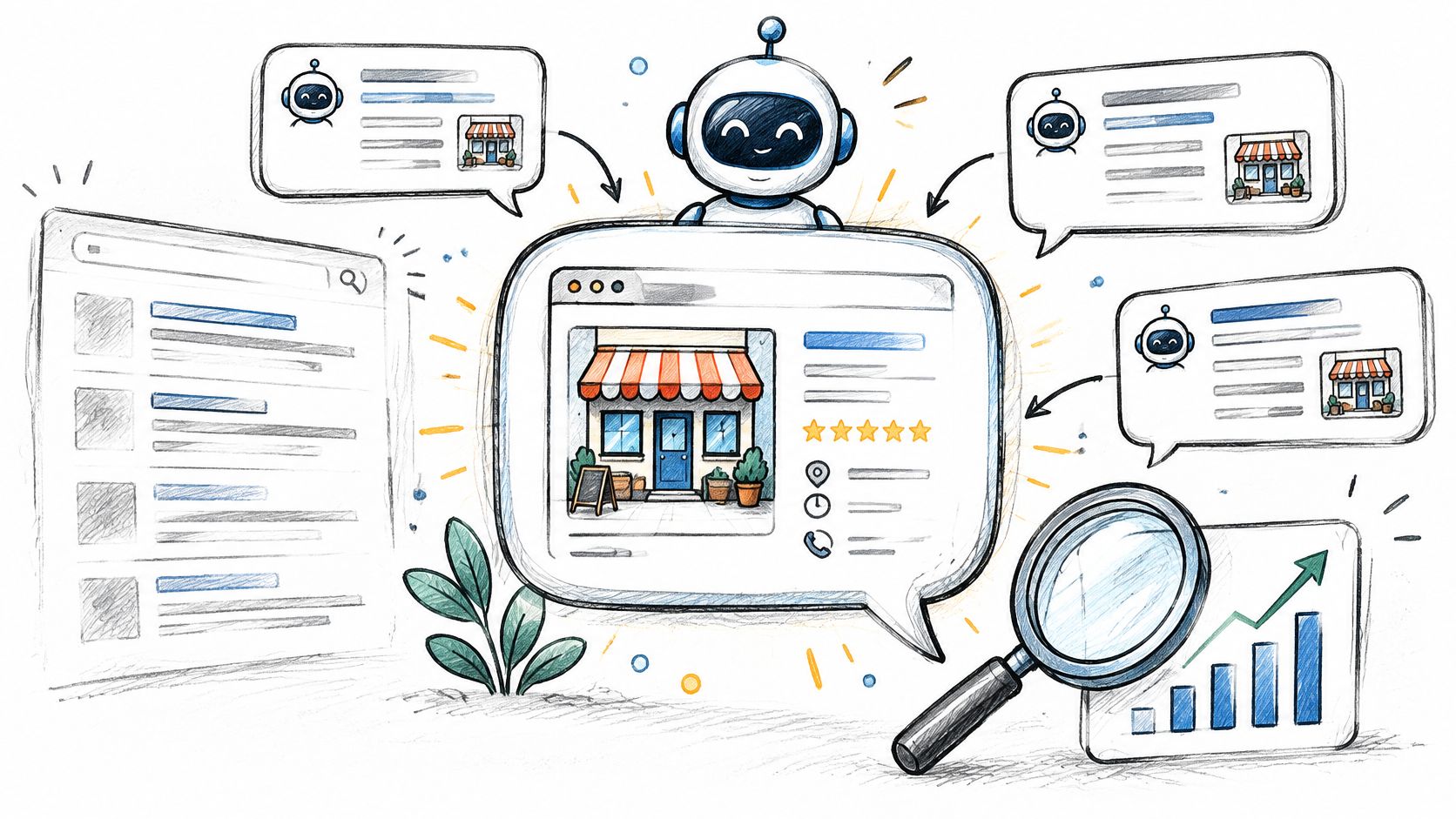
78% of surveyed organizations used AI in 2024, up from 55% in 2023, according to Stanford University's 2025 AI Index. For marketing leaders, the priority is making sure assistants can identify, explain, and recommend the business accurately when buyers ask.
An AI visibility agency should make that work measurable. The standard isn't a dashboard full of brand mentions. It's a documented connection between customer questions, the answers assistants produce, the sources they cite, and the commercial outcomes your team can observe.
What an AI Visibility Agency Delivers
An AI visibility agency structures a business's website and online presence so assistants such as ChatGPT, Google AI, Claude, and Perplexity understand the company and recommend it when people ask. We call this answer engine optimization, or AEO. You'll also see generative engine optimization, or GEO, and AI search optimization used for the same work.
The business case is concrete: 58% of participants encountered at least one Google search with an AI summary, while traditional result links received clicks in 8% of visits with a summary versus 15% without one, in Pew Research Center's analysis of approximately 68,900 searches by about 900 U.S. adults during March 2025. Ranking remains useful, but a buyer can form a shortlist before opening your website.
What you receive for the investment
Say a regional service company ranks for its main category but never appears when buyers ask assistants for a specialist. The agency's job is to identify the missing evidence, fix it, and test whether the answers change.
What an AI visibility agency delivers
| Service component | What the agency does | Deliverable you receive |
|---|---|---|
| Baseline AEO audit | Runs priority customer questions across major AI engines and records who is cited | Gap analysis and prioritized fix list |
| Answer-first content | Rewrites core service, product, and location pages so the opening sentence answers one question | Rewritten pages with supporting specifics and FAQs |
| Structured data and technical setup | Implements Schema.org markup and checks crawler access | Organization, Service, FAQ, and Article markup where appropriate, sitemap and robots.txt review, llms.txt |
| Authority and citations | Reviews directory, publication, and review-site mentions and plans outreach | Corrected profiles, harmonized listings, and an outreach plan |
| Monitoring and reporting | Re-runs the same priority questions on a recurring cadence | Monthly report of positions across engines |
At AnswerLion, these services form one managed program rather than disconnected content and technical projects. Each deliverable should address an observed gap, not add another optimized page.
Run a quick check today: ask three assistants a question a real customer would ask. Save the answers and record whether your business appears, what the assistants say, and which sources support their recommendations.
How an AI Visibility Agency Differs From an SEO Agency
SEO gets a page into a list of search results. AEO gets the business named and described in the answer itself, with no ad spend. You're paying for optimization and implementation, not buying placement inside an assistant's response.
This visual summarizes the different operating priorities.
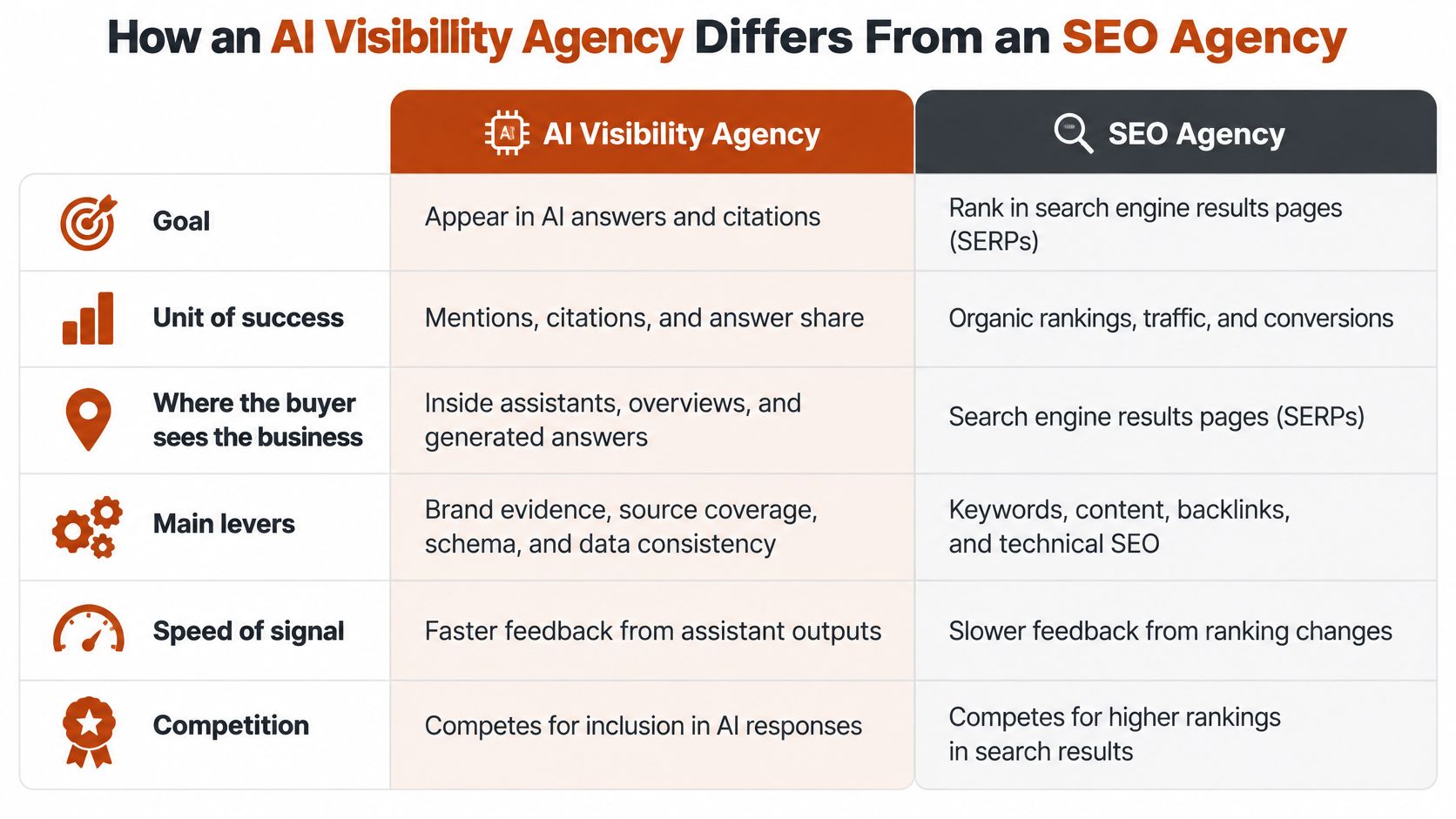
SEO agency versus AI visibility agency
| Factor | SEO agency | AI visibility agency |
|---|---|---|
| Goal | Place a page high in a list of results | Get the business named and described in the answer |
| Unit of success | Ranking position and organic traffic | Answer inclusion, citation quality, and recommendation share |
| Where the buyer sees you | A list of links | Answer text from ChatGPT, Claude, Perplexity, or Google AI |
| Main levers | Content, technical quality, and links | Direct answers, structured data, and consistent listings |
| Speed of signal | Usually measured in months | Often visible within weeks after an AI engine re-crawls the site |
| Competition | Every page targeting the same query | Most businesses in most categories haven't started |
Choose the specialist for the outcome
SEO remains the foundation. Most AI engines still draw on web search results and well-structured, credible pages, so weak technical health creates problems for both disciplines.
The gap is answer eligibility. A category page can rank well while failing to explain which customers the company serves, which use cases it supports, or what distinguishes its offer. Conflicting descriptions elsewhere can leave an assistant with competing versions of the business.
Decision rule: Start with SEO when the priority is traffic from ranked links. Add AEO when the priority is inclusion in assistant recommendations.
For many companies, the right choice is an integrated plan: SEO maintains discovery and technical quality, while AEO addresses question coverage, source consistency, and answer-level measurement. Don't fund duplicate page rewrites under separate agency retainers.
For an additional perspective on the distinction, watch the discussion below.
How AI Engines Choose Which Businesses to Name
Think of a librarian handling a recommendation request. They don't read every book in the building. They locate relevant shelves, compare suitable references, and select material that answers the question.
An assistant's process is more complex, but the analogy helps explain the optimization task. Depending on the system and request, it can draw on learned information, retrieve web sources, and synthesize an answer. The agency needs to make the business easy to identify within those sources.
Google's AI optimization guidance describes retrieval-augmented generation: its systems retrieve relevant, current pages using Search ranking systems, review specific information, and provide supporting links. That favors useful evidence tied to a question, not generic paragraphs built around a broad keyword.
From a buyer question to usable evidence
Say a homeowner asks which roofing company in Dayton handles hail-damage insurance claims. A page opening with a direct statement about that service gives the retrieval system something specific to use. A generic introduction about quality craftsmanship doesn't resolve the question.
Supporting details should explain the company's service area, inspection process, documentation support, and actual role in an insurance claim. The agency should verify those claims rather than adding services the business doesn't provide.
A large-scale study of commercial AI answers and citations found that pages whose titles and paragraphs matched user-question wording were cited more often, while commonly recommended on-site practices weren't consistently associated with higher citation rates. Treat question alignment as a content priority, not an excuse to repeat prompts mechanically.
Our explanation of how an AI answer engine works provides context for distinguishing retrieval from answer generation. For implementation, keep the rules practical:
- Match the opening to the question. State the answer before the company introduction.
- Make claims quotable. Use verified services, locations, capabilities, and conditions rather than promotional adjectives.
- Keep business details identical. Maintain consistent names and descriptions wherever the company appears.
The objective is clear evidence that an assistant can retrieve and accurately reuse.
How Agencies Measure AI Visibility Success
Start with a fixed question set, organized by buyer intent, service, product, and market. Run it across the same engines every month, preserving the exact prompts, answer text, cited URLs, and test conditions.
The scorecard should separate outcomes that agencies too often combine.
AI visibility measurement scorecard
| Metric | What it reveals | How it is captured |
|---|---|---|
| Answer inclusion | Share of priority questions where the business is named | Fixed question set run across each engine every month |
| Citation quality | Whether the cited URL is the canonical page | Log of cited URLs compared with the canonical page |
| Recommendation frequency | How often the business appears in a recommendation list | Count of recommendations per question per engine |
| Factual accuracy | Whether the description matches verified facts | Each claim checked against the canonical entity record |
| Share of voice | Mentions compared with named competitors | Competitor mentions logged in the same question set |
| Branded-search lift | Growth in searches for the business name | Search Console and analytics trend over time |
| Direct and assisted traffic | Visits and conversions from AI referrals and later sessions | Analytics reconciled with CRM data |
Separate visibility evidence from revenue attribution
A mention means the assistant named the company. A citation means it linked a supporting source. A recommendation means it presented the company as a suitable choice. None automatically means the buyer visited or purchased.
Across a sample of 95 websites, organic search generated roughly 39 times more traffic than AI assistants, according to GoGoChimp's reporting on AI search traffic. A traffic-only report therefore misses answer exposure, while a mentions-only report misses commercial performance.
Use explicit attribution labels:
- Direct effects. Identifiable AI referral visits, leads, and conversions.
- Assisted effects. Documented buyer reports or observable journeys involving AI discovery and later conversion.
- Unobservable effects. Recorded brand exposure without a traceable downstream action.
A no-click mention is measurable exposure. Its revenue contribution remains unobserved until additional evidence connects it to a buyer outcome.
Establish the baseline before publishing changes. Where practical, retain comparable question sets or markets as holdouts, and log other marketing activity that could affect branded demand. Compare treated and untreated groups rather than assigning every improvement to AEO.
Make the report useful to the CMO
Reconcile referral analytics with CRM source fields, sales notes, and buyer-reported discovery. Branded-search growth is supporting evidence, not proof that an assistant caused the increase.
Our approach to AI rank tracking focuses on repeatable observations rather than isolated screenshots. Reports are written for business owners, not other agencies: what changed, whether it's accurate, where competitors gained ground, and what action comes next.
When a mention produces no click, show the answer, its competitive context, and the attribution label. That's a defensible account of value without inventing revenue.
How an Engagement Runs From Audit to Tracking
A productive engagement turns observations into assigned fixes and verified changes. The client should always know what's being measured, who owns implementation, and what evidence will confirm progress.
The process below shows the path from initial assessment to ongoing review.
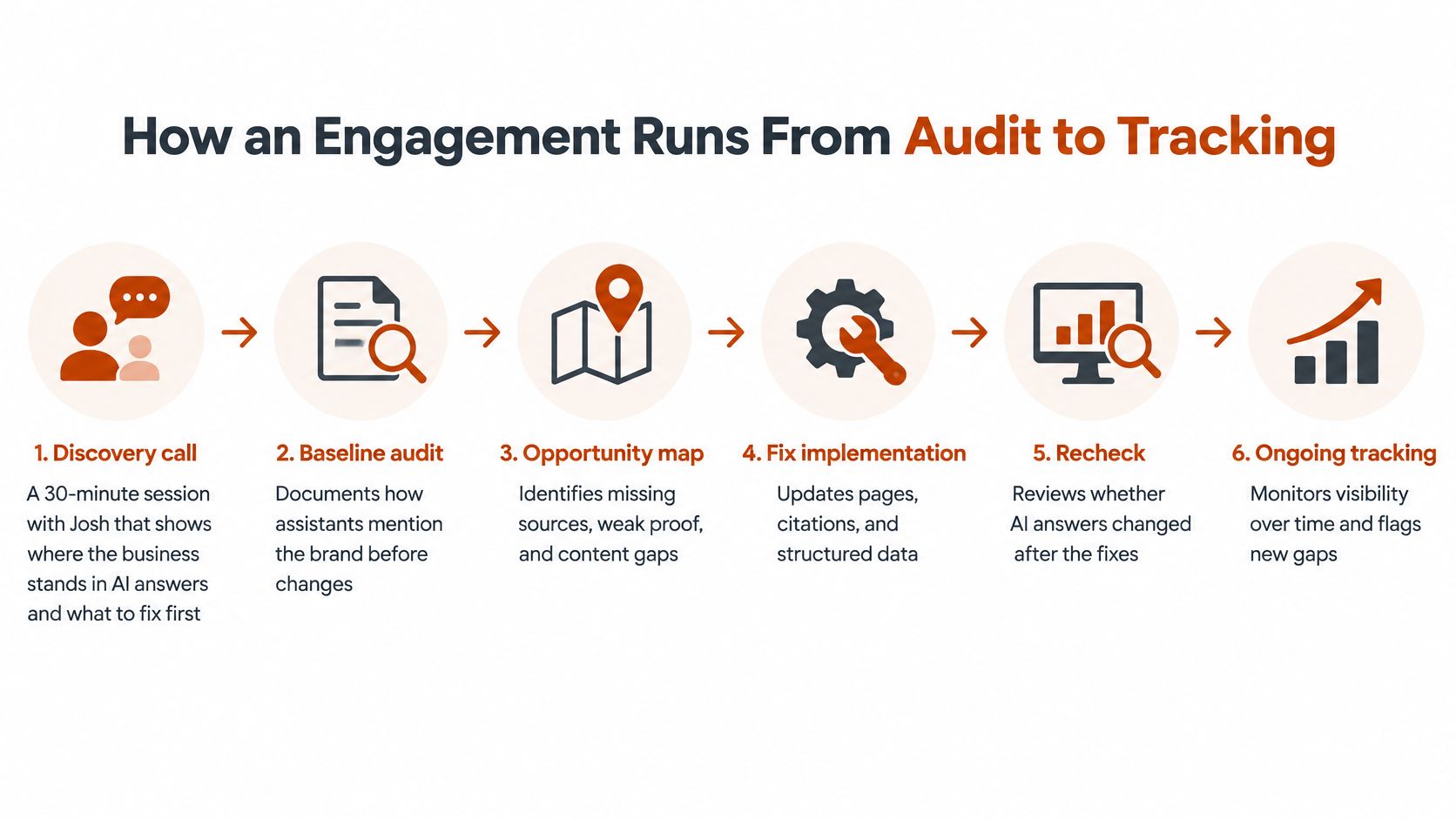
Establish the evidence before implementation
Discovery call. A 30-minute session with Josh shows where the business stands in AI answers and what to fix first. Bring your priority services, markets, and competitors so the discussion centers on commercially relevant questions.
Baseline measurement. We build the priority question set, run it across engines, and record which businesses and sources appear instead of yours. The audit itself needs no website access.
Findings and plan. The output is a prioritized fix list identifying missing or inaccurate details and the sources behind them. Before implementation, confirm robots.txt rules, CDN and authentication settings, JavaScript rendering, and server status for every priority URL; log each engine's cited URLs beside those conditions to distinguish access issues from content mismatch or source selection.
Implement, verify, and refine
Content and technical fixes. We prepare answer-first pages, appropriate schema, crawler-access changes, and an llms.txt file, then implement with site access or hand finished changes to your developer. Check indexability, rendered HTML, and sitemap coverage before treating markup as the solution.
Authority building. Correct directory and review profiles, align business descriptions, and plan outreach for relevant third-party mentions. Prioritize sources that already appear in answers to your target questions.
Tracking and iteration. Re-run the same questions every month, compare outputs with the baseline, and adjust the work queue. Keep a change log so each review connects observed movement with specific implementation work.
Google's AI-features documentation identifies Googlebot controls and confirms that no special Schema.org markup is required for AI Overviews. Structured data helps explain available content; it doesn't make an excluded page eligible for Search.
Technical priority: Adding schema doesn't recover a page blocked from crawling or excluded from indexing. Resolve access and indexability first.
Treat llms.txt as a supporting summary asset, not a substitute for accessible pages or verified citation performance. The implementation should succeed through accurate content and technical availability rather than dependence on a single file.
Our operating rhythm is Audit, Fix, and Track. After Audit, you receive the baseline and priorities. After Fix, you have implemented changes or developer-ready deliverables. During Track, monthly measurement shows what improved and which opportunity deserves attention next.
Local Source Gaps and the Timeline to Results
For local and multi-location businesses, start with source governance, not a larger FAQ library. An assistant needs the correct branch, hours, service area, phone number, and availability before it can make a useful recommendation.
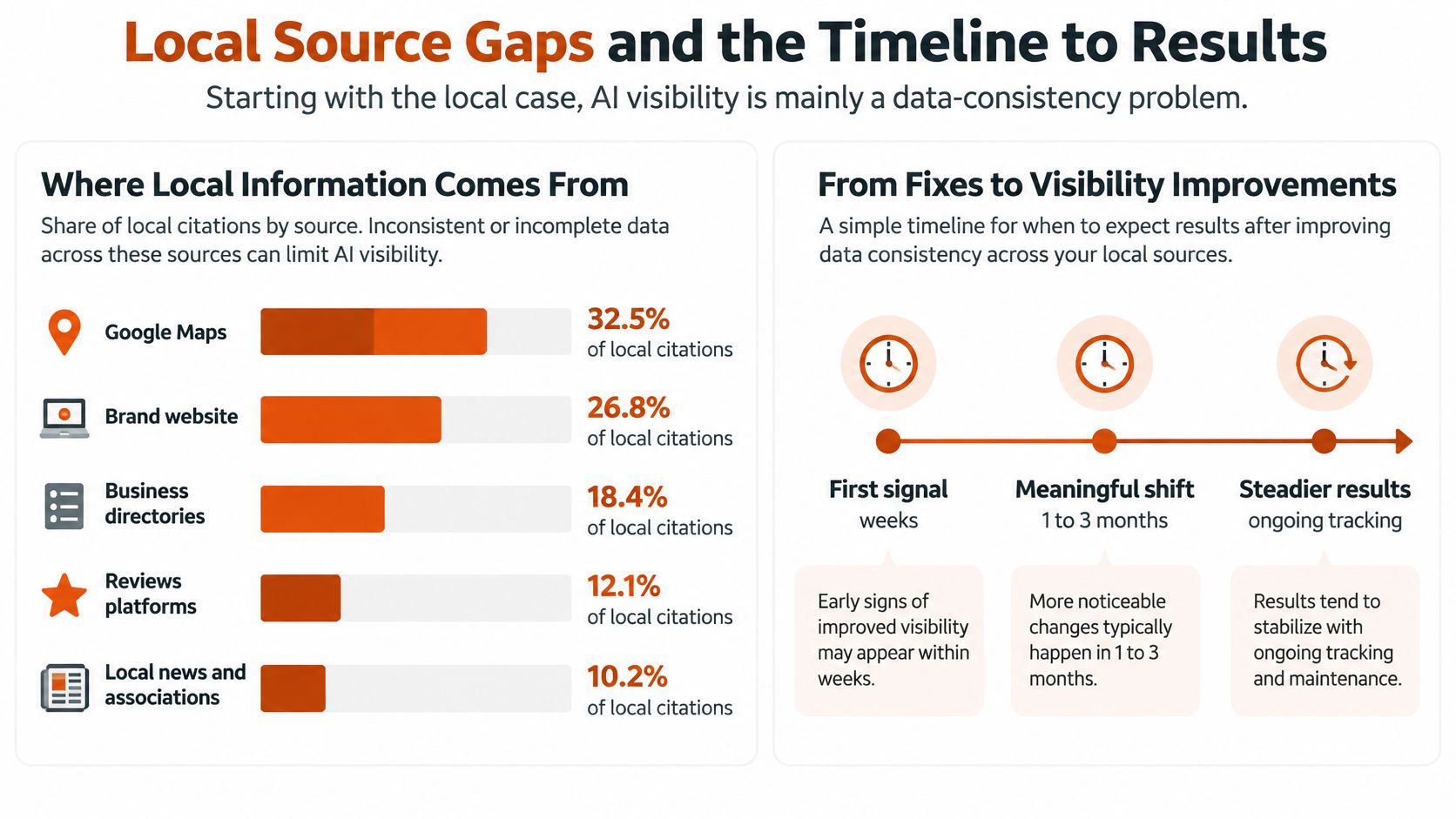
The SOCi AI visibility analysis reports the following source shares and location-data accuracy across approximately 3,000 multi-location brands and 350,000 locations.
Sources behind local AI results
| Source | Reported share | Basis |
|---|---|---|
| Google Maps | 32.5% | Local citations |
| Brand websites | 23.1% | Local AI recommendations |
| Niche sources | 26.3% | Local citations |
| Yelp | 10.5% | Local citations |
| 7.6% | Local citations |
The same analysis reported location-data accuracy of 99.2% for Gemini, which draws heavily on Google Maps, versus 69.8% for Perplexity and 65.5% for ChatGPT. These findings make engine-by-engine testing important: accurate information in one assistant doesn't establish accuracy elsewhere.
The table also uses different measures for brand websites and citation sources. Don't combine those figures into a single channel-share calculation.
Fix the sources that affect real customer decisions
Start with the sources most frequently cited across your tested engines and questions. Then separate corporate facts from branch-level facts: a company-wide emergency service policy doesn't establish that every location offers emergency response.
- Normalize location records. Give each branch a consistent name, address, contact details, hours, and service description.
- Correct influential external profiles. Resolve discrepancies at their source, including directory and review-platform records.
- Test high-risk questions locally. Check open-now, near-me, pricing, availability, and emergency-service requests in each priority market.
Publishing another website answer won't resolve a conflicting phone number on a frequently cited listing. Assign an owner to each correction and verify that the public record has changed.
The visual below illustrates the source-consistency workflow and monitoring sequence.
Look for progress in the right sequence
AEO changes can appear as soon as AI engines re-crawl the site, often within weeks. First, engines start describing the business accurately; next, they name it for targeted questions; then visibility expands into related questions as authority builds.
That broader expansion usually takes months of consistent work. Use the stages to set priorities: correct representation before broader coverage, then strengthen the supporting sources that help the company appear across more buying situations.
How to Choose an AI Visibility Agency
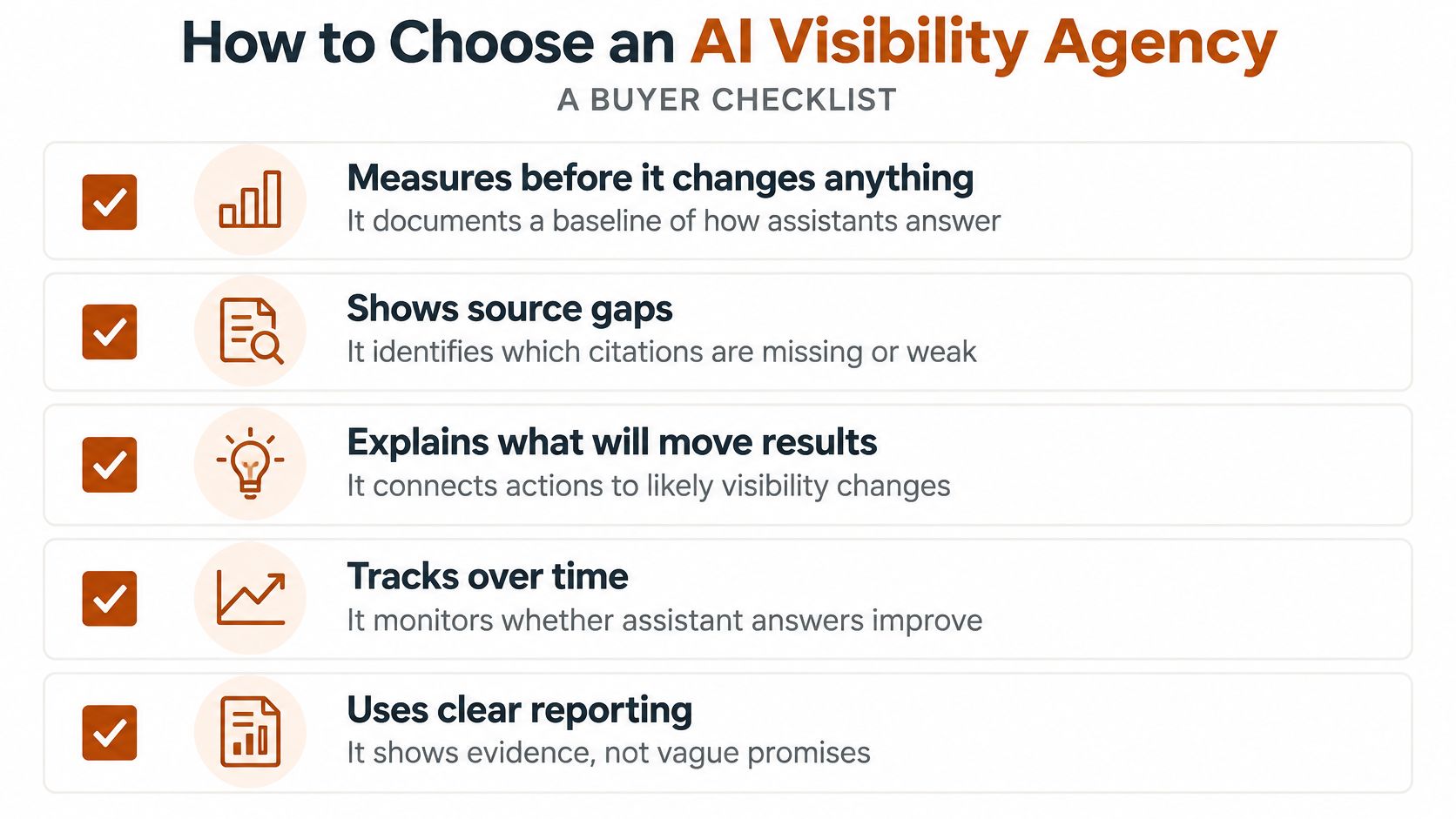
Evaluate providers through evidence they can show, not terminology they can explain. Apply these tests to every proposal:
- Measures before changing anything. Does the scope include a saved baseline of customer questions and assistant answers?
- Names its engines. Does it specify coverage across ChatGPT, Perplexity, Claude, and Google AI Overviews rather than saying major platforms?
- Separates outcomes. Does the sample report distinguish mentions, citations, recommendations, and traffic?
- Fixes external sources. Does implementation include directory, review, and profile corrections?
- Reports for owners. Can a nontechnical stakeholder identify progress and next actions?
- Checks technical readiness together. Does the audit cover crawler access, indexability, and structured-data accuracy?
- Defines verification. Does each proposed change name the expected first signal and how it will be checked?
Use the checklist below as a reference during proposal reviews.
Compare scope before comparing retainers
AnswerLion's Visibility plan costs $288 per week for the first 12 weeks, then $577 per week. It includes everything in Starter, plus 2 to 4 pages rewritten or published each month, core Organization, Service, and FAQ schema, monitoring across 2 AI engines, and listing and profile clean-up.
Our Growth plan includes everything in Visibility, plus 6 to 10 pages optimized or published each month, expanded LocalBusiness, Product, and Article schema, and authority building across directories, publications, and review sites. It monitors 4+ AI engines, including ChatGPT, Perplexity, Claude, and Google AI Overviews, with biweekly reporting and a monthly strategy call.
Custom programs support multiple locations, large catalogs, or faster timelines than Growth. Choose scope around your implementation workload: a distributed location network needs a different correction program from a software company with a concentrated set of product pages.
Buying standard: Compare every quote line by line against the tests, including implementation ownership and verification. Page volume alone doesn't tell you whether the agency will resolve your visibility gap.
A premium engagement should make the budget easier to defend because the deliverables, evidence, and decision points are clear.
Book a Baseline Audit Before You Commit
Confirm where the business stands before committing to a long program. Our 30-minute discovery call shows your position in AI answers and the first fixes to make, so you can assess the opportunity around actual customer questions.
The standalone AEO audit goes deeper. It tests priority customer questions across every major AI engine, identifies who gets cited instead of your business and why, and provides a prioritized fix list.
Run a buyer-question check today
Write five questions covering discovery, comparison, suitability, location or availability, and purchase conditions. Run each question in two assistants, then save who is named, which URLs are cited, and how your business is described.
- Competitors appear, but you don't. Commission an audit to locate the missing content, evidence, or source coverage.
- You appear with incorrect details. Start with source correction and trace each wrong claim across owned pages and external profiles.
- You appear accurately. Test whether the assistant recommends you for the buying situations that matter, rather than mentioning you only when prompted by name.
Bring those saved answers to the discovery call. They turn a broad discussion about AI into a concrete decision about which gaps to fix first and how to verify the result.
AnswerLion offers baseline audits, content and technical implementation, source correction, and recurring measurement to help your business earn accurate AI recommendations. Visit AnswerLion to book a discovery call this quarter and identify the first fixes worth funding.