 AnswerLion
SEO for LLMs
SEO for LLMs: How AI Assistants Pick and Cite Sources
Learn how SEO for LLMs works: the signals AI assistants use, the technical checks to run, and how to measure whether your business gets named.
Published · Updated · By AnswerLion
Roughly 82% of GPT-3's raw pre-training tokens came from filtered Common Crawl data, and a review of 47 language models published between 2019 and October 2023 found that at least 64%, or 30 models, used a filtered version of the same archive, according to the Mozilla Foundation's research on generative AI training data.
That single figure reframes what web visibility means. A page isn't only something a crawler fetches when a buyer types a query. It's material that may already have shaped what a model believes about a category, which firms lead it, and how the work gets described. Two mechanisms now run side by side: knowledge absorbed during training, and pages retrieved and quoted in the seconds after a question is asked.
Both reward the same underlying asset, a clear, crawlable, unambiguous description of what the business does and who it serves. What has changed is the measurement. A ranking report tells you where a page sits in a list. It doesn't tell you whether ChatGPT names the company, whether it describes the services correctly, or whether it recommends a competitor instead.
The work therefore splits into three testable stages. Eligibility decides whether a page can be reached at all. Retrieval decides whether it gets read for a specific question. Citation decides whether its words end up in the answer. Each stage fails differently, and each needs a baseline recorded before anything is changed.
What SEO for LLMs Means and How It Differs from Search SEO
SEO for LLMs is the practice of making a business easy for an AI assistant to understand, so tools such as ChatGPT, Claude, Perplexity and Google AI Overviews name it when a buyer asks for a recommendation.
The vocabulary shifts by agency and by analyst. Generative engine optimization (GEO), answer engine optimization (AEO) and LLM SEO describe one body of work: structuring content and technical signals so a generative system can retrieve, trust and quote a source. AnswerLion uses the term AEO, and the execution is the same as GEO.
This is no longer a niche behaviour. A Pew Research Center analysis of Google searches conducted in March 2025 found that 58% of respondents encountered at least one search that produced an AI-generated summary, and 65% encountered an AI reference somewhere on a results page, whether or not the query concerned artificial intelligence. The reach grew quickly: by late October 2024, AI Overviews had expanded to more than 100 countries and territories and reached more than 1 billion users monthly.
| Criterion | Search SEO | SEO for LLMs |
|---|---|---|
| Goal | Rank a page in a list of results | Get named or cited inside the generated answer |
| Output the user sees | Ten links and short snippets | One synthesized answer naming a few businesses |
| Success measure | Ranking position and organic clicks | Mention, citation and accuracy across assistants |
| Main inputs | Content quality, technical health, links | Answer-first passages, crawler access, consistent business details |
| Gap it exposes | A page that ranks but is not clicked | A business that ranks but is absent from the answer |
The two disciplines aren't rivals. Good SEO is the foundation for AEO because most AI engines still draw on web search results and well-structured, credible pages. A page that can't rank, can't be rendered, or contradicts itself across the web gives a retrieval system nothing worth quoting.
What changes is the target. Rank tracking answers a question about position. It says nothing about whether an assistant names the company at all, whether it describes the services correctly, or whether a less capable competitor gets recommended in its place. Once summaries satisfy the query before a click happens, being absent from the answer becomes a distinct commercial problem from ranking badly.
That's the takeaway for a marketing director: SEO for LLMs adds a second visibility target to the one already on the dashboard. You keep the ranking report. You add a record of what the engines say when a buyer asks the question your sales team hears every week.
How AI Assistants Decide Which Sources to Name
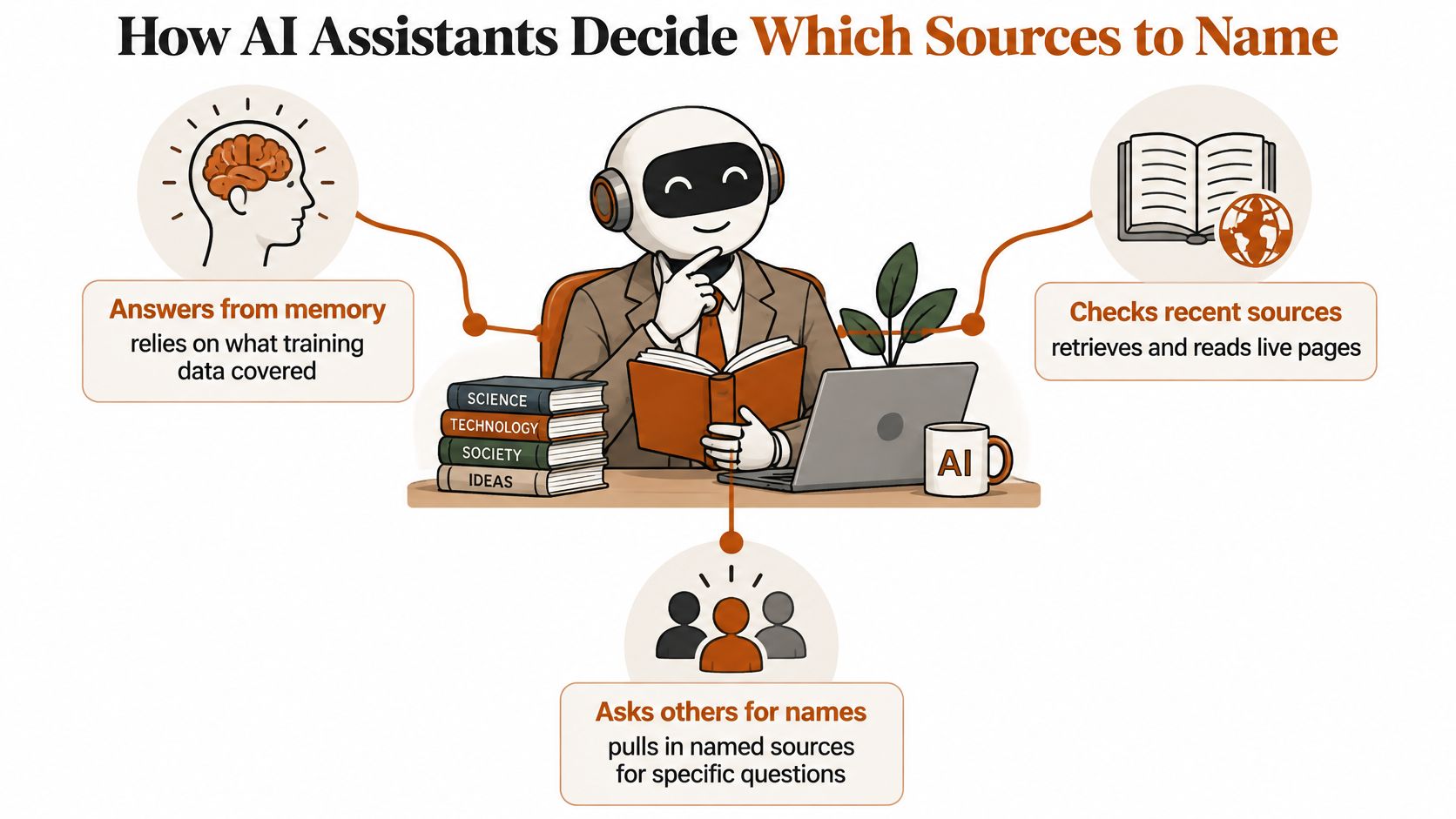
Think of an assistant as a well-read advisor with three habits. It answers from memory when the subject is general. It opens a notebook of recent sources when the question depends on what's true right now. And it asks colleagues for names when the question is specific enough that reputation matters.
Those three habits map onto the routes a business can be named through.
- Training data. Public pages absorbed during pre-training shape what the model already knows about a category and its well-known firms. Common Crawl still matters, because a page indexed in 2021 may be part of what the model believes today.
- Live retrieval. The assistant runs a search or reads pages at the moment of the question, then selects a handful of sources to quote. Questions about current pricing, local availability or the best option right now usually trigger this.
- Supplied sources. Documents, connected tools or uploaded files the operator provides. This route matters most in workplace deployments, where a company's own knowledge base becomes the assistant's reference.
Selection follows the same logic as the advisor reaching for a document. Pages that answer the exact question in their opening lines get quoted. Businesses described the same way across many sources get trusted. Pages a crawler can't reach never enter the conversation, no matter how good the copy is.
An assistant quotes the passage that answers the question, not the page that best describes the company.
This is why the same business can be named through one route and missed through another. A firm with strong directory presence and consistent profiles may surface from memory and from retrieval, while a firm with excellent on-page content behind a blocked crawler surfaces from neither. It's also why audits have to run per engine: ChatGPT, Gemini, Claude and Perplexity retrieve differently, weigh sources differently, and refresh on different schedules.
Three questions expose the state of any page. Can the assistant reach it? Can it find the answer in the first few lines? Do other sources on the web agree with what the page claims? A page that fails any one of them is invisible for a reason you can name and fix.
Measure Your AI Visibility Baseline First
Every tactic that follows needs a before picture. Skip the baseline and you'll be unable to tell a real citation gain from normal engine churn, and you'll spend months defending changes you can't evidence.
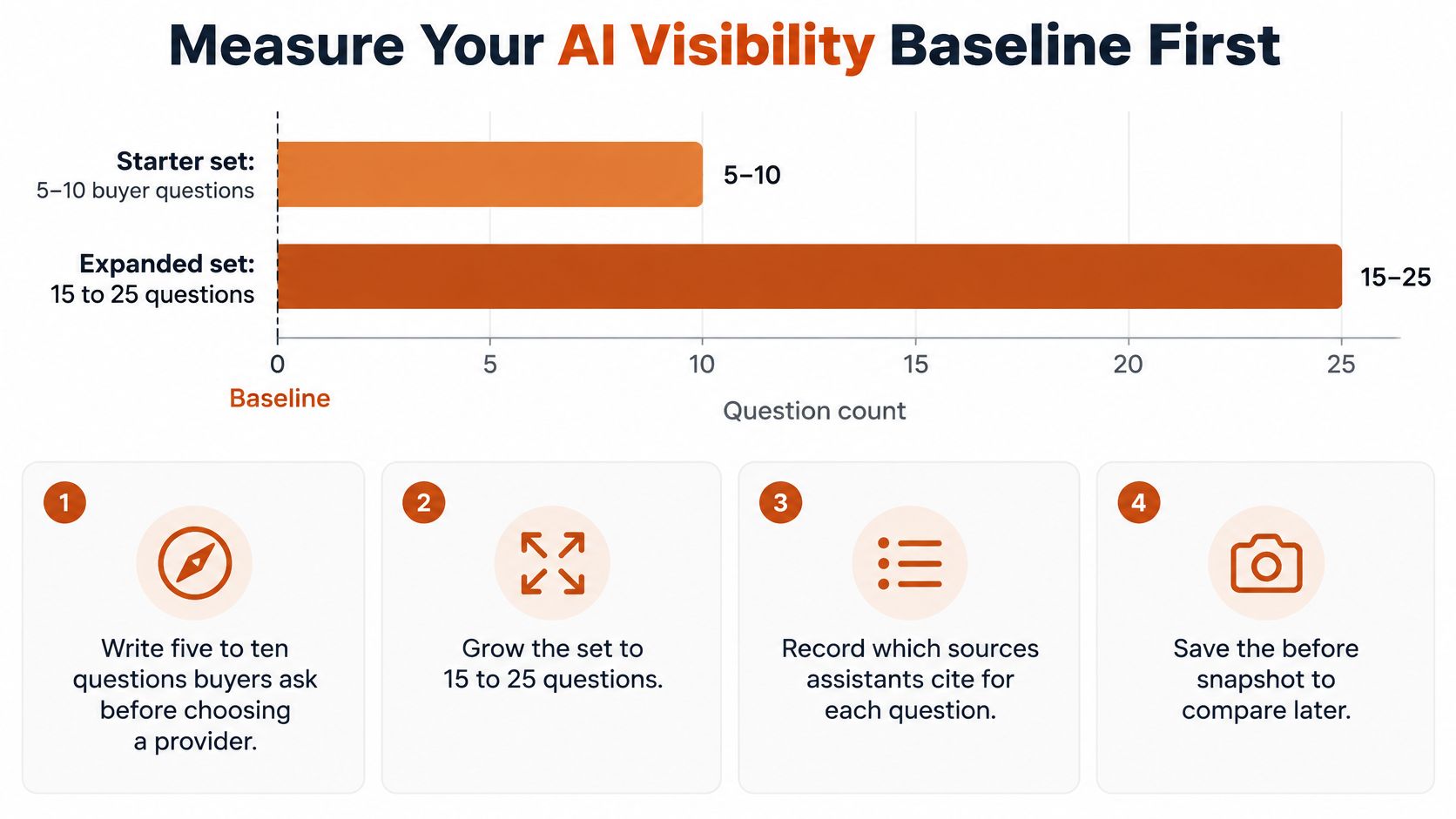
1. Write the questions buyers ask. Start with five to ten questions a customer poses before choosing a provider in your category. Use the wording from sales calls, not marketing language. "Who does bookkeeping for small manufacturers in Ohio" beats "best accounting solutions."
2. Grow the set to 15 to 25 priority questions. Add variants that reflect how people speak: by city, by industry, by budget, by problem. This is the set you'll re-run for the next year, so make it broad enough to still be useful when the business adds a service line.
3. Run each question on each major engine in a fresh session. Monthly is a workable cadence. Copy every answer in full, then record three things: whether the business is named, which details are right or wrong, and which competitors and sources appear. AnswerLion re-runs the same list of customer questions across the major AI engines on a regular schedule and records exactly those three fields. The mechanics of doing this consistently are set out in how to track LLM visibility over time.
Expect progress in stages. Engines usually start describing the business accurately, then naming it for targeted questions, then widening visibility to related questions as authority builds. Judging a first month against a third-month expectation is the most common way teams talk themselves out of work that was already succeeding.
Organic traffic alone can't carry this measurement. In Pew Research Center's analysis of Google clicks, users clicked a traditional search result in only 8% of visits when an AI summary appeared, against 15% when none appeared. Clicks on links inside the summary itself happened in just 1% of visits.
| Scenario | Clicks on traditional results | Clicks inside the AI summary |
|---|---|---|
| AI summary present | 8% of visits | 1% of visits |
| No AI summary | 15% of visits | Not applicable |
The summary absorbs the visit that used to become a click. That makes accurate inclusion in the generated answer a visibility outcome in its own right, not a bonus on top of rankings.
Before touching copy, check crawler access and technical eligibility on the pages those questions should cite. Then pick the first two fixes from the sections that follow. Pair the answer log with your ranking report so the business can see both where it's found and where it's quoted, and start this week by running the first five questions yourself. No website access is needed to begin: an audit reads public answers and public source lists, and content fixes can either be made directly or handed finished to a developer.
The Technical Checks That Make Pages Eligible
Crawlability is a prerequisite, not a ranking tactic. Google's documentation on AI features in Search states that pages must be indexed and eligible to appear with a search snippet to qualify as supporting links in AI Overviews or AI Mode, and it's explicit that eligibility doesn't guarantee crawling, indexing or serving.
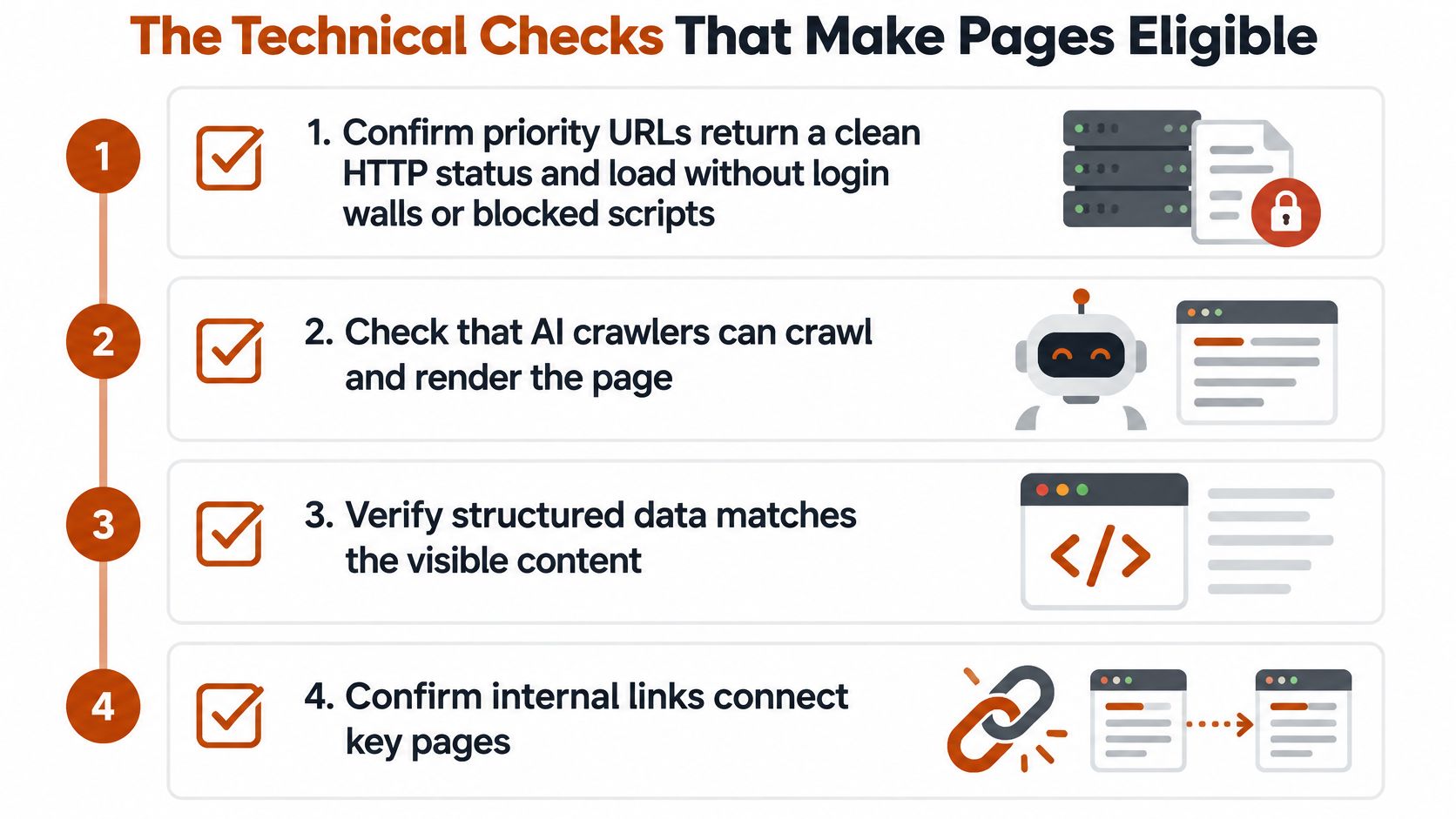
Run these seven checks on five priority URLs before editing a sentence of copy. Each one prevents a known failure.
- Clean HTTP status and open access. Confirm each priority URL returns a normal response and loads without a login wall or blocked script. Failure prevented: a page that looks fine to a logged-in marketer and returns an error to every crawler.
- Indexability. Search for accidental noindex tags and confirm the URL is in the index. Failure prevented: a launch template or CMS setting that excluded the highest-value pages.
- Canonical consistency. One URL should represent one topic. Failure prevented: two near-identical versions splitting signals so neither gets selected.
- Rendered content. Text that appears only after client-side rendering may never be read, so serve the key answers in server-rendered HTML. Failure prevented: a beautiful page whose substance exists only in JavaScript.
- Internal linking. Link to priority URLs from relevant hub pages. Failure prevented: an orphaned page that's technically indexed but never discovered or re-crawled.
- XML sitemaps. Submit sitemaps that list canonical priority URLs. Failure prevented: slow discovery after a rewrite, which delays any measurable result.
- Structured data accuracy. Markup should match the visible page text, and Google states there's no special AI-only schema requirement. Failure prevented: contradictions between markup and copy that weaken confidence in the entity.
The llms.txt file is a separate asset, and its purpose is a curated map rather than eligibility. The llms.txt specification defines a file at the root path /llms.txt that opens with an H1 naming the project or site, follows with a blockquote giving a concise contextual summary, then presents H2-delimited sections of Markdown links to relevant resources, each with an optional note explaining what the page covers. It tells a model which pages matter and how to interpret them.
It does not replace basic search eligibility. A site can publish a flawless llms.txt and still block its own pricing page through an overly broad rule or a staging noindex tag.
Here's a walkthrough of how these checks play out on a live site.
The failures cluster in predictable places: JavaScript-heavy product configurators, gated whitepapers that hold the only substantive explanation of a service, staging environments whose noindex tag followed the site to production, and localization folders excluded by a rule written for one market. Test the seven checks now, note which fail, and fix them before commissioning any content work.
Choosing Which AI Crawlers Can Read Your Site
robots.txt is an access control, not a visibility guarantee. The Robots Exclusion Protocol, standardized as RFC 9309, asks crawlers to honor rules published in a root-level /robots.txt file when accessing URIs. It governs what can be fetched. It has nothing to say about whether a fetched page is understood, trusted or quoted.
The stakes of getting this wrong run both ways. An ACM study of AI crawler access found that 60.0% of reputable websites disallowed at least one AI crawler, compared with only 9.1% of misinformation websites, and among reputable sites, blocking rose from 23% in September 2023 to nearly 60% by May 2025. Restrictive policies remove authoritative evidence from the pool while less reliable sources stay open.
OpenAI's setup shows how precisely the decision can be made. Its documentation for GPTBot separates two user agents: OAI-SearchBot controls crawling that helps a site appear in OpenAI search results, while GPTBot controls crawling for potential use in training OpenAI's foundation models. A site can allow the first and disallow the second, keeping search eligibility without granting training permission. OpenAI recommends allowing OAI-SearchBot and permitting requests from its published IP ranges when a site wants to be included in search results.
| Crawler | Controls | Typical setting |
|---|---|---|
| OAI-SearchBot | Eligibility for OpenAI search results | Allow, and permit its published IP ranges |
| GPTBot | Crawling for potential use in training OpenAI foundation models | Disallow if training use is unwanted; search eligibility is separate |
| Googlebot | Indexing that makes pages eligible for AI Overviews and AI Mode | Allow priority URLs and keep them indexable |
| Other AI crawlers | Retrieval, training or both, depending on the operator | Check each operator's documentation before writing a rule |
The audit routine is short and unglamorous. Check every origin and subdomain separately, because a rule written for the marketing site rarely covers the shop or the help centre. Confirm that the CSS, JavaScript, images and API resources needed to render a page aren't blocked, since a blocked stylesheet can leave a crawler reading an empty shell. Test staging, localization folders and faceted navigation URLs for rules nobody intended. Then compare the file against the user agents that appear in server logs.
Set policy by purpose. Decide separately whether crawlers may use your content for search visibility and whether they may use it for training, then write one rule per decision.
A blanket Disallow feels decisive and costs the most. It removes the evidence an assistant would have quoted. If you're rewriting rules from scratch, this guide to generating a robots.txt file that allows AI crawlers covers the syntax and the common traps.
Build Consistent Entity Signals Across the Web
Assistants verify a business by checking whether independent sources describe it the same way. When a directory lists one trading name, a review site lists another, and the website lists a third, the assistant has no reliable entity to attach a recommendation to.
Use one identity everywhere. One legal name, one trading name, one address format, one service description. Pick the exact wording of the service line and reuse it rather than paraphrasing on each platform. Machines match strings and entities, not intentions.
Claim the listings that already matter. Directories and industry bodies your buyers already trust carry weight precisely because they're independent. Confirm each listing matches the website word for word on name, location and service, and fix the ones that don't before chasing new ones.
Earn third-party mentions that name the service, not just the brand. A trade publication article or a customer case study that says "invoice automation for mid-market finance teams" alongside the company name does more than a mention that says only the company name, because it attaches the entity to a category.
Correct wrong details at the source. When an assistant repeats an outdated address or a discontinued service, find the page or listing it's drawing from and fix that. Editing your own site won't change an answer built from someone else's directory.
Check quarterly. Run your brand and service questions every quarter and compare the descriptions against your own service page. Drift shows up in answers long before it shows up in rankings.
Start with the sources that already name the business. Those are the cheapest corrections available, and they compound. Extending to new mentions is the slower half of the work, and it's covered in this guide to earning AI brand mentions across directories, publications and review sites.
Writing Answer-First Passages AI Assistants Quote
Each core page should answer one question in its opening sentence, then support it with specifics. Everything else on the page serves that answer.
Consider a regional accounting firm whose services page opened with a welcome paragraph and a list of company values. Nothing on it was wrong. Nothing on it was quotable either. Asked who handles bookkeeping for small manufacturers in Ohio, an assistant had no sentence to lift.
The rewrite opens with one line naming the service, the client type and the location: tax returns and bookkeeping for small manufacturers in Ohio. Three specifics follow. How fees are set, whether by hourly rate, fixed monthly retainer or return complexity. Typical turnaround, in working days, from records received to filed return. One named credential, such as a licensed CPA on staff with a stated specialization. Each of those is checkable, and each gives an assistant a reason to prefer this page over a generic directory entry.
A short FAQ closes the page, built from questions customers ask during sales calls rather than from keyword tools. If three prospects asked last quarter whether you handle multi-state filings, that's an FAQ item.
Writing rule that does the most work. Put the strongest, most specific answer paragraph near the top of the page, and make it survive being read alone with no surrounding context.
Four rules make the passage quotable. Name the business in full at least once, because an assistant quoting a fragment still has to attribute it. Use the vocabulary buyers use, including the plain-language version of your category, since that's what gets searched. Keep every claim verifiable on the page, because an unsupported superlative gives the model nothing to repeat. Match the page title to the question buyers ask wherever the wording fits naturally, which helps on some engines more than others.
Timing expectations should be set at the start. Fixing a wrong description can show up as soon as engines re-crawl the site, often within weeks. Authority built through third-party mentions takes longer, because it depends on other people publishing and on engines revisiting those sources. Plan the quick corrections and the slow reputation work as two separate tracks with two separate review dates.
Which Tactics Move Citations and Which Only Look Useful
Most published advice about SEO for LLMs is wrong about cause and effect. A 90-day study that held websites constant and observed retrieval daily found that FAQ blocks, Schema.org markup, summary boxes, author boxes and page speed were not associated with more citations, and at equal search rank were slightly associated with fewer, according to the longitudinal study on AI citation factors.
What did move citations was narrower and more demanding. Improving the strongest answer paragraph on a page correlated with citation increases of 9.5% for ChatGPT, 7.8% for Gemini and 4.8% for Perplexity. Title-question matching helped Gemini and Perplexity but not ChatGPT.
| Tactic | Observed effect on citations | Action |
|---|---|---|
| FAQ blocks, Schema.org markup, summary boxes, author boxes, page speed | No association with more citations; slightly fewer at equal search rank | Keep for semantic clarity and search features, not as a citation lever |
| Improving the strongest answer paragraph | Citation increase of 9.5% for ChatGPT, 7.8% for Gemini and 4.8% for Perplexity | Primary lever to test first |
| Title-question matching | Helped Gemini and Perplexity, not ChatGPT | Apply on pages targeting Gemini and Perplexity |
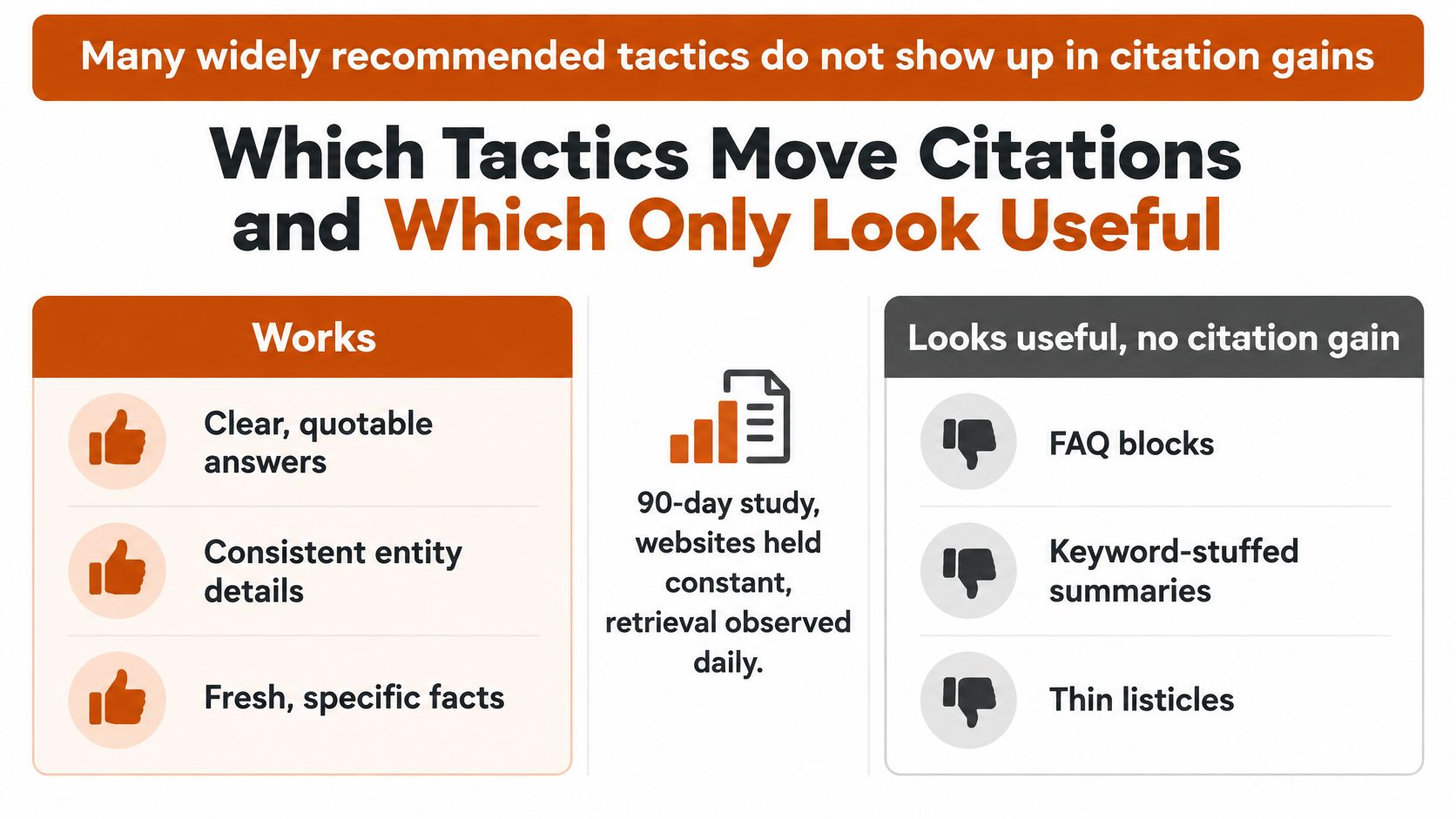
The practical reading isn't that schema is worthless. Valid markup supports semantic clarity and earns search features, and it costs little to maintain. The mistake is treating it as the lever that makes an assistant quote you. It isn't. The paragraph is.
The test that settles arguments. Change one variable across a set of pages, then re-run the same questions after re-crawl and compare engine by engine.
Run it this way. Choose ten priority questions and record which engines currently cite which URLs. Group pages into a test set and a control set. Rewrite only the strongest answer paragraph on the test pages, leaving schema, titles and layout untouched. After the engines re-crawl, re-run all ten questions in fresh sessions and compare results per engine rather than in aggregate, because a change that helps Gemini may do nothing for ChatGPT.
Keep the control set. Without it, seasonal shifts in retrieval look like wins, and you'll attribute the gain to whatever you changed most recently. The discipline of separating crawlability, retrieval, citation selection and quotation is what turns AI visibility from a set of opinions into a program you can defend in a board meeting.
AnswerLion runs the sequence this article describes as a service: a baseline audit that records how ChatGPT, Google AI, Claude and Perplexity answer your customers' real questions today, then answer-first content and technical fixes aimed at the paragraphs that get quoted, with monthly tracking across engines so each change is measured rather than assumed. If you want to know what the engines currently say about your business before you spend anything on fixes, email hello@answerlion.com with your website and a few questions your customers ask, and we'll show you where you stand and what we'd change first. You can also see how the audit and reporting work at AnswerLion.