 AnswerLion
how to get recommended by ChatGPT
How to Get Recommended by ChatGPT: A 2026 Guide
See how to get recommended by ChatGPT: score mentions against real picks, then ship answer-first pages, schema, and citations.
Published · Updated · By AnswerLion

Most advice on how to get recommended by ChatGPT treats a brand name inside an answer as the prize. That reading is too generous. A name in a shortlist is inclusion. A sentence that tells the buyer to hire you is the commercial result. Marketing directors who chase mentions alone will celebrate dashboards that never move pipeline.
The work that produces a pick is narrower. Publish the facts a buyer would check, keep those facts identical on the pages and listings an assistant retrieves, and score every answer for recommendation strength rather than presence. The pages, schema, and citations below are built for that stronger outcome.
What a ChatGPT Recommendation Actually Means
Visibility reports hide the gap that matters. An analysis of 8,392 AI responses, covered by BeOmniscient, found brands in 97.0% of answers, yet a direct recommendation in only 47.6% of answers. Across individual brand mentions, just 18.8% were direct recommendations, while 57.9% were neutral mentions or options the assistant warned against. ChatGPT directly recommended 29.9% of the brands it mentioned, higher than several other AI interfaces and still far from every appearance.
| Signal | What the assistant did | Rate |
|---|---|---|
| Inclusion | Brand name appears somewhere in the answer | 97.0% of answers |
| Answer contains a direct recommendation | The response tells the user to choose a brand | 47.6% of answers |
| Direct recommendation of a mention | That specific brand mention is a pick | 18.8% of mentions |
| Neutral or negative mention | Named without endorsement, or advised against | 57.9% of mentions |
| ChatGPT pick rate | Share of mentioned brands ChatGPT directly recommended | 29.9% |
Score the next ten answers with five labels before anyone rewrites a page.
Inclusion means the name appears. Positive description means the copy is accurate and favorable without a pick. Conditional fit means the assistant names the conditions under which you win. Direct recommendation means the line tells the buyer to use you. Best-option positioning means you are the preferred choice for that constraint set.
Say a facilities director asks which CMMS fits a 200-person plant across three sites. A name inside a list of five tools is inclusion. The line that says choose this vendor when multi-site work orders and a public API matter is conditional fit. The line that says use this vendor is the commercial result.
Label the next ten answers before a single page is rewritten. Later work is judged on recommendation strength, not on whether the name showed up.
Run those prompts with real constraints: budget, headcount, city, and must-have integrations. Branded queries only test whether the model already knows the name. Unbranded buyer questions show whether the assistant prefers a competitor once the constraints get specific.
Run the Same Buyer Questions Until the Gaps Are Clear
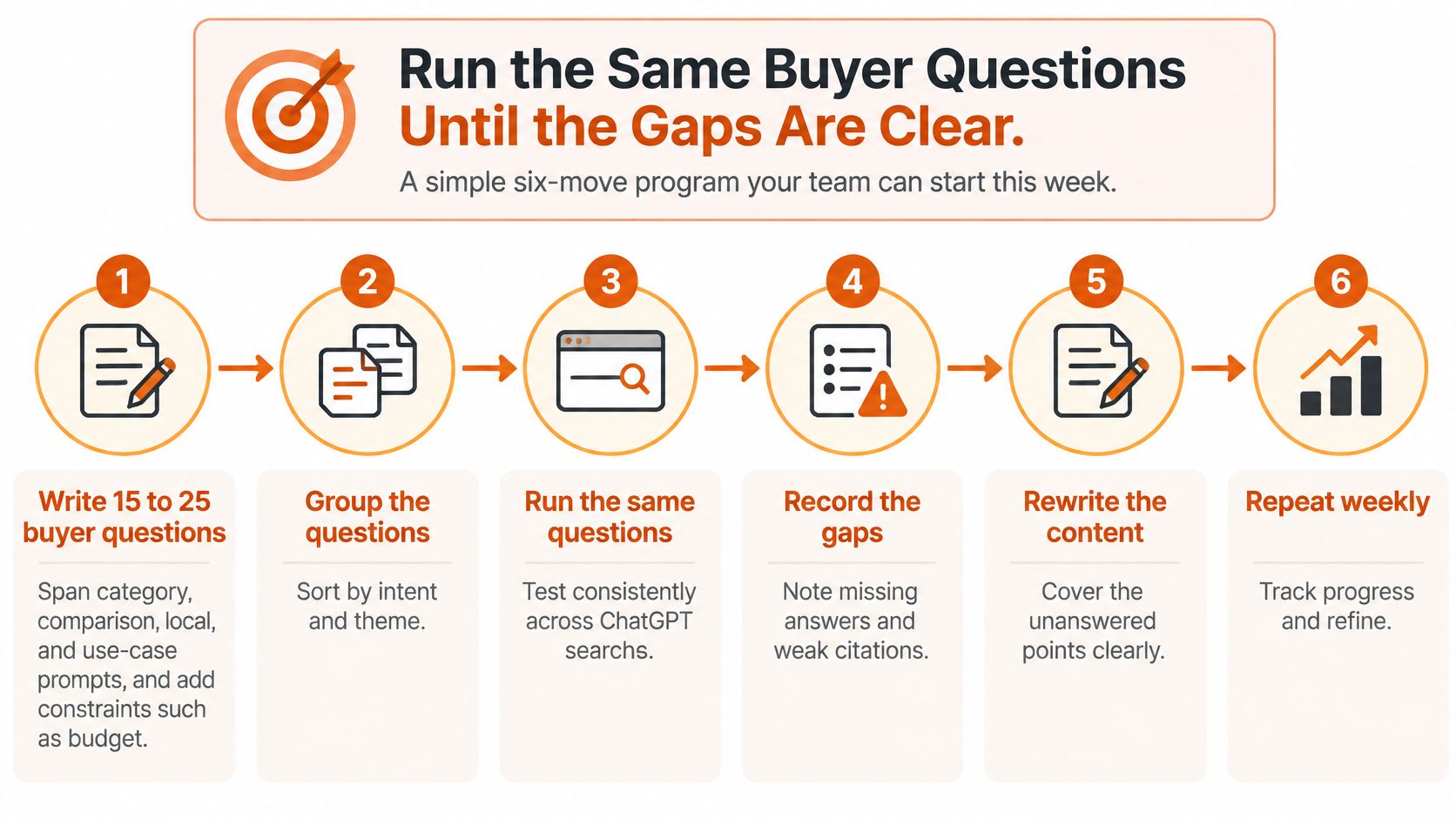
One prompt, run once, proves nothing. The audit is a fixed question list run across every major AI engine, logged so page owners can act on what the answers reveal: whether the business is named, described accurately, cited, or left out while a competitor gets the recommendation.
OpenAI's ChatGPT Search documentation treats each answer as retrieval plus qualification, which is why the log has to capture more than presence. OpenAI states that sites should permit OAI-Searchbot crawling and allow traffic from its published searchbot IP ranges. Google's position in the same checklist is that structured data is not a special requirement for generative AI features, while crawlability, indexing, and ordinary search eligibility remain the prerequisites.
Six moves and the record each one keeps
- Write the buyer set. Draft 15 to 25 questions spanning category, comparison, local, and use-case prompts. Attach real constraints: budget, headcount, city, must-have integrations. Keep the exact wording in a sheet so later runs match.
- Run a fresh chat. Ask each question in a new ChatGPT chat with search on, then repeat the list in Perplexity, Claude, and Google AI Overviews. Log four fields: named or not, description accurate or not, cited URL, and who gets recommended instead.
- Read the cited pages. List the facts the named competitors state that you do not: pricing model, service area, integrations, certifications, ideal customer. The gap is usually a missing sentence, not a missing keyword.
- Map each fact to one URL. One missing fact, one first-party page. Service pages hold offer and audience. Location pages hold geography. A product page holds integrations. One fact spread across five URLs splits the signal.
- Publish the answer first. Put the direct answer in the opening sentence of that URL, then the proof. Server-rendered HTML, working internal links, an XML sitemap, accurate robots directives, and Organization, Service, Article, and location data matching the visible text give the crawler something quotable.
- Freeze the list. Rerun the identical questions weekly or monthly, split by engine, geography, and intent. Track mention rate, citation rate, factual accuracy, and competitor share of recommendations. The last metric carries the most weight. A mention means you exist. A recommendation means the engine told the buyer to choose you.
Hand page owners a one-page spreadsheet with these columns: question, engine, named (yes/no), accurate (yes/no), cited URL, recommended instead, missing fact, owning URL, owner, and next rerun date. That sheet is the baseline. Every later run reuses the same rows, so when competitor share of recommendations climbs, the log points at the exact page that lost ground and the exact fact it failed to state.
Write the Answer in the First Sentence
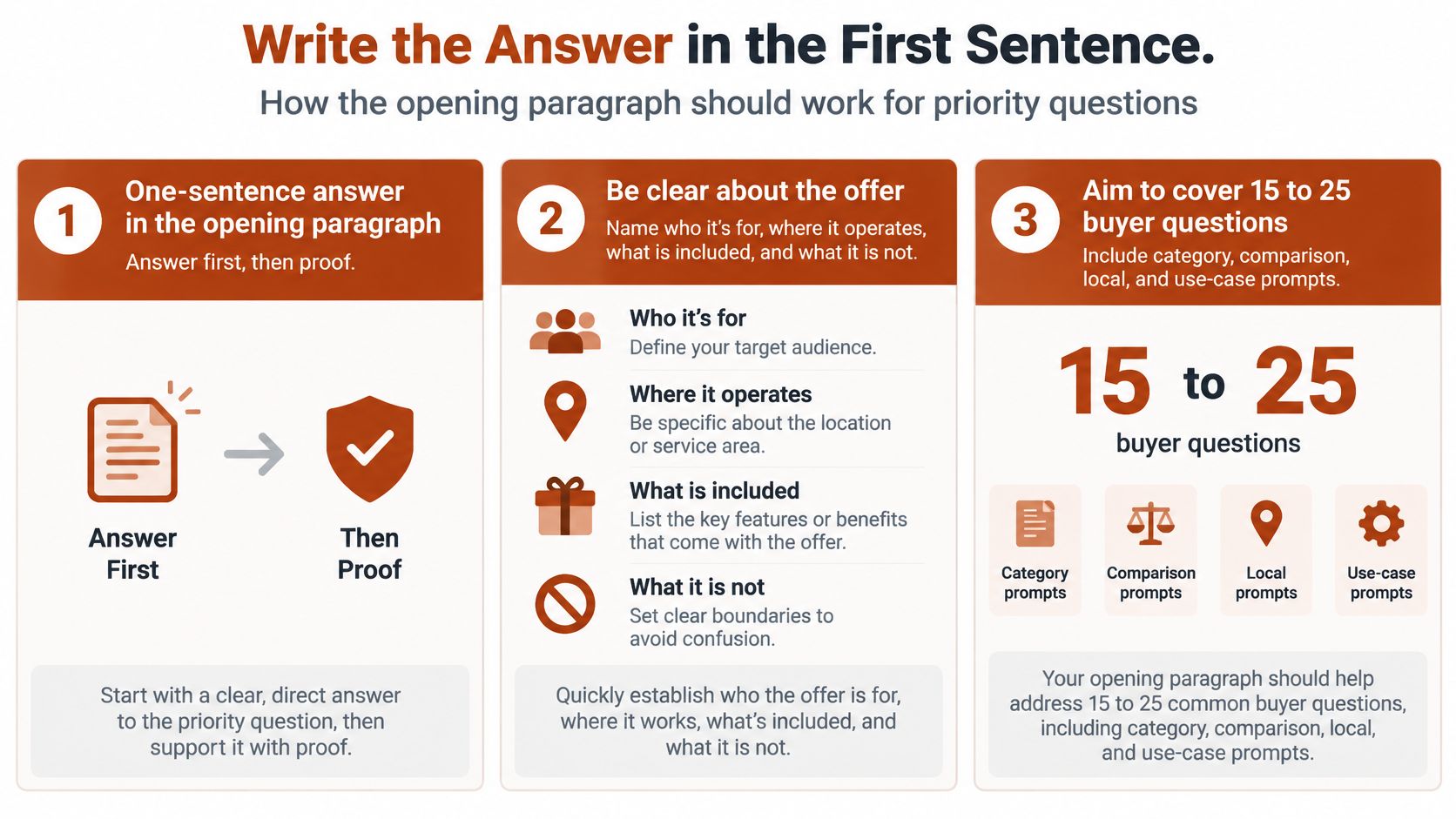
A priority page earns a citation when the first sentence can be quoted without editing. The Princeton Generative Engine Optimization study, published through Princeton University, evaluated nine content modifications and reported visibility improvements of up to 40%, with outcomes varying by domain. For content already in fifth position in the underlying results, source citations produced a 115.1% visibility lift, quotations 99.7%, and statistics 97.9%. Treat those lifts as a controlled test: revise one page, hold a matched query group unchanged, and compare citation rate and recommendation rate after the next recrawl.
Replace the slogan with a checkable sentence
A weak opener sounds like this: "trusted experts in comfort." A multi-location HVAC firm replaces it with: "We service commercial rooftop units for warehouses within 40 miles of Columbus, with same-week emergency calls." That sentence names who the offer is for, where it operates, what is included, and, in the next line, what it is not. Follow it with a dated statistic, a named qualification, and one third-party source. The same pattern belongs on service, product, and location pages, which is the point of answering the buyer's problem in the first line.
Opening pattern: [Who you serve] + [where you operate] + [what is included] + [what is excluded]. Then one dated number with place, denominator, and source, plus one named qualification.
Every number on the page needs a date, a place, a denominator, and a source. Prefer government data, standards bodies, research, and transparent reviews over slogans. Unsupported superlatives and conflicting details across directories give an assistant nothing safe to repeat.
| Change on the page | Reported visibility lift | How to apply it |
|---|---|---|
| Add source citations | 115.1% at fifth position | Link a claim to a named independent source |
| Add direct quotations | 99.7% at fifth position | Quote a named expert or customer with a date |
| Add statistics | 97.9% at fifth position | State date, place, denominator, and source |
| Best of nine tested modifications | Up to 40% across the benchmark | Test one change against a held-out query group |
Ship one evidence-rich revision this month. Leave the control queries untouched so the next rerun attributes the lift to the page, not to a model update.
Open the Site to AI Crawlers and Schema
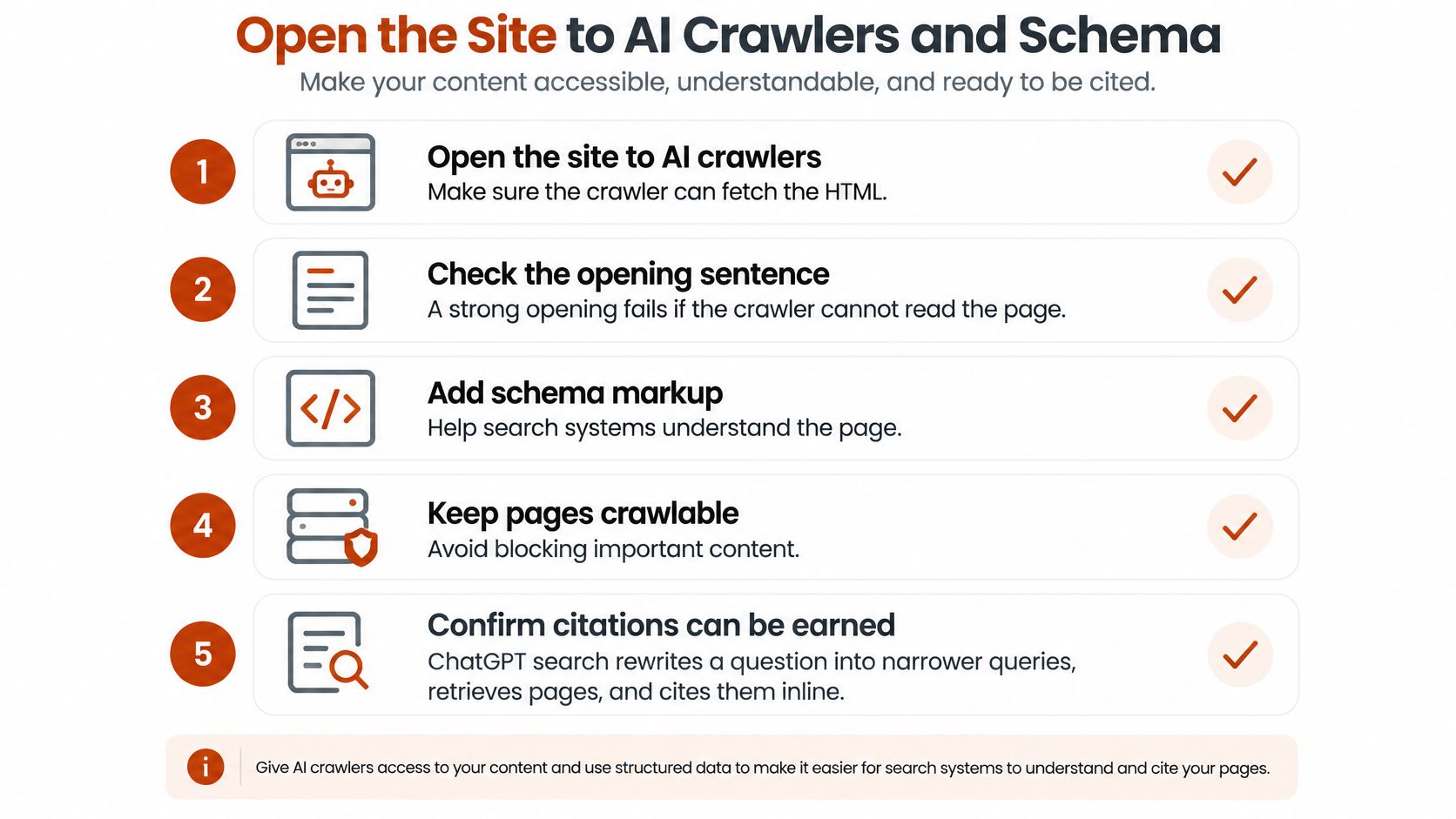
ChatGPT search rewrites a question into narrower queries, retrieves pages, and cites them inline. A strong opening sentence fails if the crawler cannot fetch the HTML. Work the access list in this order, and log the date of each change so the next monitoring run shows whether the cited page moved.
Google's crawling and indexing guidance defines robots.txt as the control that tells crawlers which pages they may request, and sitemaps as the file that identifies new or updated URLs. Google will not restrict crawling only to sitemap-listed pages, but it will prioritize those pages, and it recommends structured data when a system needs extra guidance on non-text content or site meaning. Google's structured data documentation adds a practical sequence: deploy markup on a small set of pages, inspect each URL, confirm the pages are not blocked by robots.txt, noindex, or a login, request recrawling, and submit a sitemap. Discovery and crawling can take several days after publication.
The implementation order
- Open the crawler path. Allow OAI-Searchbot and traffic from OpenAI's published searchbot IP ranges. Confirm no service, product, or location URL is blocked. A clean robots file is the first technical fix, and generating a robots.txt file is the practical starting point when the current file is a leftover from a security plugin.
- Remove the walls. Strip noindex tags and login requirements from every page you want cited.
- Serve the facts in HTML. Use server-rendered HTML and working internal links so name, offer, area, and audience appear without client-side scripts.
- List the answer URLs. Maintain an XML sitemap of the pages that answer the priority questions. Google prioritizes those URLs without limiting the crawl to them.
- Match schema to visible text. Add Organization, Service, FAQ, and Article markup on core pages, plus LocalBusiness or Product only where the page is that thing. Every field repeats text a visitor can read.
- Ship a small set first. Deploy markup, inspect each URL, request recrawling, and submit the sitemap. Wait the several days Google notes before you judge the run.
- Publish llms.txt. State what the business does, whom it serves, and which URLs answer the priority questions.
A wrong description can show up quickly after engines re-crawl the site. Authority built through third-party mentions takes longer, so the crawl checklist is the change you can finish this month while outreach runs in parallel.
Keep Listings Aligned and Read the Demand
Engines blend the company site with directories, profiles, and reviews. A clean homepage still loses when those sources disagree.
Take a distributor whose site says "industrial parts, Midwest fulfillment" while a directory still says "consumer hardware, ships from Florida." Ask ChatGPT where the Florida line came from, search the business name with that phrase, and correct the page that still states the old fact. Start from one statement of name, offer, service area, and audience. Bring the Google Business Profile, major directories, and review-site profiles into line with it. Plan outreach for mentions on publications and review sites the buyer already trusts. On-site fixes move sooner. Third-party references compound over months.
What a real pick does after the chat
A recommendation changes behavior after the user leaves the assistant. A 2026 panel study linking ChatGPT, Claude, and Gemini conversations with opt-in clickstream data, published on arXiv, found that a recommendation increased same-name Google searches by 4.3 percentage points, visits to the brand's own site by 2.4 points, and visits to brand-specific retailer pages by 1.0 point. Incidental name-drops produced substantially smaller effects. The session often never arrives as an AI referral click. Demand shows up as search, direct navigation, and retailer pages.
Build the dashboard around those downstream signals:
- Branded search: week-over-week change in same-name queries after a prompt set starts returning a direct recommendation.
- Direct traffic: visits that skip a tracked referral, read next to the dates you corrected a listing.
- Retailer exposure: brand-specific retailer or marketplace pages when the sale does not happen on your domain.
- Assisted conversions: orders and demo requests in the same window, paired with recommendation-strength scores from the prompt log.
We re-run the same list of customer questions across the major AI engines on a regular schedule and record whether the business is named, how it is described, and who else is cited. Read that log beside branded search and assisted conversions. A rising mention rate with flat branded search means you are being named, not chosen.
Results usually come in three stages. Engines start describing the business accurately. They then name it for the targeted questions. Visibility widens to related questions as outside mentions accumulate. Judge the month on which stage moved, not on a single screenshot.
Confirm Your Buyer Questions Before You Change the Site
The first action is five questions a real buyer would ask this month. Run each once through ChatGPT with search on. Label every answer with the five recommendation terms: inclusion, positive description, conditional fit, direct recommendation, and best-option positioning.
For each answer, note three things.
- Who is named, including the competitor the assistant prefers when your name is missing or neutral.
- Which sentence is quotable, so you can see the pattern a cited page already uses.
- Which fact is missing or contradicted, so the first edit has an owner.
That short list is enough to choose the first page, the first listing, and the first crawler check. Direct answers, matching listings, and open crawl access are changes a team can ship this month. AEO rewards those inputs because they sit under the business's control, and fixes to a description can show up as soon as engines re-crawl the site, often within weeks.
Five labeled answers beat a sitewide rewrite. They tell you the page, the listing, and the crawler check to ship first.
We work with any business whose customers research before they buy and might ask an AI assistant for a recommendation. The first step is a 30-minute discovery call with Josh to see where the business stands in AI answers. A Google Meet link goes out as soon as the call is booked. Email hello@answerlion.com with your website and a few questions customers ask, and we will tell you where you stand and what we would change first. After the call, we confirm the questions to test, run them through the major AI engines, and send a short written report with the gaps and the recommended first fixes: what the engines say now, which competitor is being picked, and the page or listing to correct first.
AnswerLion helps marketing teams get recommended by ChatGPT by auditing the buyer questions that already shape shortlists, then fixing the pages, listings, and crawl access those answers rely on. If your buyers research in ChatGPT before they talk to sales, the written gap report shows who is being picked and what to change first. Visit AnswerLion to start with the questions your customers ask this month.