 AnswerLion
answer the problem
Answer the Problem in One Clear Sentence
Answer the problem in the opening sentence so AI assistants can quote you. Use the sentence pattern, writing steps, scope lines, and citation checks.
Published · Updated · By AnswerLion

By June 2025, 34% of U.S. adults had used ChatGPT, approximately twice the share recorded in summer 2023, according to Pew Research Center. That changes your job. Your buyers aren't only comparing blue links anymore. They're reading a short synthesized answer that names a few businesses and leaves the rest out.
Your page earns its place when it answers the problem in a sentence an assistant can lift without rewriting it. State the result first. Name who it's for. Attach the condition that makes it true. Then give the reader one useful next step. Do that clearly and you give ChatGPT, Google AI Overviews, Claude, and Perplexity something accurate to repeat, and you give the buyer a reason to keep reading.
Why a Direct Answer Wins Consideration
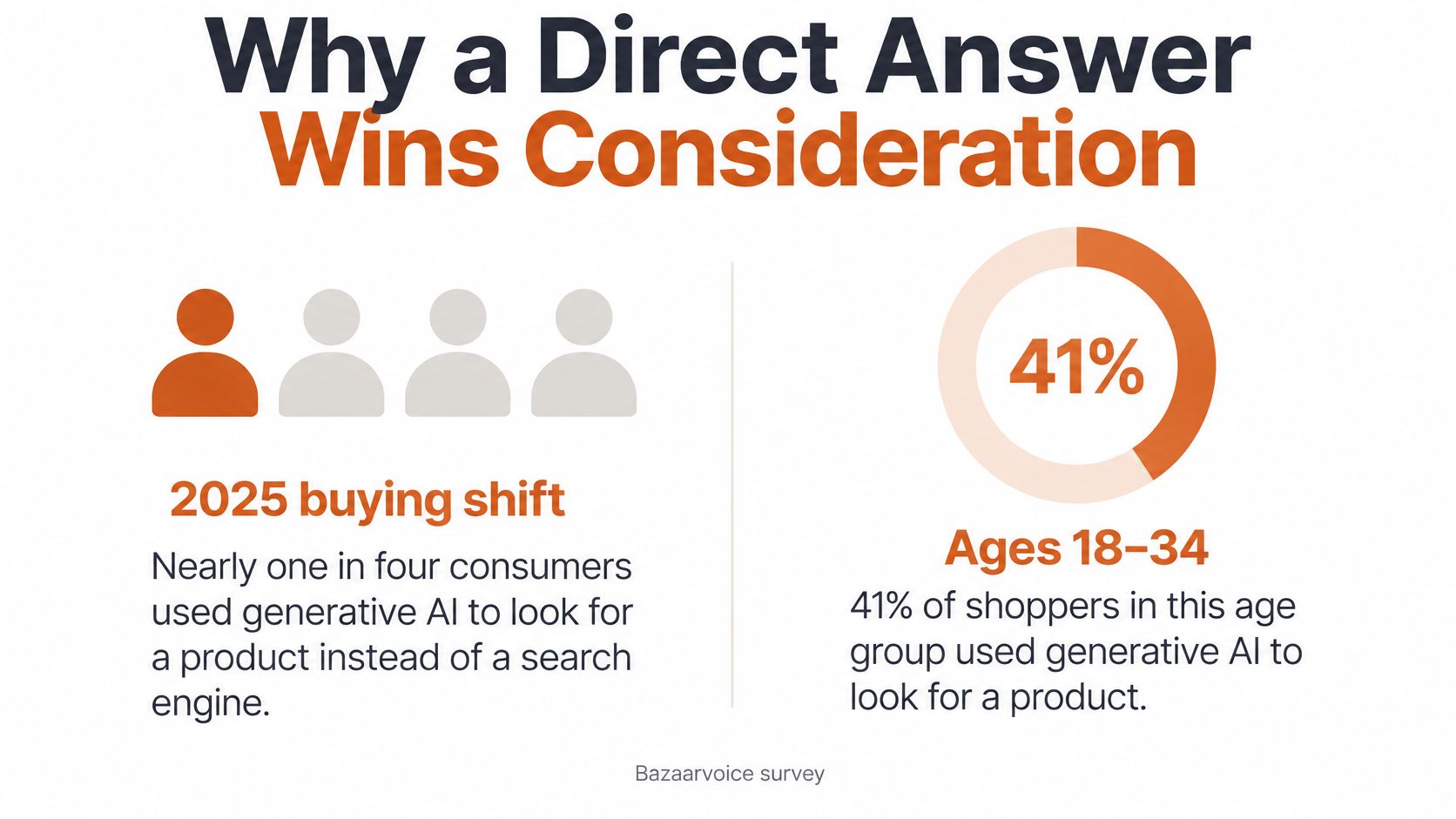
In 2025, nearly one in four consumers said they had used generative AI to search for a product instead of a search engine, and among consumers aged 18 to 34 the figure was 41%, according to Bazaarvoice's survey of more than 7,000 consumers. That's a buying shift, not a curiosity. The shortlist now forms inside the answer.
The Shortlist Forms Before the Click
An assistant doesn't return ten equal options and wait. It writes a paragraph, names a handful of businesses, and explains why each one fits. If your page opens with your founding story, your values, or a tour of the category, the assistant has to guess what problem you solve. It won't guess in your favor. It will quote the competitor whose opening sentence already does the work.
Answering the problem means stating the result the searcher came for in the first sentence. Not the topic. Not the service category. The result. Then you support it with who it is for, the condition that makes it true, and the next action. A page built that way reads well to a person skimming on a phone and parses cleanly for a machine deciding what to repeat.
Three Outcomes Worth Measuring
Treat every target query as three distinct outcomes, because each one pays differently.
- Being named: The assistant includes your business in the answer, even without a link. You've entered consideration.
- Being cited: The assistant points to your page as the source. You've supplied the evidence others get judged against.
- Earning a qualified visit: A reader who already has the headline answer clicks through for price, timing, or fit. That visitor arrives informed and closer to buying.
Rankings alone can't tell these apart. A page can sit on page one and never be named. A page can be cited often and send modest traffic that converts well. Measure all three and you'll know whether your opening sentence is winning attention, authority, or revenue, and which one needs work next.
Position your strongest page to win the first two outcomes and the third follows from readers who want the specifics only you can give. That's a healthier target than chasing raw sessions from people who haven't yet decided what they need.
The page that states the answer first becomes the sentence the assistant can lift.
The Sentence That Answers the Problem
Start with the table. It's the fastest way to see why most opening lines fail and what a quotable one needs.
Four Parts of a Quotable Answer
| Part | What it does | Vague line | Quotable line |
|---|---|---|---|
| Result | States the outcome in one clause | We help teams grow | Test buyer questions before rewriting the page |
| Audience | Names who the answer is for | Businesses of all sizes | Mid-market software companies |
| Proof | Adds one checkable condition | Industry-leading results | Named in the first measurement cycle |
| Action | Tells the reader what to do next | Contact us to learn more | Bring the website and three buyer questions |
Part one is the result in plain language. Write the outcome the buyer wants, using a verb they would use. If you can't name the result without a vague adjective, you haven't found it yet.
Part two names the audience, market, or use case. Most pages lose their nerve here and write for everyone. Don't. A named audience lets an assistant match you to the right question and lets the wrong reader self-select out, which improves the quality of every enquiry that follows. Choosing precise audience language works the same way as choosing examples of focus keywords that mirror how buyers search, rather than how your team talks internally.
Part three supplies one proof point, a number, a timeframe, a location, or a condition a reader could check. One is enough. Stacking three claims into the opening makes the sentence long and gives the assistant three chances to repeat something out of context.
Part four tells the reader the next useful action. Not a generic invitation to get in touch. A specific step that moves the decision forward, such as what to bring, what to compare, or what to measure first.
Two Openings Rebuilt
Say a B2B firm opens with, "We help teams grow with modern marketing." There's no result, no audience, and nothing to verify. Rebuilt, it reads, "A mid-market software company can see which AI assistants name it for its buyer questions within the first measurement cycle by testing those questions before rewriting a page." Now the assistant can repeat it, and the right reader recognizes themselves in the first five words.
Local services benefit the same way. "Quality plumbing you can trust" says nothing a competitor couldn't claim. Try, "A licensed plumber in Columbus clears a standard clogged main line the same day for homes inside the service area when the call comes before noon." The city, the job, the timeframe, and the cutoff all travel together. A homeowner knows instantly whether to call.
Keep one question per page and use the words the buyer would type. If your customers say cost, don't write investment. If they say fix, don't write solution. Draft this sentence before you touch anything else on the page, because every paragraph below it exists to prove it.
Scope Lines That Keep Answers Accurate
AI summaries appeared for 60% of searches beginning with question words such as who, what, when, or why, according to Pew Research Center. Question-shaped searches get synthesized most often, so your crispest sentence is also the one most likely to be repeated away from your page. That's exactly why its limits must travel with it.
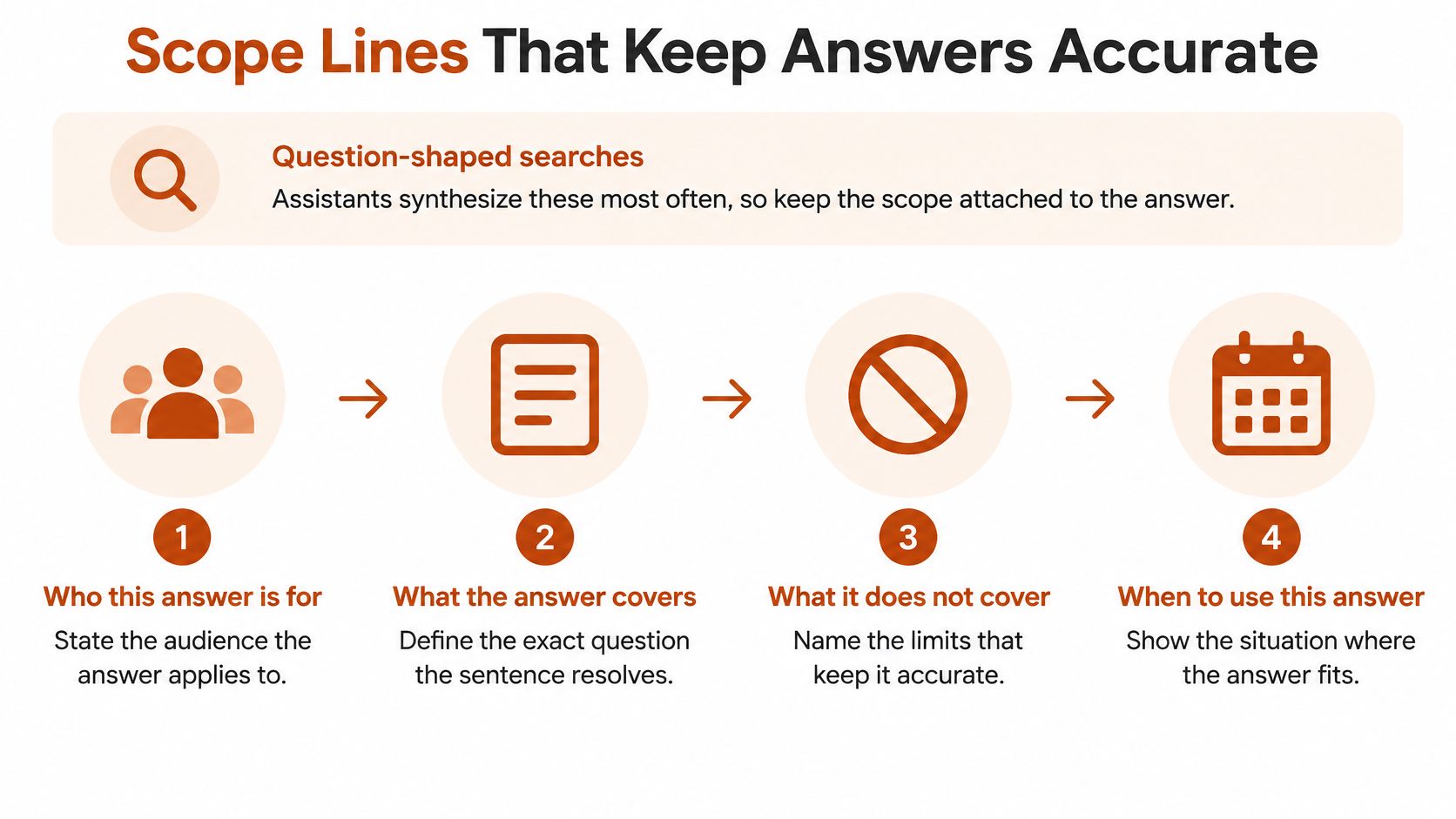
Users also stop sooner once they have that summary. In the same Pew analysis, 26% of visits with an AI summary ended the browsing session, compared with 16% without one. Fewer readers reach your footnotes, your terms page, or your correction. Put the scope in the opening itself, or in the sentence immediately after it, where it will be quoted alongside the claim.
The Four Scope Lines
- Market or location: Name the country, state, or cities the answer covers. A service promise that holds in one territory can be wrong in the next.
- Date or version: State the plan year, release, or review date. Fast-changing products and prices need a timestamp the reader can trust.
- Who qualifies: Name the plan, account type, property type, or eligibility condition. This turns a broad claim into a useful filter.
- The exception: Name the case that changes the answer, and say what happens instead. One exception, stated plainly, prevents the most damaging misquotes.
Apply them by page type. A pricing page states the plan year and what's included. A regulated claim in finance, health, or legal names the jurisdiction and points to the primary source or a specialist. A multi-location service names the cities and the booking cutoff. A software page states the version and the date it was last reviewed.
Framing rule: A scope line is what makes the quote safe to repeat. Write it as part of the offer, not as a warning label underneath it.
Watch the difference in an enterprise software claim. "The platform integrates with every CRM" invites an assistant to promise something your team can't deliver. Rewrite it as, "The 2026 release connects to Salesforce and HubSpot for US accounts on the Growth plan, and other CRMs go through the listed API." The second version is longer and far more valuable, because a buyer can act on it and your sales team can stand behind it.
Qualify, Refuse, or Escalate
Some questions shouldn't get a flat answer. Build three responses into your editorial standard.
When evidence is missing or the market is unclear, qualify in the opening. State what you know, name the uncertainty, and give the date you checked. Readers trust a dated, bounded answer more than a confident guess, and assistants repeat the boundary along with the fact.
When the question asks for something your business can't verify or shouldn't decide, say so directly and point to the right source. A clear refusal with a useful redirect beats a vague paragraph that an assistant might compress into a claim you never made.
When the question touches a high-risk decision, escalate. Name the decision that needs a human or a primary source, such as a diagnosis, a filing deadline, or a contract interpretation, and give the reader the route to that person. Mark each statement on the page as a verified fact or a recommendation, so a suggestion is never lifted and repeated as a fact.
Finish with a simple gate. A page that can't name its market, its date, and who qualifies isn't ready to become the sentence an assistant repeats.
How to Build an Answer-First Page
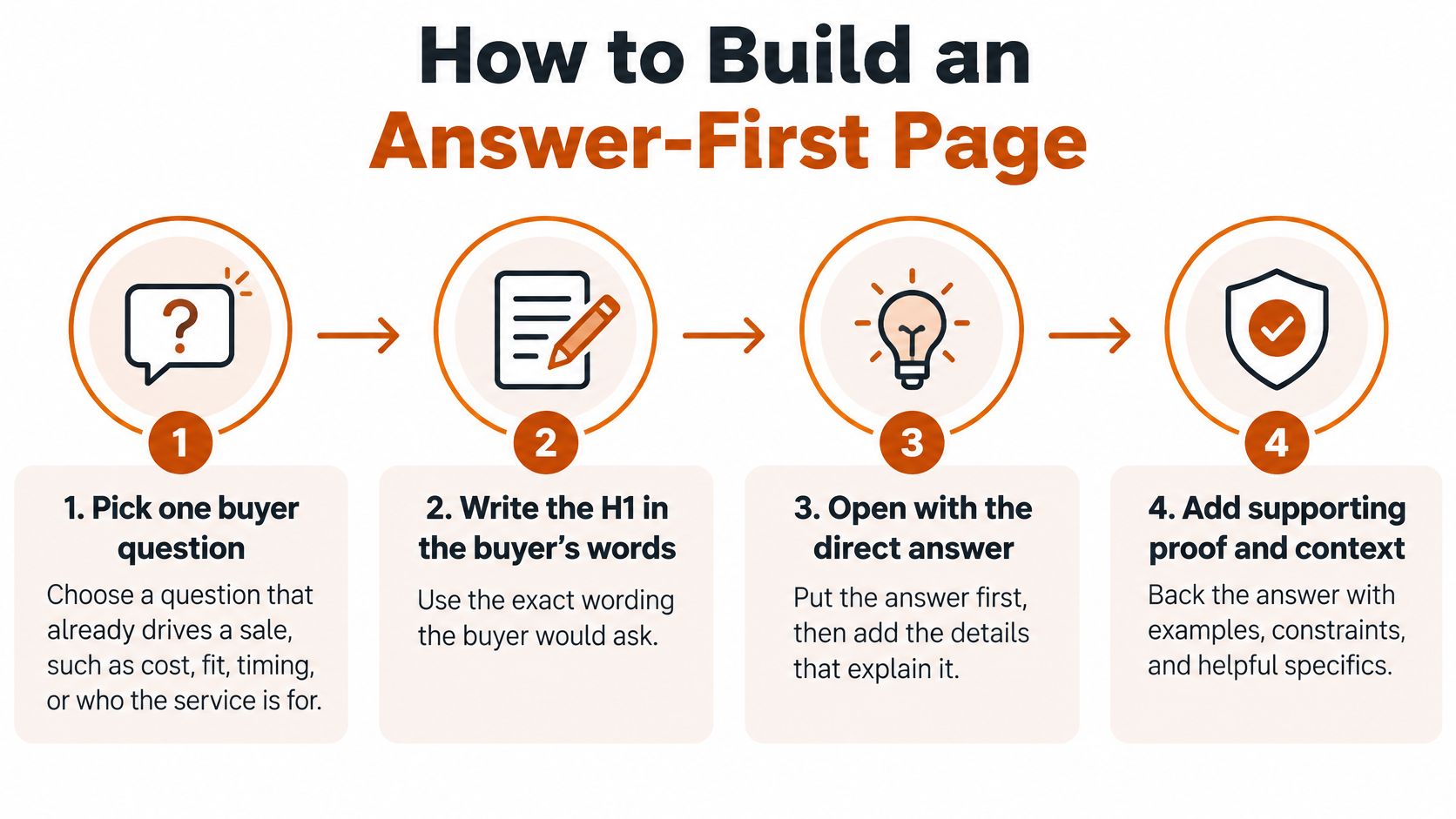
Build one page properly before you rebuild ten. The sequence below takes a working page from topic-led to answer-first without a redesign, and each step has a clear owner, either your writer or your developer.
Steps One to Three
1. Pick one buyer question that already drives a sale. Cost, fit, timing, and who the service is for are reliable starting points because your sales team hears them weekly. Write that question as the H1 in the buyer's words. If customers ask, "Can I get seen today," don't headline the page "Urgent Care Services."
2. Draft the four-part sentence and place it first. It goes directly under the H1, before any brand story, awards, or introduction. This placement matters because it's the text a reader sees first and the text an assistant can extract most cleanly.
3. Support it with three to five short paragraphs or bullets. Each one adds a single specific, a price band, an eligibility rule, a location, a timeframe, or a worked scenario. Resist the urge to re-argue the opening. Your job now is evidence, one fact at a time, in the order a buyer would ask for it.
Say a multi-location dental group rewrites its emergency appointment page. The H1 becomes the question patients type at midnight. The first sentence states same-day availability, the cities served, and the cutoff time for calling. The bullets below cover what counts as an emergency, what the first visit includes, and what to bring. A frightened patient gets a decision in seconds, and the assistant gets a complete, bounded answer.
Steps Four to Six
4. Add a short FAQ of three follow-ups. Choose questions the opening doesn't already answer, and reply to each in one sentence. This keeps the page tight while covering the adjacent queries an assistant might pair with yours.
5. Match the visible copy with structured data. Put the same facts in applicable schema, such as Organization, Service, Article, or FAQ. Google identifies JSON-LD as the recommended structured-data format and states that pages with structured data shouldn't be blocked by robots.txt, noindex, or other access controls, in its general structured data guidelines. Keep the markup and the visible text identical in meaning. Contradictions between the two are an easy way to be described inaccurately.
Before publishing, validate the page. Google recommends validating markup with the Rich Results Test, checking interpretation with URL Inspection, and requesting recrawling after successful validation, in its structured data guidance for articles. Run all three, in that order, and fix what the tools report before you promote the page. These checks sit alongside the wider technical standards covered in our guide to AEO best practices, and together they give engines a clean, crawlable page to work from.
6. Publish the date and market, then save your baseline. Show when the answer was reviewed and where it applies, submit the URL in your XML sitemap, and record the pre-change AI answer for your target questions. Without that saved baseline, you'll have no honest way to show what moved.
A stranger should be able to repeat your answer accurately after reading only the first sentence. If they can't, the page isn't finished.
Measure and Rewrite the Highest-Value Page
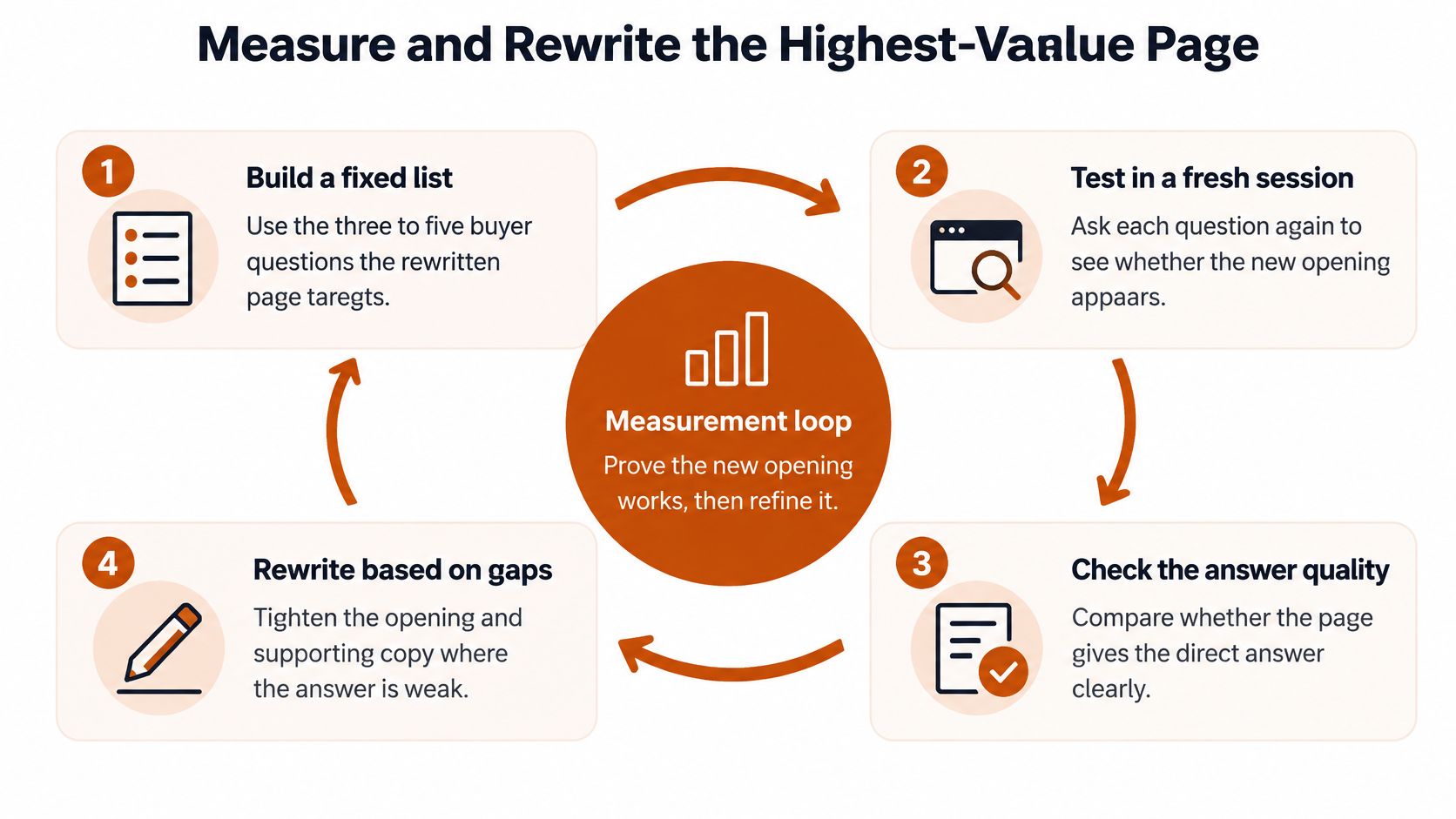
Measurement comes first, because a rewritten opening you can't prove is just new copy. Run the loop below on a fixed set of questions, and keep the wording identical every time so the comparison stays honest.
The Measurement Loop
1. Build a fixed list of the three to five buyer questions your rewritten page targets. Choose the questions buyers ask just before they buy, not the broad informational ones your blog already ranks for.
2. Ask each question in a fresh session on ChatGPT, Perplexity, Claude, and Google AI Overviews. Record whether your business is named, which URL is cited, and whether the description matches your page. A structured AI search visibility audit gives you that baseline in one pass, including who gets cited instead of you.
3. Track named, cited, and assisted demand together each month. Add branded search volume, direct visits, and lead quality to the same view. Don't wait for an organic session spike to declare progress, because the answer itself now does much of the persuading.
The Pew browsing data shows why. Pew Research Center analyzed browsing data from 900 U.S. adults during March 2025 and found that 58% conducted at least one Google search that generated an AI summary, according to Pew Research Center. When a summary appeared, users clicked a traditional result in 8% of visits, compared with 15% when no summary appeared. Clicks on links inside the summary occurred in just 1% of visits. Your summary presence is the visibility event. Report it that way to leadership, with assisted demand beside it, and the investment case writes itself.
Rewrite One Page, Then Rerun
Pick the single page tied to the question buyers ask right before purchasing. Rewrite only its opening, using the four-part sentence and the scope line that fits. Leave the rest of the page alone for this cycle, so you can attribute any movement to the change you made.
Expect a staged payoff. Results usually come in three stages. AI engines start describing the business accurately, then start naming it for targeted questions, then visibility widens to related questions as authority builds. Accuracy first is a genuine win, because a wrong description costs you enquiries long before a missing mention does.
If you'd like that baseline built for you, the first step is a 30-minute discovery call with Josh to see where your business stands in AI answers. You can also email hello@answerlion.com with your website and a few questions customers ask, and we'll tell you where you stand and what we'd change first.
Do one thing this month. Publish the new first sentence on your highest-value page, keep the saved pre-change answer beside it, and rerun the same questions after the next crawl. That single before-and-after pair tells you more about your AI visibility than a quarter of traffic reports.
Ready to see which sentence assistants are repeating about your business, and which page to rewrite first? Visit AnswerLion to book a discovery call, and bring your website plus the questions your customers ask before they buy. You'll leave with a clear picture of where you stand in AI answers and the first fix that will move you into the shortlist.