 AnswerLion
answer engine optimization
What Is Answer Engine Optimization? Definition and Tactics
Find out what is answer engine optimization and how ChatGPT, Google AI, Claude and Perplexity choose which businesses to name.
Published · Updated · By AnswerLion

A marketing director asks ChatGPT for the best commercial plumber in a city, or Perplexity for a project management tool for a 40-person agency, and reads the three or four names that come back. Then they type their own company. Some of the answer is right. Some of it is a service area from two years ago, or a competitor written in the exact words from their homepage.
The timing matters: a growing share of buyers now start their research with an AI assistant, so the answer a tool composes about your category decides a large share of who gets considered at all.
What each AI engine says about your business today, and which details it gets wrong or misses, is a measurable marketing problem. It is also a manageable one. The inputs that decide the answer sit largely under your control.
Answer engine optimization is that measurement plus the governance of those details. You record the answer, correct the facts the engines get wrong, and fill in what they leave out.
What Answer Engine Optimization Means
A marketing director pastes the same buyer question into four assistants on a Monday morning. ChatGPT names three vendors and skips yours. Perplexity quotes a pricing tier you retired last quarter. Claude cites a competitor's page for a claim that lives on your site. Google AI Overviews gets the category right and the hours wrong. That gap, between the business you run and the version each engine recites, is what answer engine optimization is for.
Answer engine optimization (AEO) is information governance with a measurement loop. You decide which facts an assistant should be able to repeat about you, place those facts where engines can read them, then record what each engine says and which details it misses. The surfaces are your website, your structured data, your directory listings, and every third-party page that describes you.
A traditional search engine works like a card catalogue. It points at shelves, and the reader walks over to choose the books. An answer engine works like a research librarian who has already read those shelves, writes a short summary in front of you, and names about four books worth opening. AEO is how your book reaches that librarian, written clearly enough to be quoted, then checked so a wrong edition does not stay on the desk.
ChatGPT and the other assistants now handle a large and growing share of buying research. Adobe's analysis of generative-AI referral traffic found that 25% of U.S. generative-AI users surveyed in 2025 used generative AI for shopping or price comparison.
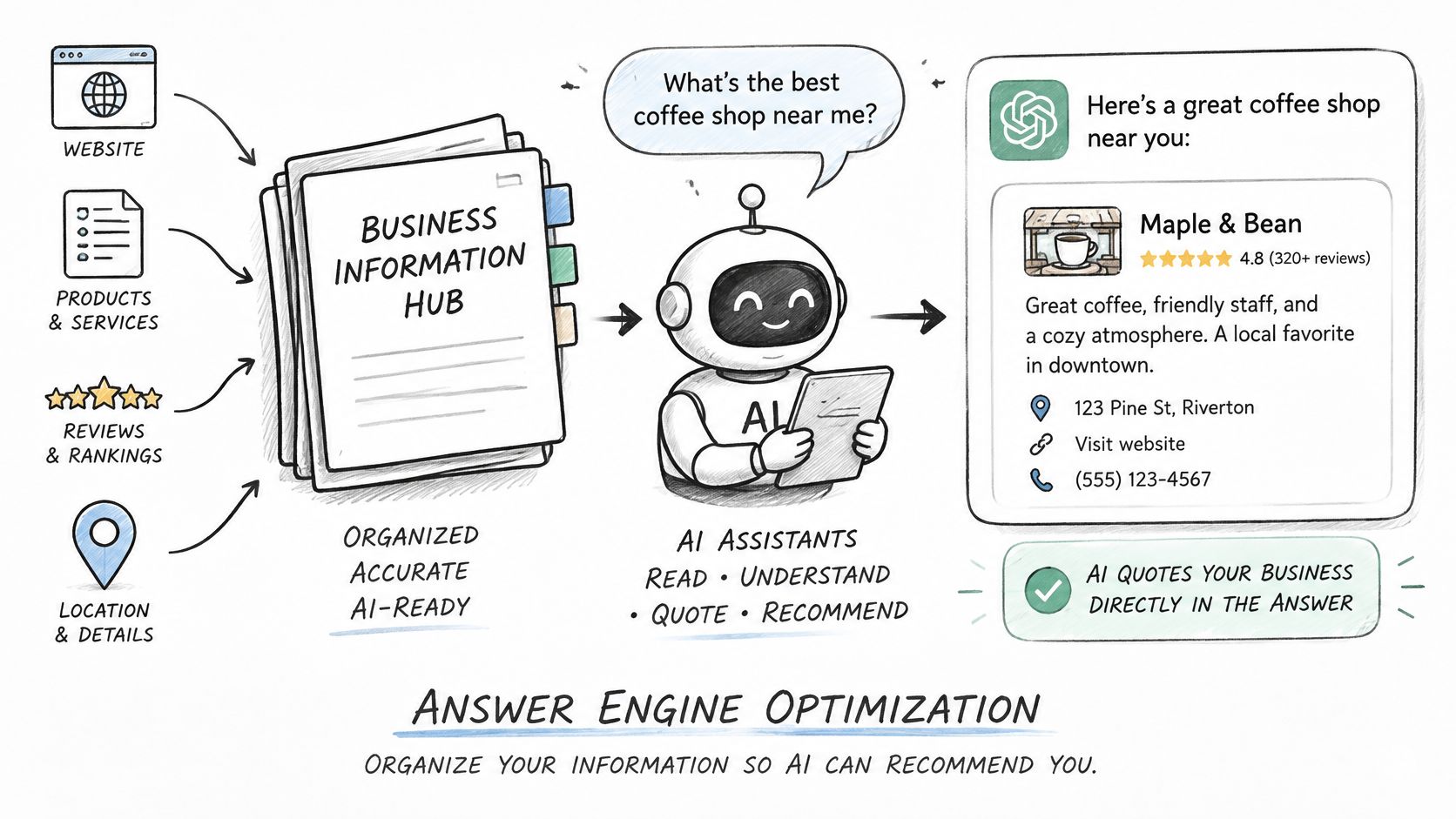
The payoff shows up in three escalating outcomes. Being named means your business appears in the answer at all, rather than sitting outside a shortlist of about four. Being described accurately means the engine repeats your services, service area, qualifications, and hours the way you would state them. Being cited as evidence means the engine links to your page as the source for a specific claim, a stronger trust signal than a passing mention.
A few terms stay fixed through the rest of this work. An answer engine is any system that composes a direct answer rather than returning a list: ChatGPT, Google AI Overviews, Claude, Perplexity, Copilot. A citation is the link or source reference attached to a claim inside that answer. A priority question is a question a real buyer asks before they buy, chosen by you and tracked on a schedule so you can see which details each engine gets right, which it gets wrong, and which it never mentions.
How AEO Differs From Traditional SEO
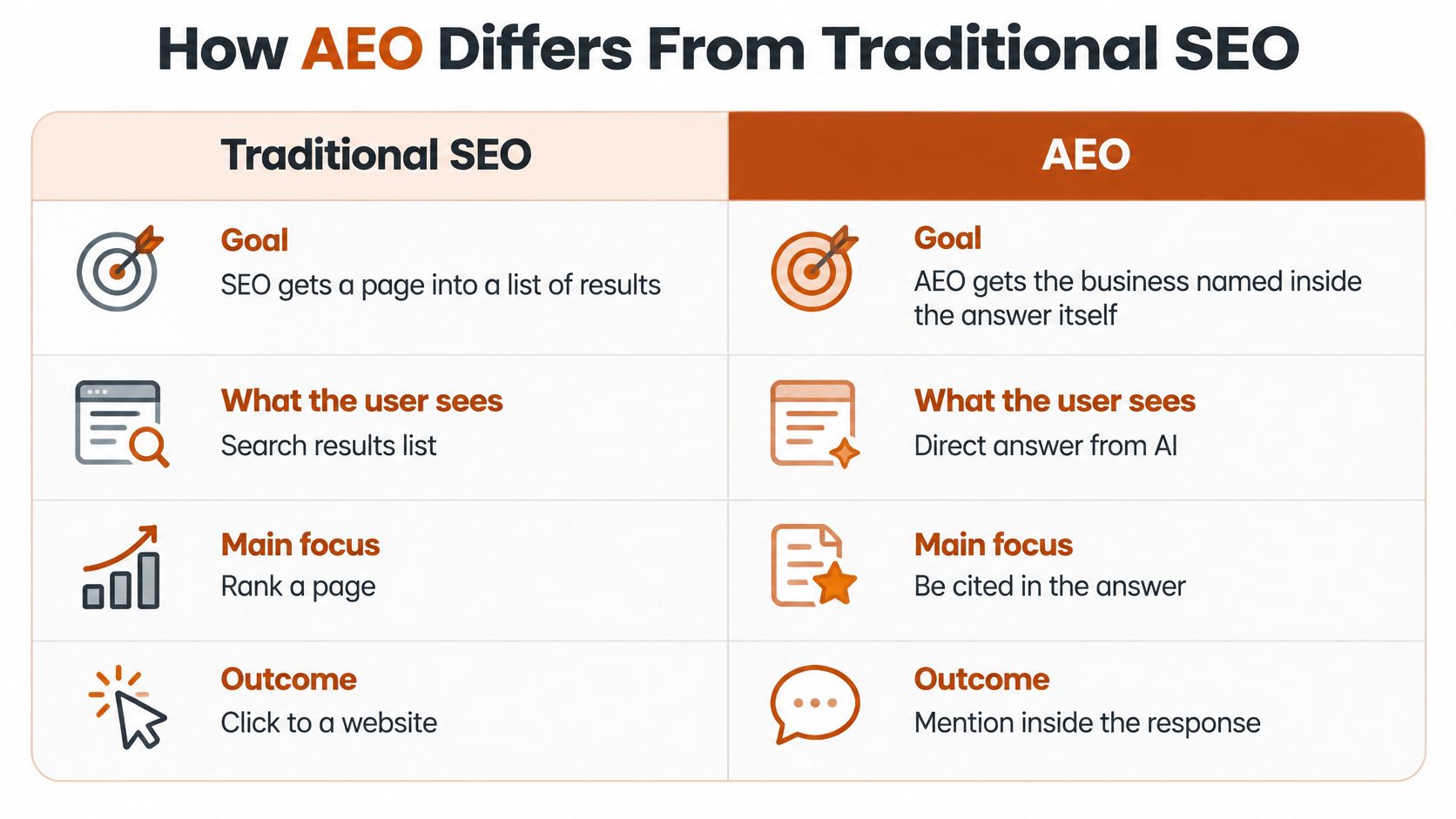
SEO gets a page into a list of results. AEO gets the business named inside the answer itself. Nearly everything else follows from that single distinction.
| Factor | Traditional SEO | AEO |
|---|---|---|
| Goal | Rank a page in a list of results | Get named and described in the generated answer |
| What the user sees | Ranked blue links and ads | One synthesized answer naming a few sources |
| Success metric | Position and organic sessions | Mentions, citations, recommendation share and accuracy |
| Competition | Every page targeting the same query | A handful of businesses named in each answer |
| Time to first signal | Often several months of ranking movement | Set by the engine re-crawl cycle, from days to months |
The two disciplines diverge on what the user encounters first. Here's how that looks side by side.
The click data explains why the answer above the results matters more than the ranking below them. Pew Research Center analyzed browsing activity from 900 U.S. adults and found 58% conducted at least one Google search in March 2025 that produced an AI-generated summary. When a summary appeared, those users clicked a traditional search-result link in only 8% of visits, against 15% when no summary appeared, and clicked a source link inside the summary in just 1% of visits (Pew Research Center).
Read that as a marketing director rather than a statistician. If you rank third for "emergency plumber [city]" and a generated summary above you answers the question with three named companies, that ranking buys you very little on that query. The decision happens before anyone reaches your listing.
For the visual version of the same argument, this walkthrough covers how the answer layer changes the click.
AEO doesn't replace the SEO work, and treating them as rivals is the most expensive mistake in this field. AnswerLion's view is that good SEO is the foundation for AEO: most engines still draw on web search results and well-structured, credible pages, so crawlability, page speed and a plain service description serve both disciplines at once. What AEO adds is a stricter standard for how each page states facts, and a second scoreboard.
That second scoreboard reads per question and per engine, not per keyword. "Is our business named when someone asks who handles emergency water heater repair on a Sunday?" is a testable unit with a yes-or-no answer and a named competitor list attached.
Practical rule: if you can't point to the one sentence on your site that answers a buyer's question directly, a ranking won't make an engine quote you.
Keep SEO running. Add AEO as the layer that decides whether you're named once the answer is written.
How AI Engines Choose Which Businesses to Cite
An assistant writes its answer from three inputs, and knowing which one is doing the work tells you where to spend effort:
- Training knowledge. Information learned during model training, which is why an assistant can describe a well-known brand instantly and a regional one barely at all.
- Live web search results. Fresh pages the assistant reads in real time when a question needs current facts.
- Given access. Sources the assistant is explicitly allowed to use, such as connected files, feeds or partner data.
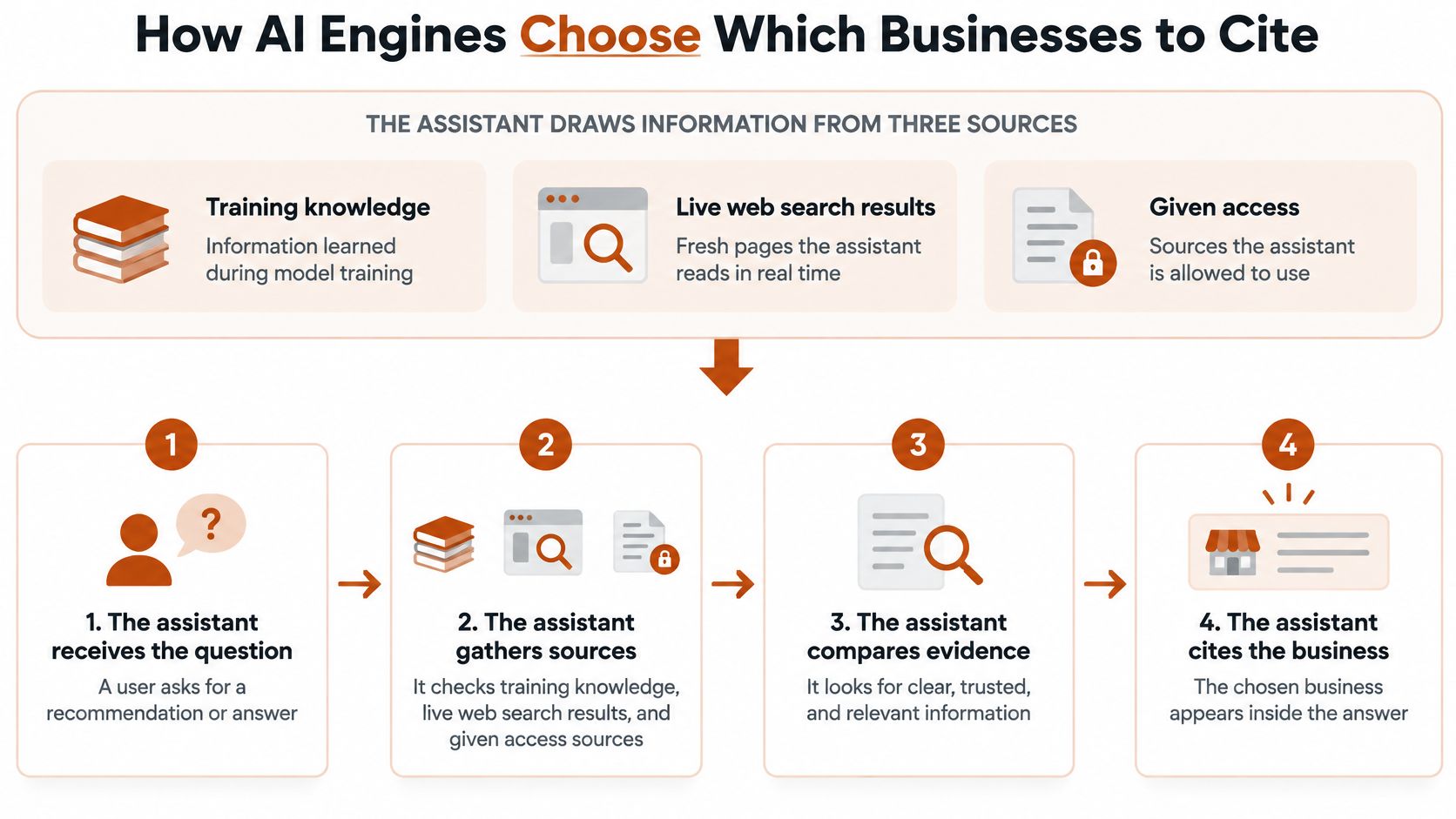
Most commercial questions run through the second input, which means the sequence looks like this:
- The assistant receives the question. A buyer asks for a recommendation in full sentences, with context attached: city, budget, industry, deadline.
- The assistant gathers sources. It checks training knowledge, live web results and any sources it has been given access to.
- The assistant compares evidence. It reads the most relevant passages and looks for facts that agree across sources.
- The assistant cites a handful. The final answer names a few businesses and links to the pages it drew on.
Step three is where most businesses lose. Eligibility comes before quality, and Google is explicit about the boundary. Its documentation states that pages shown as supporting links in AI Overviews or AI Mode must already be indexed and eligible for normal Search snippets, with no additional technical requirements and no special AI schema types (Google Search Central). A page the crawler can't reach can't be cited, whatever it says.
Once a page is eligible, clarity decides selection. Engines favour passages that put the entity, scope, location, qualifications and date in one place, because those passages are easy to verify and easy to quote. Details that conflict across your site and your listings push an engine to hedge, soften the claim or skip you entirely. That's why tracking AI brand mentions across third-party sources belongs in the same workflow as page edits: the engine's confidence comes from agreement between sources, not from one perfect page.
Check two things in this order. Indexing and crawl access first, because nothing downstream matters without them. Then the clarity of each answer on the page, because a page that buries the answer in paragraph four gives an engine nothing clean to lift.
The Core AEO Tactics and How to Apply Them
Start with the opening sentence, not the schema
A service page should answer one customer question directly in its first sentence, then support that answer with specifics. This answer-first approach takes editing time rather than development time, and it gives AI engines a clear statement to understand and quote.
A plumber's water heater page could open: “We repair and replace tank and tankless water heaters across [city] and the inner suburbs, with same-day appointments booked before 3pm and a licensed gas fitter on every job.” The rest of the page can explain the services, qualifications, and booking details behind that answer. A company history may matter elsewhere, but it does not answer a customer's immediate question.
Make the facts machine-readable
Structured data gives engines clear labels for facts that might otherwise be buried in prose. Add Organization, Service, FAQ, and Article markup, and make sure each property matches the visible page content. Validate the markup with Google's Rich Results Test and URL Inspection, then allow time for Google to recrawl the pages. Markup clarifies what a page says; it does not replace clear, accurate text.
Open the door for crawlers
Check that robots.txt allows AI search crawlers to access relevant pages, and keep an XML sitemap available at the site root. A sitemap can help with discovery, but submitting one does not guarantee that Google will crawl every listed URL (Google Search Central's sitemap guidance). Submitting it through Search Console gives you a record of which priority pages you offered for discovery.
Summarize the site and align the web
An llms.txt file can serve as an optional plain-text summary of key pages. Treat it as a supplementary site asset, not a confirmed way to make AI engines find or quote those pages. The more durable information-governance task is to align your directory, review-site, and publication mentions. If one listing gives an outdated service area, the web presents conflicting versions of the business.
| Tactic | What It Does | Example | How to Verify |
|---|---|---|---|
| Answer-first content | Gives a direct answer to one customer question | Opening sentence states service area, response time, and qualifications | Read the first sentence alone and check whether it answers the question |
| Schema markup | Labels facts in a machine-readable format | Organization, Service, FAQ, and Article markup matching visible text | Validate with the Rich Results Test and URL Inspection, then allow a recrawl |
| Citable facts and FAQs | Makes specific information easy to understand and quote | Service area, qualifications, and prices stated plainly | Re-run priority questions and check which details engines use |
| Crawler access and llms.txt | Supports access to pages and offers an optional site summary | robots.txt allows AI search crawlers; llms.txt lists key pages | Check robots.txt rules and open the llms.txt file directly |
| Consistent listings | Keeps business details aligned across the web | Same name, address, and services on each directory and profile | Compare listings against a canonical fact sheet |
Sequence matters. Check the accuracy of your business details and crawler access before expanding the site. More pages will not resolve conflicting descriptions across existing ones. When you rewrite a page, answer the problem your buyer actually typed rather than relying only on the category term your team uses internally.
Common Misconceptions About AEO
Four assumptions arrive whenever a team asks what is answer engine optimization for the first time.
"One set of changes fixes every engine." ChatGPT, Google, Claude and Perplexity draw on different sources and cite at different rates. Research on how people use these systems reflects the same split: a 2025 ACM study comparing Bing Chat with conventional Bing found generative search reduced users' search effort and improved the experience without reducing perceived credibility. Less effort means fewer sources consulted, so the engine's shortlist carries more weight. The fix is per-engine testing against one canonical fact sheet.
"Adding schema makes a business appear." Markup can't repair a blocked page or settle contradictory content. It has to match the visible text before it helps at all.
"Results show up overnight." Crawl cycles run from days to months, so progress arrives in stages: engines start describing the business accurately, then start naming it for targeted questions, then widen to related questions as authority builds.
"AEO and GEO are different disciplines." The labels differ. The work, structuring information so an answer engine selects and cites it, is identical. Teams that split them end up running the same project twice under two names.
AEO rewards businesses that have something specific to say: a real service area, a real response time, a real qualification. Vague marketing copy gives an engine nothing to select.
Measuring Results and Running Your First Audit
Build the baseline before you change anything
Compile 20 to 30 priority questions that real buyers ask, phrased the way they'd say them out loud. Run each one through ChatGPT, Google AI Overviews, Claude and Perplexity before you edit a single page. For every answer, record the same six fields so the comparison holds.
| Metric | What It Shows | How to Record It |
|---|---|---|
| Named in answer | Whether the business appears at all | Yes or no for each question on each engine |
| Description accuracy | Whether services, location and details are right | Score each answer against your fact sheet |
| Recommendation share | How often you are recommended against competitors | Count named businesses across repeated runs |
| Citation source | Which pages or listings the engine relied on | Log the cited URLs for each answer |
| Competitor inclusion | Who is named when you are not | List every competitor named in each answer |
| Stability over time | Whether results hold across re-runs | Repeat the same question set on a fixed monthly schedule |
Repeat the identical set monthly. A single good answer proves almost nothing, because retrieval systems miss relevant sources even when those sources exist. A 2024 study in JAMIA Open on large-language-model-assisted systematic-review searches found model-generated queries reached a median sensitivity of 85%, with an interquartile range of 40% to 100%, and in some reviews the model identified none of the relevant citations. Your buyers are running the same lottery on your category. Omission and inconsistency are failure modes to be measured, not copywriting complaints.
Separate three levels of influence
A mention, a citation and a recommendation are different assets, and they move at different speeds. A mention is awareness. A citation is credibility, since the engine treats your page as evidence for a claim. A recommendation is the commercial one, because it puts you on the buyer's shortlist before they've opened a single tab.
Track them separately. A business that's mentioned often but recommended rarely has an accuracy problem or a competitor with clearer facts.
Pair answer tracking with demand signals
Citations build consideration without a tracked session, so pair answer data with branded search volume, direct enquiries and assisted conversions. Watch whether branded queries rise in the weeks after an engine starts naming you in a high-intent answer. That's the honest read on zero-click influence.
What to watch: a rising branded-search line alongside a flat organic-traffic line usually means you're being named in answers without being clicked, which is exactly what AEO is designed to produce.
Read one bad answer as a task list
Say a plumbing company's priority question is "who should I call for a burst pipe on a Sunday in [city]". The answer names two competitors, puts the company's service radius three suburbs short and cites an old directory listing. That output is a work order: correct the directory record, publish an answer-first page for Sunday emergency callouts that states the radius and the after-hours line, then re-run the question after the next crawl.
Run the first audit this month
Write the 20 to 30 questions. Ask each engine. Compare every answer against your own site and your fact sheet. Fix your pages first, since that's the input you fully control, then correct third-party listings and re-run after the next crawl. Log the results in a shared sheet so month two compares like with like, and read the whole thing as an AI search visibility audit rather than a one-off experiment.
For a faster start, AnswerLion's standalone baseline audit runs your priority questions across the major AI engines and returns a short written report with the gaps and the first fixes, and it doesn't need access to your website. Email hello@answerlion.com with your website and a few customer questions to begin.
AnswerLion runs exactly the baseline this article describes: your priority customer questions put to ChatGPT, Google AI Overviews, Claude and Perplexity, with a written record of where you're named, how you're described and who gets recommended in your place. From there we rewrite the pages, add the structured data and correct the listings that decide the answer, then re-run the same questions monthly to show the movement. Visit AnswerLion to see where the engines currently place your business and what we'd change first.