 AnswerLion
AI rank tracking
AI Rank Tracking: What to Measure and How to Report It
Learn which AI rank tracking metrics matter, how to run repeatable checks, and how to read monthly reports that show real movement in AI answers.
Published · Updated · By AnswerLion
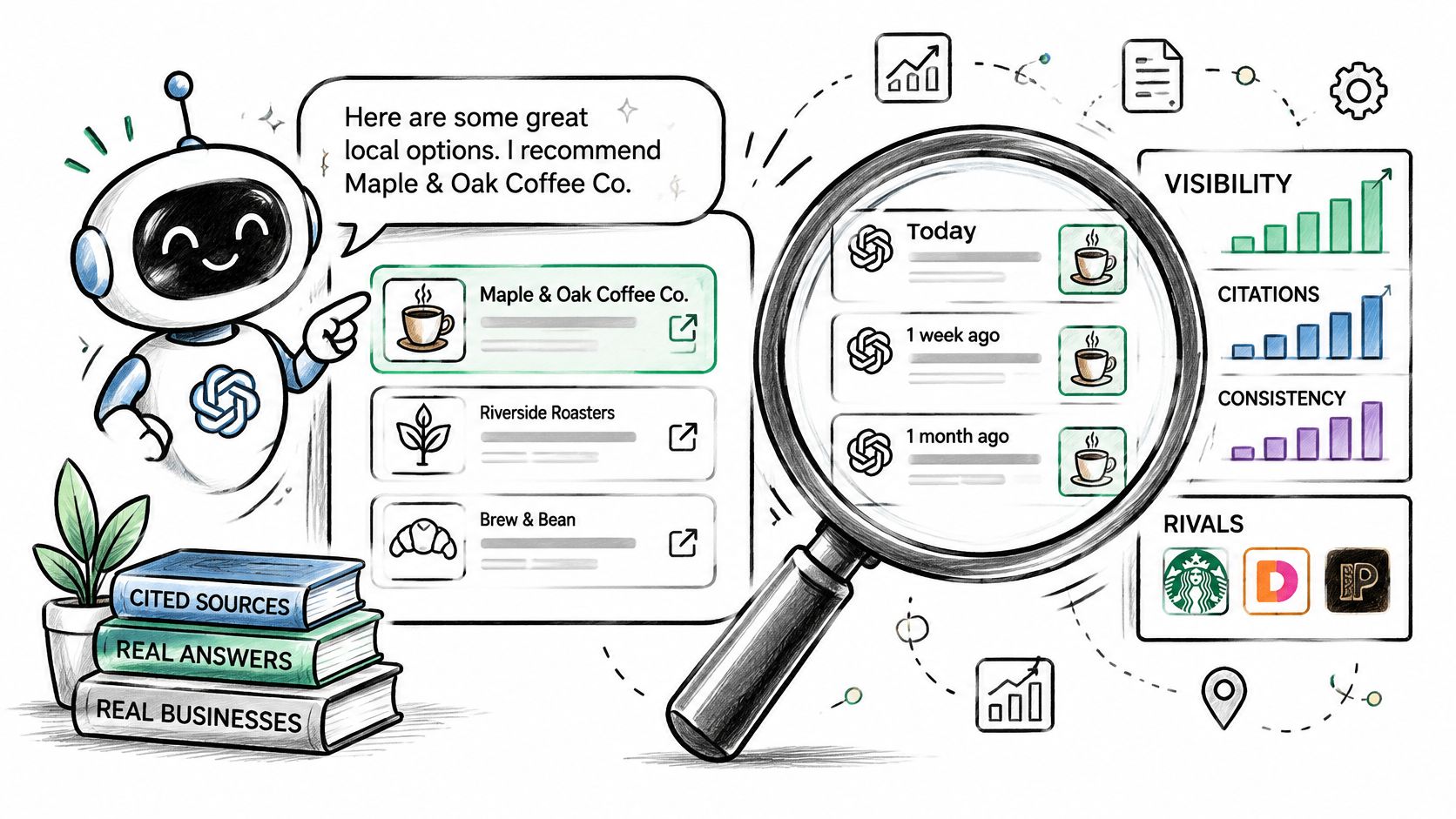
A 2025 study of 800 queries found that only about 30% of brands remained visible in consecutive AI responses. That finding reframes AI rank tracking: a single answer isn't a reliable position report. The useful question is whether your brand shows up consistently, with accurate claims and relevant citations, when buyers ask the questions that matter. The AirOps study on citations and mentions in AI search points to a more rigorous approach: measure repeat appearances, not just the highest placement you happened to capture.
The Core Metrics Behind AI Rank Tracking
A conventional rank report records where a page sits in a list. AI rank tracking measures repeat appearances across a fixed question set: whether an assistant names the business when a buyer asks for a recommendation, and whether that naming holds from one run to the next. The buyer sees the invitation list, often without inspecting the pages that produced it.
AI summaries now sit above ordinary search results. Pew Research Center's analysis of browsing by 900 U.S. adults found that 58% conducted at least one search-engine query that produced an AI-generated summary in March 2025. A business can rank in conventional results and still be absent from the summary above them. Tracking only conventional rankings misses that gap.
Six metrics to request
| Metric | Question it answers | How it's calculated |
|---|---|---|
| Mention rate | Is the brand named in the answer? | Runs naming the brand divided by total runs |
| Source inclusion | Is the brand's domain cited? | Runs citing the domain divided by total runs |
| Citation recall | Are answer claims backed by a cited source? | Claims supported by at least one cited source divided by all claims |
| Citation precision | Are cited passages relevant to the claims? | Necessary, relevant cited passages divided by all cited passages |
| Claim fidelity | Does the description match the source? | Brand claims that match their source divided by all brand claims checked |
| Competitor share | How often do rivals take the slots? | Rival mentions divided by total mentions across tracked brands |
Read the metrics in sequence. Mention rate shows whether the business is included at all; source inclusion shows whether its own pages support that presence. Citation recall and precision test whether the answer's claims have relevant backing, while claim fidelity checks that assistants describe the business accurately. Competitor share puts visibility in context by showing how often rivals occupy the same answer slots. Each figure should come from the same question set run repeatedly, not from a single saved answer.
For a fuller framework for weighting these signals, see this guide to AI visibility scoring. These six measures give you a practical baseline: a defined set of numbers you can request from a tracking provider or calculate in a spreadsheet from saved answers.
Why Organic Rankings Do Not Predict AI Recommendations
Many teams assume that climbing Google's rankings will automatically earn them AI recommendations. The evidence suggests that relationship depends on the engine. A 2026 industry analysis reported that 37% of Google AI Overview sources ranked in Google's organic top ten for the same question, while the comparable share for ChatGPT, Perplexity and Copilot ranged from 13% to 18%. The practical implication is that a strong conventional ranking can help in one answer engine without securing a citation or recommendation in another.
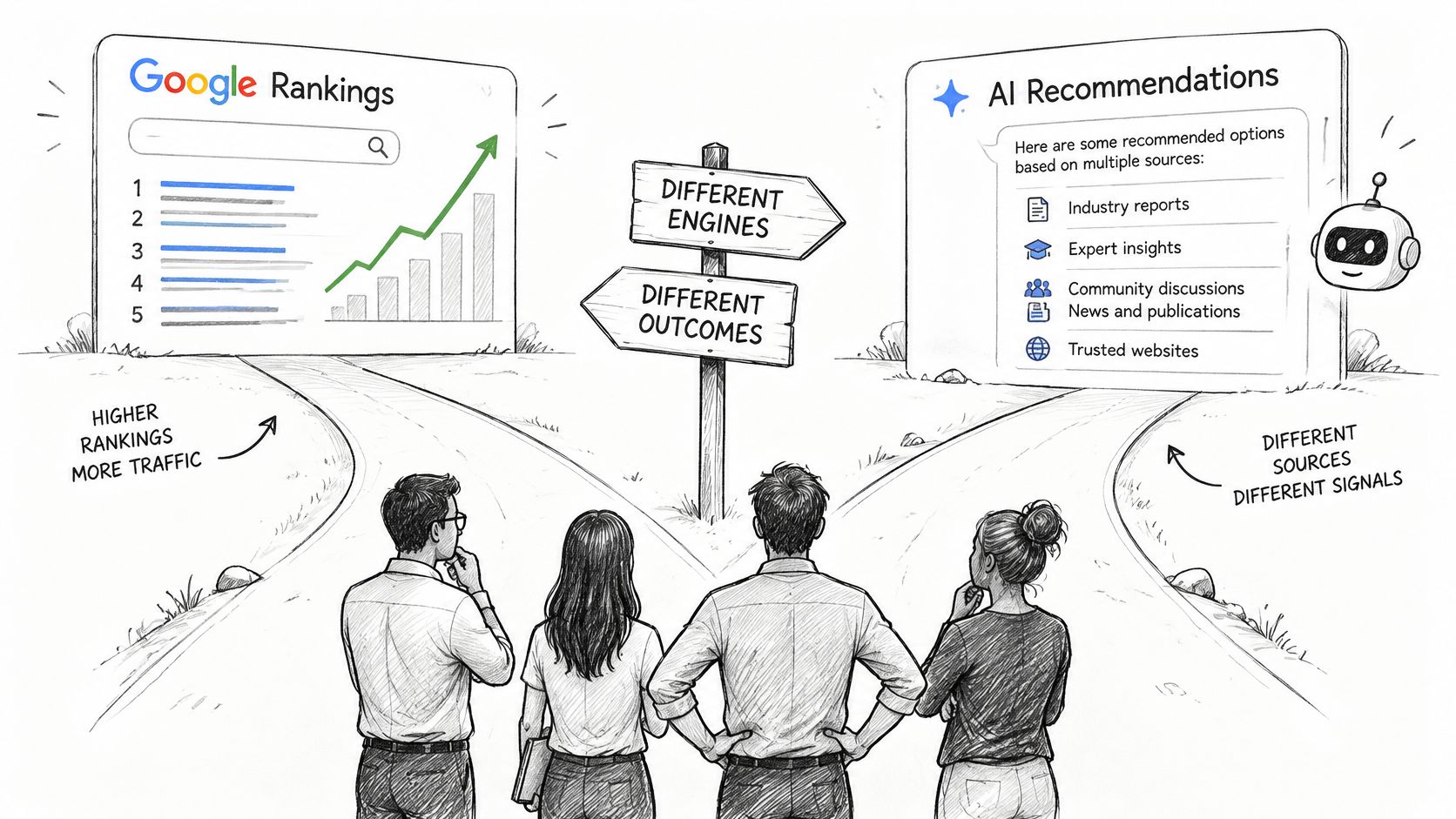
A useful diagnostic model keeps the signals separate. Compare AI citations with organic rankings, third-party mentions, review signals, structured data, entity consistency and how directly your pages answer the question. Don't compress them into one blended score: if visibility changes, you need to know which part of the system to investigate.
Say a company appears in Google AI Overviews but is missing from ChatGPT recommendations. If its organic performance is already strong, the first fix may sit outside its pages: perhaps third-party references are sparse, or the company's identity and product details aren't consistent across the web. If the company also lacks useful answer-first content, that's a separate issue to address. The point is to diagnose the gap from the engine-by-engine evidence, rather than assuming another ranking improvement will fix it.
Good SEO remains the foundation for AEO. AnswerLion's position is that most AI engines still draw on web search results and well-structured, credible pages. Run SEO work and AI tracking together, but keep their reports distinct so a conventional ranking gain doesn't stand in for an AI recommendation.
How to Run a Repeatable AI Visibility Check
A useful visibility check starts with a fixed question set and a record of how each answer was produced. Otherwise, you can't tell whether the result changed because your content improved, the prompt changed, or the engine returned a different answer. Use the same procedure each cycle.
Build the question set. Start with 20 to 30 priority buyer questions, mixing informational, comparison and local intent. Different intents can surface different businesses, so include the questions your prospects use to learn, compare options and find a provider.
Lock the configuration. Record the locale, language, engine and model version, prompt wording, device context and sampling protocol for every run. Changing these between checks makes a month-to-month comparison harder to interpret.
Repeat each question. Run every question at least three times per engine on the same day each month. Repeats help reveal whether an apparent gain or loss holds across answers rather than appearing in just one response.
Save the evidence. Store the raw answer text, every cited URL and the timestamp. Raw records let you check what the answer said and whether a cited page supports its claims.
Score each run. Mark whether your brand was mentioned, whether your domain was cited, whether claims were supported, and which competitors appeared. Keep those observations separate so the report shows what changed, not just whether a headline score moved.
Aggregate by question and engine. Report repeat-run rates for each question and engine instead of choosing one answer as representative. Preserve the configuration and raw text alongside the results so the comparison stays auditable.
Log changes beside results. Compare the report with your baseline, then note the site, listing or content changes made during that period. That record helps your team see which adjustments are plausible explanations for movement.
Practical rule: Preserve the prompt, settings and full answer with every score. A number without its run record can't explain what changed.
This is the operating loop AnswerLion uses: it re-runs the same customer questions across major AI engines on a regular schedule, recording whether the business is named, how it's described and who else is cited. Every engagement starts with a baseline of how the engines answer those questions today. For a practical audit workflow, see AnswerLion's guide to an AI search visibility audit.
The process is easier to follow when the cycle is visible:
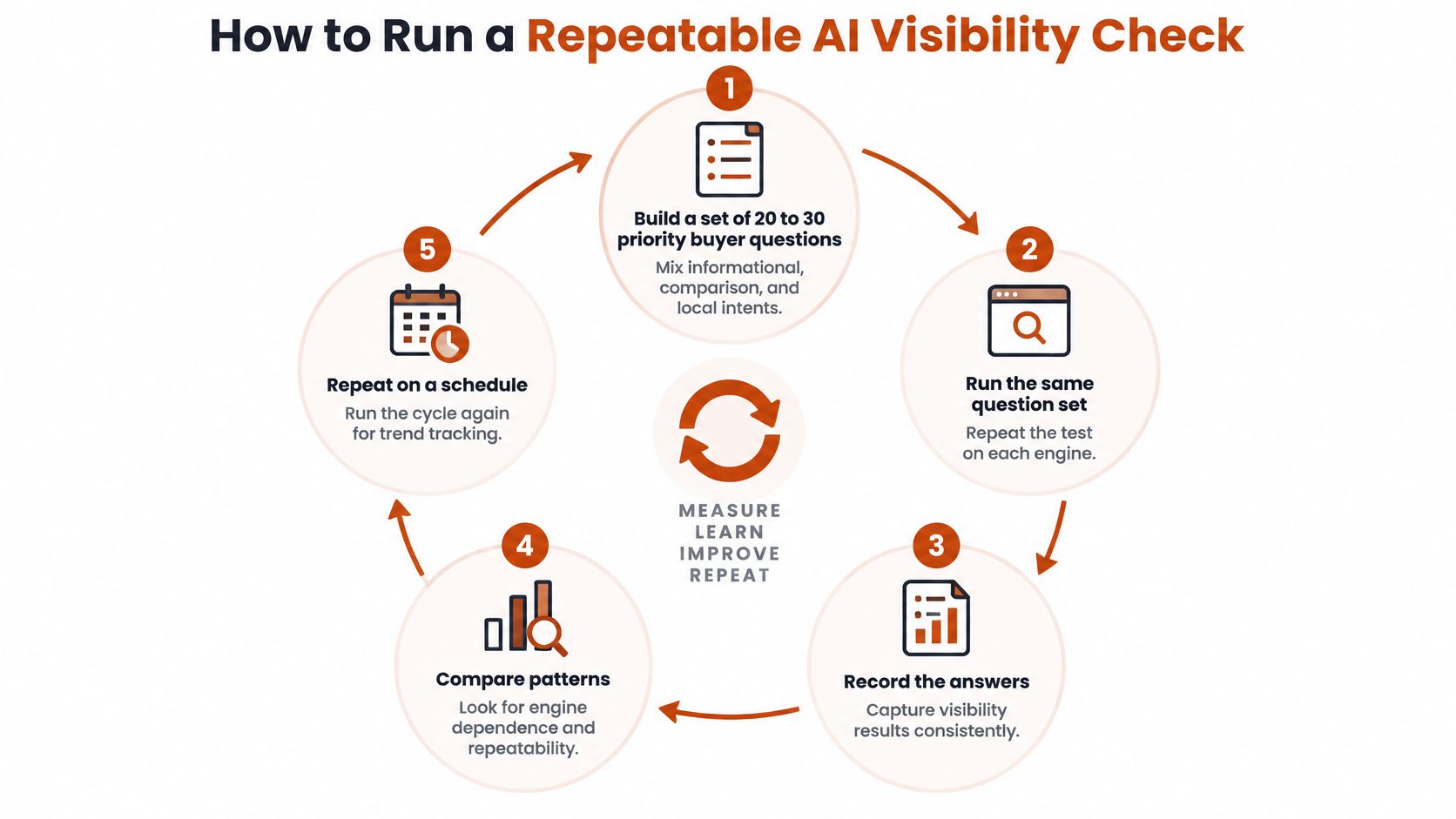
A repeatable check also gives the team a record that connects each later movement to the evidence and changes around it.
Reading Volatility Without Overreacting
A screenshot of an AI answer is one sample, not a trend. Generative answers can change across repeated runs, so a brand missing once hasn't necessarily lost durable visibility. In the AirOps study of 800 queries and more than 45,000 citations, about 30% of brands remained visible in consecutive responses. Of brands that were both mentioned and cited, approximately 57% later resurfaced. Disappearance from one answer, then, isn't enough evidence to justify a content change.
Track repeat-run visibility rates, confidence intervals, citation frequency, mention-plus-citation rates and volatility alerts. Set alerts for patterns that persist rather than for every fluctuation. A workable team rule is to treat movement as a meaningful change when it holds across at least three consecutive monthly runs on the same engine.
Match the pattern to the action
| Pattern in runs | Likely cause | Next action |
|---|---|---|
| Brand missing in one run, named in the next | Normal sampling variation | Keep the schedule and make no content change |
| Named in most runs on one engine only | Engine-specific source preferences | Compare that engine's citations with organic and third-party pages |
| Cited as a source but never named | Trusted page without a clear recommendation | Add a direct answer and summary statement to the cited page |
| Absent for three or more consecutive monthly runs | Missing listing, review or third-party signal | Audit directory and review mentions, then correct the description |
| Named, but a claim has no supporting cited page | Vague or missing first-party detail | Publish the specific fact on an owned page and link its source |
A dashboard that reports only the best observed placement overstates performance and encourages teams to react to noise. A lower but persistent presence can be more valuable than a top placement that appears once, because repeat visibility gives you stronger evidence that the brand is consistently part of the answer.
A Three-Month Report Example Teams Can Read
Consider an illustrative mid-market B2B software company tracking 24 buyer questions across three AI engines. The table shows a baseline and three monthly runs; its figures are examples, not reported business results. Questions named means the questions where the brand appears in most runs. Mention rate is the share of all runs naming the brand, while competitor share is rivals' share of mentions. Supported-claim rate, tracked separately, is the share of brand claims that match a cited source.
| Period | Questions named | Mention rate | Competitor share |
|---|---|---|---|
| Baseline (month 0) | 4 of 24 | 17% | 44% |
| Month 1 | 6 of 24 | 25% | 39% |
| Month 2 | 9 of 24 | 38% | 34% |
| Month 3 | 12 of 24 | 50% | 29% |
A CMO should start with the clearest outcome: the brand moved from appearing for 4 of 24 questions to 12 of 24. Next, the mention rate rose from 17% to 50%, suggesting the gain extends beyond a handful of selected answers. Then compare competitor share: it fell from 44% to 29% as the brand's presence increased, showing a shift in the mentions across the tracked set.
Finally, check the supported-claim rate. If it improves alongside visibility, the assistants are not just naming the company more often; they're describing it in ways that match the cited evidence. That accuracy check matters because expanded visibility is useful only when buyers receive a faithful account of the business.
A team can expect progression from accurate descriptions, to naming for targeted questions, and then wider coverage of related questions as authority builds. AnswerLion's monthly report shows where the client appears and what moved, with each stage measured against the baseline from day one. For teams that need a clear format for stakeholder updates, AnswerLion's guide to branded SEO reporting offers a complementary reporting perspective.
The monthly report should be a one-page account of what AI engines say now, what changed since the last run, and what the team should do next.
What to Look for in an AI Rank Tracking Setup
Evaluate a tracking setup by whether it can produce a comparable record and a decision you can act on. Use these seven checks as buyer tests:
- Engine coverage: Confirm the same question set runs on every engine your buyers use, and ask which engines and model versions the setup covers.
- Scheduled repeats: Verify that each question can run at least three times on a fixed monthly date, so you can compare repeat-run rates rather than isolated answers.
- Raw evidence: Check that you can export the full answer text, cited URLs and timestamps. Those records let you audit the figures in a report.
- Configuration record: Confirm that locale, model version, prompt wording and sampling settings are stored with each run.
- Citation separation: Make sure cited domains and passages are separated from generic summary text, so you can inspect what supports a claim.
- Competitor scoring: Confirm that rivals are measured against the same questions in the same run, rather than in a separate or mismatched sample.
- Readable output: Check that a non-technical stakeholder can understand the monthly summary quickly and see what action it supports.
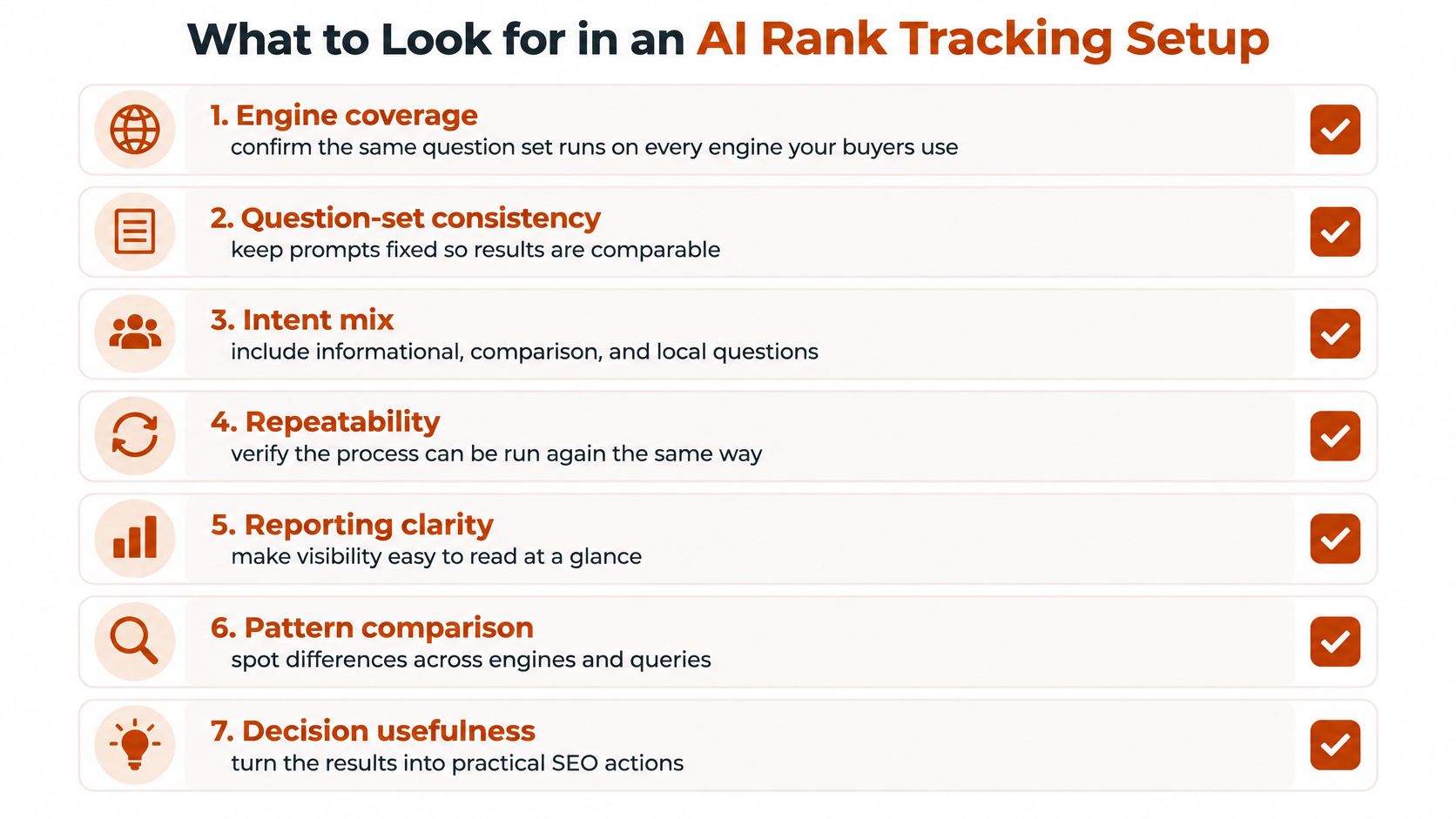
Before committing, test the setup on a 20-question sample for one month and check whether the same question returns comparable output across two runs. That trial reveals whether the system preserves useful context and evidence, not just whether its dashboard is attractive. A setup that passes these checks helps your team separate engine noise from movement worth investigating.
Confirm Your Baseline Before Changing Anything
A baseline is a repeated measurement of what major AI engines say about your business before you change a page. One saved answer is a sample, not a baseline. Run each priority question more than once, because a single response can reflect sampling noise, a stale index, or a prompt variation that will not recur. The baseline should show whether the business is named consistently, how it is described, and which sources engines cite when they recommend someone else.
Agree on the buyer questions first, usually in a discovery call, then run them across major AI engines. Fix inaccurate descriptions and missing answers before chasing third-party authority. You control the wording, schema, and listings on your own pages. Mentions and citations from other sites take longer to build, so they belong in a later wave.
Before editing content, check access and machine readability. OpenAI documents separate robots.txt policies for OAI-SearchBot and GPTBot: OAI-SearchBot affects whether a site can appear in OpenAI search results, while GPTBot controls use of content for training. Set each one deliberately. Validate JSON-LD with Google's Rich Results Test, confirm that important pages are not blocked by robots.txt, noindex tags, or access controls, inspect indexed pages with URL Inspection, and submit a sitemap. Search engines may take time to re-crawl updated pages, so do not treat a change as visible until engines return the updated answer.
AnswerLion runs the work in three steps: Audit, Fix, and Track. After the call, AnswerLion confirms the questions to test, runs them through the major AI engines, and sends a short written report with gaps and recommended first fixes. Each stage appears in the monthly report, measured against the day-one baseline. The Starter plan includes a full AEO audit in the first month, 1 to 2 pages rewritten or published each month, Organization and FAQ schema markup, crawler access, an llms.txt file, monitoring on Google AI Overviews, and a monthly report readable in five minutes.
Book the baseline before changing any page. A persistent presence across repeat runs is worth more than one top placement, because the next run can erase a single answer while a documented baseline shows what moved.
AnswerLion helps businesses measure and improve how AI assistants cite and recommend them, with a process that connects audits, practical fixes and monthly tracking. Start with a baseline of your buyer questions, then visit AnswerLion to discuss the next steps.